Explore jobs
Find specific jobs
Explore careers
Explore professions
Best companies
Explore companies
Job outlook for senior oracle database administrators in the United States
Senior oracle database administrator job growth summary. After extensive research, interviews, and analysis, Zippia's data science team found that:
The projected senior oracle database administrator job growth rate is 9% from 2018-2028.
About 10,500 new jobs for senior oracle database administrators are projected over the next decade.
Senior oracle database administrator salaries have increased 12% for senior oracle database administrators in the last 5 years.
There are over 171,492 senior oracle database administrators currently employed in the United States.
There are 60,527 active senior oracle database administrator job openings in the US.
The average senior oracle database administrator salary is $117,623.
Are senior oracle database administrator jobs in demand?
Senior oracle database administrator job and salary trends over time
Senior oracle database administrator jobs over time
Senior oracle database administrator job growth rate over time
| Year | # of jobs | % of population |
|---|---|---|
| 2021 | 171,492 | 0.05% |
| 2020 | 59,263 | 0.02% |
| 2019 | 56,119 | 0.02% |
| 2018 | 58,991 | 0.02% |
| 2017 | 60,920 | 0.02% |
Average senior oracle database administrator salary over time
Senior oracle database administrator salary by year
| Year | Avg. salary | Hourly rate | % Change |
|---|---|---|---|
| 2026 | $117,623 | $56.55 | +3.4% |
| 2025 | $113,747 | $54.69 | +2.3% |
| 2024 | $111,172 | $53.45 | +3.5% |
| 2023 | $107,407 | $51.64 | +2.4% |
| 2022 | $104,852 | $50.41 | +4.0% |
Senior oracle database administrator jobs by state
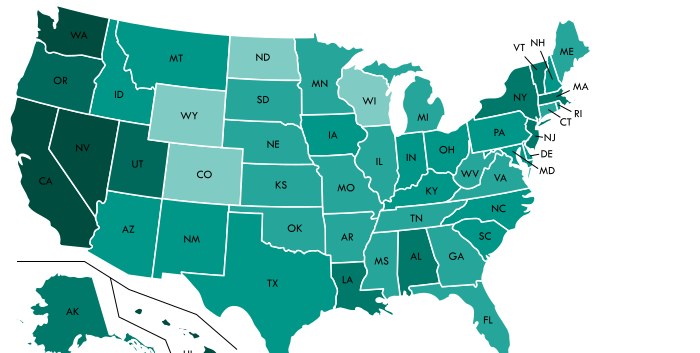
Most common states for senior oracle database administrators
| Rank | State | Population | # of jobs | Employment/ 1000ppl |
|---|---|---|---|---|
| 1 | District of Columbia | 693,972 | 231 | 33% |
| 2 | Massachusetts | 6,859,819 | 1,204 | 18% |
| 3 | Utah | 3,101,833 | 485 | 16% |
| 4 | New Hampshire | 1,342,795 | 210 | 16% |
| 5 | Rhode Island | 1,059,639 | 168 | 16% |
| 6 | Colorado | 5,607,154 | 833 | 15% |
| 7 | Vermont | 623,657 | 93 | 15% |
| 8 | Alaska | 739,795 | 104 | 14% |
| 9 | Oregon | 4,142,776 | 547 | 13% |
| 10 | Montana | 1,050,493 | 137 | 13% |
| 11 | North Dakota | 755,393 | 100 | 13% |
| 12 | Arizona | 7,016,270 | 812 | 12% |
| 13 | Minnesota | 5,576,606 | 671 | 12% |
| 14 | New Mexico | 2,088,070 | 242 | 12% |
| 15 | New Jersey | 9,005,644 | 952 | 11% |
| 16 | Washington | 7,405,743 | 816 | 11% |
| 17 | Nebraska | 1,920,076 | 218 | 11% |
| 18 | Idaho | 1,716,943 | 197 | 11% |
| 19 | North Carolina | 10,273,419 | 1,076 | 10% |
| 20 | Delaware | 961,939 | 99 | 10% |
Most common cities for senior oracle database administrators
| Rank | City | # of jobs | Employment/ 1000ppl | Avg. salary |
|---|---|---|---|---|
| 1 | Annapolis | 4 | 10% | $115,696 |
| 2 | Dover | 1 | 3% | $113,955 |
| 3 | Tampa | 2 | 1% | $108,093 |
| 4 | Bridgeport | 1 | 1% | $107,926 |
| 5 | Davenport | 1 | 1% | $116,111 |
| 6 | Washington | 3 | 0% | $122,974 |
| 7 | Boston | 2 | 0% | $126,086 |
| 8 | New York | 2 | 0% | $126,494 |
| 9 | Atlanta | 1 | 0% | $109,274 |
| 10 | Birmingham | 1 | 0% | $127,159 |
| 11 | Chicago | 1 | 0% | $109,101 |
| 12 | Colorado Springs | 1 | 0% | $100,682 |
| 13 | Denver | 1 | 0% | $100,718 |
| 14 | Detroit | 1 | 0% | $107,652 |
| 15 | Gilbert | 1 | 0% | $112,334 |
Senior Oracle Database Administrator job outlook: Expert opinions
Our panel of senior oracle database administrator experts

Tarleton State University

Springfield College

Virginia Commonwealth University
Dr. Jacqueline Abernathy
Assistant ProfessorTarleton State University
Public Administration
What are the biggest trends we'll see in the Senior Oracle Database Administrator job market given the pandemic?
Dr. Jacqueline Abernathy: I think one of the most significant changes to the job market is how the pandemic forced employers to do business virtually if they wanted to do business at all. For non-essential businesses, they had to find a way for employees to work at home if they wanted employees to keep working. This means that jobs that were originally considered location-bound were found to be done remotely, some with little to no modifications.
What this means is that some employers have reconsidered the costs of maintaining physical office space for workers that could telecommute and would rather work at home. Instead of paying rent and utilities for all employees to work in cubicles, they could export those costs to the employee using the spare bedroom they pay for, and home internet, phone, power, the water they pay for themselves. This cost-saving epiphany could affect employers and jobseekers alike in several ways. If a job can be done from anywhere, it means that those who are interested in a job can apply regardless of where they live.
This means a wider pool of talent for employers to choose from instead of just those willing to live within commuting distance. It also means more potential opportunities for jobseekers that might not be willing or able to relocate. But there is a downside, and that is that it increases competition for available jobs. The labor pool is no longer limited to those with skills and experience in a metro area, so those seeking a job are no longer just up against other locals anymore. This means those on the job market might have a more difficult job finding ways to set themselves apart. I think it means more opportunities, potentially, but greater challenges getting hired and a need to find ways to make themselves more marketable than they may have needed to be when labor pools were shallower.
What general advice would you give to a Senior Oracle Database Administrator?
Dr. Jacqueline Abernathy: My advice to graduates would be this: do not sell yourself short by taking a job at a lower level than you have to or a job that does not fully utilize your education. Otherwise, why did you spend the time and money, and effort to get your degree? I think many graduates assume that having a degree in a job where it is not required (but preferred) makes them more valuable as employees. I think the opposite is true. I think it devalues their worth to an organization and just makes them cheaper and more replaceable, especially when employers know that they can pay someone less to do the same job if they run into a budget crunch.
If having a degree is considered a plus for a job rather than a necessity, it actually makes their degree less valuable as a perk than if it were a requirement. If a degree is necessary to do a job, then the time, effort, and expense obtaining it was worthwhile because it was necessary to do that job, and also, the employer knows that they have to compensate employees for those costs. There is nothing wrong with working your way up, paying your dues, etc. but starting at a lower rung just makes a longer, harder climb to the top. They may have upward mobility more than somebody without a degree, but they will be compensated less than they are worthwhile waiting for something better to manifest. I would exhort graduates to start as high as they can and not settle for underemployment. Find a job where your knowledge, skills, and abilities are put to complete use, and the degree you earned to get those assets is not wasted or unfairly compensated.
What general advice would you give to a Senior Oracle Database Administrator?
Eileen Cyr Ed.D.: Use every resource at their disposal to increase their understanding of SEL and FACE. Build a resume that provides evidence of their ability to thrive in both a virtual and face to face classroom. Be prepared to engage with online platforms like Zoom, Nearpod, Jamboard, Padlet, and google slides.
Breathe - the airline advice of putting on your oxygen mask before assisting others is 100% applicable to today's teachers.
How would you rate the starting salaries for Senior Oracle Database Administrators, as well as the prospects for salary advancement?
Dr. Richard Huff Ph.D.: While MPA students are not drawn to public service by high salaries, it is reasonable to expect remuneration, which respects their credentials and experience. Many students are mid-level careerists and are likely to remain in their jobs where an advanced degree may improve their opportunities for advancement, and others may be looking for a career change. Also, a cohort of students moving from undergraduate to graduate degrees with internships is common.
These groups likely present varying degrees of salary requirements and qualifications. In the federal service, an MPA qualifies as one at the GS-9 entry-level. The Office of Personnel Management (OPM) publishes salary tables at Link The beginning salary varies by location from $53K to $61K, with the higher amount near large metropolitan areas. Higher salaries are common in overseas areas. Progression is based on performance with opportunities to achieve salaries of $150K and over at the executive levels. Overall, beginning salaries for the MPA considering nonprofits and government agencies is estimated at $53K.