Explore jobs
Find specific jobs
Explore careers
Explore professions
Best companies
Explore companies
Job outlook for senior product analysts in the United States
Senior product analyst job growth summary. After extensive research, interviews, and analysis, Zippia's data science team found that:
The projected senior product analyst job growth rate is 19% from 2018-2028.
About 150,300 new jobs for senior product analysts are projected over the next decade.
Senior product analyst salaries have increased 5% for senior product analysts in the last 5 years.
There are over 4,732 senior product analysts currently employed in the United States.
There are 163,508 active senior product analyst job openings in the US.
The average senior product analyst salary is $95,351.
Are senior product analyst jobs in demand?
Senior product analyst job and salary trends over time
Senior product analyst jobs over time
Senior product analyst job growth rate over time
| Year | # of jobs | % of population |
|---|---|---|
| 2021 | 4,732 | 0.00% |
| 2020 | 4,510 | 0.00% |
| 2019 | 4,385 | 0.00% |
| 2018 | 4,194 | 0.00% |
| 2017 | 3,999 | 0.00% |
Average senior product analyst salary over time
Senior product analyst salary by year
| Year | Avg. salary | Hourly rate | % Change |
|---|---|---|---|
| 2025 | $95,351 | $45.84 | +3.2% |
| 2024 | $92,424 | $44.43 | +1.1% |
| 2023 | $91,453 | $43.97 | --0.2% |
| 2022 | $91,612 | $44.04 | +1.1% |
| 2021 | $90,642 | $43.58 | +0.7% |
Senior product analyst jobs by state
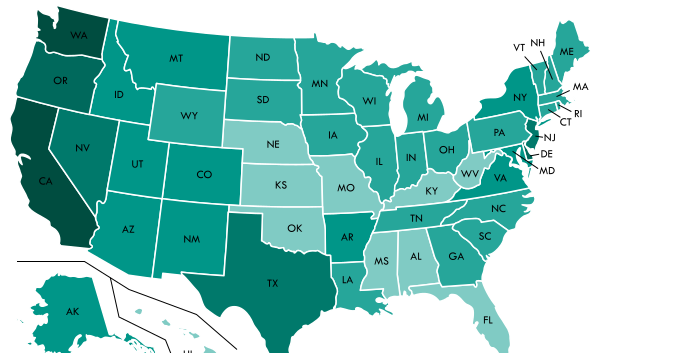
Most common states for senior product analysts
| Rank | State | Population | # of jobs | Employment/ 1000ppl |
|---|---|---|---|---|
| 1 | District of Columbia | 693,972 | 596 | 86% |
| 2 | Virginia | 8,470,020 | 2,613 | 31% |
| 3 | Massachusetts | 6,859,819 | 2,026 | 30% |
| 4 | Washington | 7,405,743 | 1,996 | 27% |
| 5 | Colorado | 5,607,154 | 1,509 | 27% |
| 6 | Maryland | 6,052,177 | 1,558 | 26% |
| 7 | Oregon | 4,142,776 | 1,063 | 26% |
| 8 | Rhode Island | 1,059,639 | 276 | 26% |
| 9 | Vermont | 623,657 | 162 | 26% |
| 10 | Utah | 3,101,833 | 769 | 25% |
| 11 | Delaware | 961,939 | 238 | 25% |
| 12 | Nebraska | 1,920,076 | 440 | 23% |
| 13 | Georgia | 10,429,379 | 2,252 | 22% |
| 14 | North Dakota | 755,393 | 165 | 22% |
| 15 | Pennsylvania | 12,805,537 | 2,661 | 21% |
| 16 | Alaska | 739,795 | 158 | 21% |
| 17 | Arizona | 7,016,270 | 1,394 | 20% |
| 18 | Wisconsin | 5,795,483 | 1,177 | 20% |
| 19 | Minnesota | 5,576,606 | 1,099 | 20% |
| 20 | New Hampshire | 1,342,795 | 265 | 20% |
Most common cities for senior product analysts
| Rank | City | # of jobs | Employment/ 1000ppl | Avg. salary |
|---|---|---|---|---|
| 1 | Wilmington | 3 | 4% | $119,577 |
| 2 | Annapolis | 1 | 3% | $87,557 |
| 3 | Springfield | 2 | 2% | $83,859 |
| 4 | Atlanta | 6 | 1% | $84,275 |
| 5 | Boston | 5 | 1% | $84,244 |
| 6 | Tampa | 3 | 1% | $75,450 |
| 7 | Tallahassee | 2 | 1% | $77,375 |
| 8 | Chicago | 6 | 0% | $86,375 |
| 9 | Phoenix | 3 | 0% | $87,688 |
| 10 | San Diego | 3 | 0% | $122,004 |
| 11 | Los Angeles | 2 | 0% | $126,249 |
| 12 | New York | 2 | 0% | $94,197 |
| 13 | Sacramento | 2 | 0% | $143,854 |
| 14 | Washington | 2 | 0% | $91,271 |
| 15 | Baton Rouge | 1 | 0% | $86,566 |
Senior Product Analyst job outlook: Expert opinions
Our panel of senior product analyst experts

UMass Lowell
University of Cincinnati Clermont College
University of North Dakota
Western Kentucky University
Kent State University
Widener University
University of Southern Maine
Sullivan University
University of Wisconsin - Green Bay
Western Kentucky University
Prairie View A & M University
SUNY College at Geneseo
John Jay College of Criminal Justice of the City University of New York
Michael Ciuchta Ph.D.
Associate Professor, Program Coordinator, Masters of Science in EntrepreneurshipUMass Lowell
Department of Marketing, Entrepreneurship & Innovation
What will help Senior Product Analysts increase their earning potential?
Michael Ciuchta Ph.D.: If all you want is the highest potential starting salary, then you should aim for careers that offer them. But that is a shortsighted way to view things. For example, many careers that have tournament-like pay structures (think entertainment) often have very low starting salaries but the so-called winners enjoy outsized financial gains. If you are thinking about a more traditional career, I think it's important to make sure you are more valuable to your employer than they are to you. This means you have to market yourself, both to your current employer as well as to potential ones. Of course, this approach may not be for everyone and maximizing your salary potential is only one thing you should be considering when assessing job and career opportunities.
What Senior Product Analyst skills would you recommend for someone trying to advance their career?
Dr. Swagata Banerjee PhD: Digital literacy: As technology continues to evolve, proficiency in digital tools and platforms will become increasingly essential. Adaptability: The ability to quickly learn new skills and adapt to changing circumstances will be crucial in a rapidly evolving industry landscape. Data literacy: Understanding and analyzing data will become more important for making informed decisions and optimizing strategies. Interdisciplinary skills: The ability to work across different disciplines and collaborate effectively with diverse teams will be highly valued. Emotional intelligence: Soft skills such as empathy, communication, and teamwork will continue to be in demand as workplaces become more interconnected and dynamic.
Renee Robinson Ph.D.
Professor of CommunicationWhat Senior Product Analyst skills would you recommend for someone trying to advance their career?
Renee Robinson Ph.D.: What skills do you think will become more important and prevalent in the field in the next 3-5 years?
What will help Senior Product Analysts increase their earning potential?
Renee Robinson Ph.D.: That would be awesome! We were hoping you could answer the following questions: 1. What general advice would you give to a graduate beginning their career in the field?
What will help Senior Product Analysts increase their earning potential?
Marilyn Krogh: Have a strong undergraduate portfolio, do an internship before graduation, and be willing to 'go an extra mile' for your employer.
What Senior Product Analyst skills would you recommend for someone trying to advance their career?
Dr. David Powell Ph.D.: Public administration is always a good field to enter as government touches the lives of everyone on a daily basis. Public administration careers are also very stable as most public administrators are civil servants. As such, they are hired, and keep their positions, based upon their qualifications and performance.
What will help Senior Product Analysts increase their earning potential?
David Hart: This field has become more valuable ever since the supply chain interruption due to Covid. The analyst is challenged every day with supply chain issues and deployment of the right resources to their prospective areas. Every day can be a new challenge so the work is rarely mundane.
What Senior Product Analyst skills would you recommend for someone trying to advance their career?
Adam Roth: I recommend that students start by identifying a specific skill in demand within your field, such as data analysis or social media marketing, and focus on developing expertise in that area. Research salary ranges and living costs in particular areas where you’re interested in working to ensure your compensation aligns with the local market. Always negotiate a salary and consider other aspects of the offer, such as funds for continuing education, technology and more. Continuing to network and establish demand for your services is essential; attend industry events, join professional associations, and engage with professionals in your field. Never miss an opportunity to reach out to and check in with your professional contacts. Pursue additional learning opportunities and education, such as certifications or advanced degrees, to provide a competitive advantage and increase your earning potential over time.
What general advice would you give to a Senior Product Analyst?
Bradley Andrew Ph.D.: So-called soft skills are still in demand by employers, based on recent surveys, because a smaller percentage of graduates possess them. These include:
Showing up and on time;
Having a strong work ethic;
Critical thinking skills
Social skills, including the ability to get along well with people, motivate and encourage them, and leadership skills. Also be able to schmooze with clients over dinner or drinks, or just in your office. A personal touch and connection is something software can’t provide.
Creativity—Apple products, for example, appeal to many people because of their combination of form and function.
The ability to work AI in order to increase one’s productivity will become more important over the next 5 years.
What will help Senior Product Analysts increase their earning potential?
Bradley Andrew Ph.D.: Once you have your first job, ask about or determine the 20% of your supervisor’s job that they hate and start doing that for them. They will love you for it and it will quickly get you recognition. You’ll also be well on your way to learning your boss’s job. Continue doing this as you progress in your career (Kudos to Theo Epstein, former GM for the Red Sox, for this recommendation)
No matter the task you’re given, do it to the absolute best of your abilities. In the professional world, you may often be given menial tasks or tasks that you don’t believe are part of your job description. Doing those tasks to the absolute best of your ability leads to increased trust, recognition and responsibility and will put you “above class.” If asked, the coffee you bring should be the best your boss has ever had. You never know who’s watching.
Don’t expect credit and don’t ask for credit when things go right; give the credit to others.
Fawen Zhang PhD
Professor of AudiologyUniversity of Cincinnati Clermont College
Communication Disorders Sciences And Services
What will help Senior Product Analysts increase their earning potential?
Fawen Zhang PhD: This is perfect! Thank you so much. We will be sure to feature your response in the article and send a draft over for your review before we promote it.
Yvette Koepke
Associate Dean for Academic SuccessUniversity of North Dakota
Ethnic, Cultural Minority, Gender, And Group Studies
What will help Senior Product Analysts increase their earning potential?
Yvette Koepke: Skills: Given the rapidly increasing rate of change in our world, human skills like emotional intelligence and innovation will become ever more important. Your background will help you make connections and work well with others, and think creatively and critically by considering various perspectives.
Xiaowen Chen Ph.D.
Assistant ProfessorWestern Kentucky University
Psychology
What Senior Product Analyst skills would you recommend for someone trying to advance their career?
Xiaowen Chen Ph.D.: Present your knowledge, skills, competencies, and experience by showing your research and applied projects so that employers will know what you have accomplished and the potential value you can bring to their organization.
What Senior Product Analyst skills would you recommend for someone trying to advance their career?
Dr. Vaneet Kaur: There are two sets of skills I will highly encourage graduates to proactively start building. Firstly, business graduates need to develop higher-order skills and capabilities like knowledge-based dynamic capabilities. These will help them to (a) constantly collect knowledge about emerging opportunities (and threats) in the industry, (b) mobilize themselves and their resources to bring identified opportunities into fruition, and (c) constantly renew their skills to effectively respond to the changes in the environment. Developing such knowledge-based dynamic capabilities will automatically prepare them for the different waves of skill set requirements that will keep arising in the job market. Secondly, it is no secret that we are living in the times of artificial intelligence and automation. So, in this day and age, it is extremely important that graduates learn to ride the wave of automation rather than being discouraged by it. Business graduates are set to contribute to the world with their business acumen and expertise, what they can do to complement it is to develop low-code, no-code skills. Such skills will help graduates to automate routine processes so that their time and energies can be strategically channelized towards those activities and processes that can add significant value to their organizations.
Tongyang Yang Ph.D.
Assistant Professor of Economics and Business AnalyticsWidener University
Business/Commerce
What general advice would you give to a Senior Product Analyst?
Tongyang Yang Ph.D.: There are many reasons that people like about being a business analyst, including reasons listed as follows: 1. Analytical Skills and Data Exploration: BAs often analyze data to understand trends and identify areas for improvement. Seeing a successful implementation and its positive impact can be very rewarding. 2. Problem-solving. BAs get to identify inefficiencies and propose solutions that can improve how a business operates. 3. Continuous learning. Business analysts may work on a range of projects and the field of business analysis may be constantly evolving, which required BAs to actively cultivate skills in new businesses. For example, the coming of the AI era requires BAs to master AI fundamentals and data fluency. 4. While some thrive on the problem-solving and communication aspects of a BA role, others may find them less appealing. Carefully consider your personality and preferences to see if this aligns with your career goals.
What Senior Product Analyst skills would you recommend for someone trying to advance their career?
Tongyang Yang Ph.D.: The rise of AI has brought many opportunities for the professions like business analysts in terms of AI integration. Businesses will need analysts who can bridge the gap between AI and human needs and focus on more strategic areas like identifying ethical considerations of AI implementation, developing plans to mitigate AI bias, and designing human-AI collaboration workflows. For people who are interested in entering this profession, I would suggest adapting your skillset to include AI understanding, data storytelling, and strategic thinking to be well-positioned in the future.
Tove Rasmussen
LecturerUniversity of Southern Maine
Specialized Sales, Merchandising And Marketing Operations
What Senior Product Analyst skills would you recommend for someone trying to advance their career?
Tove Rasmussen: Tove Rasmussen believes that the skills that will become more important and prevalent in the field in the next 3-5 years are...
What will help Senior Product Analysts increase their earning potential?
Thomas Smith PhD: Soft skills (people skills) and critical thinking are both skills that will serve you well throughout your career, and unfortunately, they are areas that receive little focus in most education today. Remember the 'Golden Rule' and learn from your mistakes.
What will help Senior Product Analysts increase their earning potential?
Praneet Tiwari: Continue to be a learner! Business degrees give students the foundation they need to begin their careers but to continue to do well in their careers, they need to keep learning. Find opportunities to learn more to keep evolving whether it’s the use of free resources when available or if your organization funds additional degrees then use those opportunities too. The business world is constantly evolving so it’s important to stay current. Another important thing to focus on is networking. Often after we get our first jobs, we get complacent when it comes to networking but building a network is crucial. Connect with other professionals through LinkedIn, your university’s alumni associations, and events specific to your industry.
What Senior Product Analyst skills would you recommend for someone trying to advance their career?
Timothy Rich PhD: Think about the types of jobs that interest you and the skills necessary for those jobs early. So many students start thinking about post-graduation life spring their senior year, when it should be an incremental process much earlier. Another pieces of advice would be to talk to faculty and alum about your interests, find internship or research opportunities when possible, and try to figure out early your strengths and weaknesses. It's easy for students, especially high performing ones, to not fully consider what their weaknesses are. I encourage students to jot down what they see as their skills too and to share them with others. It helps them to identify what's a common skill versus something that might make them stick out.
What will help Senior Product Analysts increase their earning potential?
Timothy Rich PhD: In social science fields, many of the highest paid jobs straight out are government related or data analysis related. Without developing research, writing, and in some cases foreign language skills, this will be a limitation. Depending on the desired job, a graduate degree may be required and students should be maximizing their exposure to graduate-style experiences as undergrads to not only get into prestigious law schools, master's programs, etc., but to take advantage of the internship and research opportunities that first year entrants are rarely equipped to handle.
What will help Senior Product Analysts increase their earning potential?
Terésa Dowell-Vest Ph.D., M.F.A.: First, I would celebrate them getting to that point. Everything after is going to be challenging and, in some cases…in most cases, difficult to navigate, so boosting their confidence and morale are key to ensuring they see themselves as worthy of success. Second, network! For young people beginning their careers, it is vital to meet other people with similar passions and pursuits. Find your tribe and climb together. Finally, craft a plan. A dream is not a plan. You need to create a BUSINESS PLAN for your life. Establish what your goals are, pare them down to one or two SMART goals, determine who will likely be supporters of your goal, create a brand for yourself (social media, business cards, a personal motto) and determine the resources you’ll need to achieve your goal.
Jasmine Tang
SUNY College at Geneseo
Bilingual, Multilingual, And Multicultural Education
What general advice would you give to a Senior Product Analyst?
Jasmine Tang: You need to set a goal first then go for it. Also, your first job is not your permanent job. Try to have a break from the school or work before your new job, new school term after the graduation. Be healthy & happy!
What Senior Product Analyst skills would you recommend for someone trying to advance their career?
Jasmine Tang: Be confident of their major/minor or the subject they like and do best of the field they like for themselves not for money or please their parents or fulfill the dream of others.
What will help Senior Product Analysts increase their earning potential?
Jasmine Tang: I always advise the students to apply any job that accept their degree or go for the one they really like.
Professor Shonna Trinch Ph.D.
ProfessorJohn Jay College of Criminal Justice of the City University of New York
Ethnic, Cultural Minority, Gender, And Group Studies
What general advice would you give to a Senior Product Analyst?
Professor Shonna Trinch Ph.D.: Being able to negotiate a salary is also a skill that students need to learn and one that is rarely taught in college. Students need to be able to ask for more than they are offered, but also take jobs at entry levels, prove themselves and then ask for an increase in pay six months into the job after they have shown that they are doing the work and achieving their goals.