Explore jobs
Find specific jobs
Explore careers
Explore professions
Best companies
Explore companies
Job outlook for senior program coordinators in the United States
Senior program coordinator job growth summary. After extensive research, interviews, and analysis, Zippia's data science team found that:
The projected senior program coordinator job growth rate is 7% from 2018-2028.
About 15,000 new jobs for senior program coordinators are projected over the next decade.
Senior program coordinator salaries have increased 7% for senior program coordinators in the last 5 years.
There are over 6,028 senior program coordinators currently employed in the United States.
There are 80,629 active senior program coordinator job openings in the US.
The average senior program coordinator salary is $74,468.
Are senior program coordinator jobs in demand?
Senior program coordinator job and salary trends over time
Senior program coordinator jobs over time
Senior program coordinator job growth rate over time
| Year | # of jobs | % of population |
|---|---|---|
| 2021 | 6,028 | 0.00% |
| 2020 | 5,604 | 0.00% |
| 2019 | 5,738 | 0.00% |
| 2018 | 5,312 | 0.00% |
| 2017 | 5,136 | 0.00% |
Average senior program coordinator salary over time
Senior program coordinator salary by year
| Year | Avg. salary | Hourly rate | % Change |
|---|---|---|---|
| 2025 | $74,468 | $35.80 | +1.0% |
| 2024 | $73,711 | $35.44 | +2.9% |
| 2023 | $71,665 | $34.45 | +1.1% |
| 2022 | $70,887 | $34.08 | +2.1% |
| 2021 | $69,453 | $33.39 | +0.3% |
Senior program coordinator jobs by state
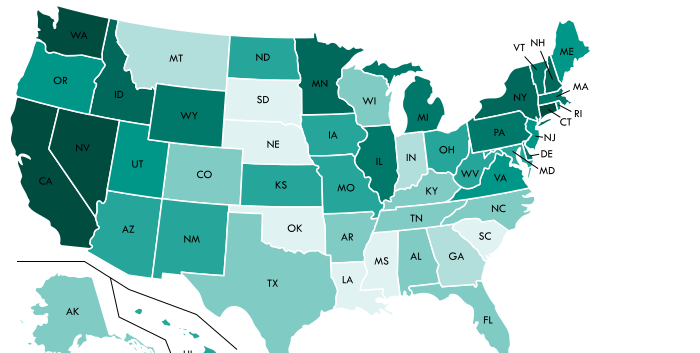
Most common states for senior program coordinators
| Rank | State | Population | # of jobs | Employment/ 1000ppl |
|---|---|---|---|---|
| 1 | District of Columbia | 693,972 | 295 | 43% |
| 2 | North Dakota | 755,393 | 286 | 38% |
| 3 | Delaware | 961,939 | 318 | 33% |
| 4 | Kansas | 2,913,123 | 714 | 25% |
| 5 | South Dakota | 869,666 | 219 | 25% |
| 6 | New Mexico | 2,088,070 | 499 | 24% |
| 7 | Arkansas | 3,004,279 | 675 | 22% |
| 8 | Idaho | 1,716,943 | 381 | 22% |
| 9 | New Hampshire | 1,342,795 | 266 | 20% |
| 10 | Alabama | 4,874,747 | 892 | 18% |
| 11 | Rhode Island | 1,059,639 | 186 | 18% |
| 12 | Montana | 1,050,493 | 175 | 17% |
| 13 | Oklahoma | 3,930,864 | 627 | 16% |
| 14 | Minnesota | 5,576,606 | 782 | 14% |
| 15 | Colorado | 5,607,154 | 774 | 14% |
| 16 | Oregon | 4,142,776 | 583 | 14% |
| 17 | Connecticut | 3,588,184 | 491 | 14% |
| 18 | Utah | 3,101,833 | 433 | 14% |
| 19 | Nebraska | 1,920,076 | 268 | 14% |
| 20 | Massachusetts | 6,859,819 | 898 | 13% |
Most common cities for senior program coordinators
| Rank | City | # of jobs | Employment/ 1000ppl | Avg. salary |
|---|---|---|---|---|
| 1 | Coral Gables | 4 | 8% | $55,828 |
| 2 | Annapolis | 2 | 5% | $64,261 |
| 3 | Menlo Park | 1 | 3% | $102,913 |
| 4 | Boston | 8 | 1% | $74,199 |
| 5 | Washington | 5 | 1% | $86,455 |
| 6 | Atlanta | 4 | 1% | $52,471 |
| 7 | Baltimore | 4 | 1% | $64,505 |
| 8 | Miami | 3 | 1% | $55,778 |
| 9 | Flagstaff | 1 | 1% | $62,653 |
| 10 | Frederick | 1 | 1% | $64,126 |
| 11 | Ontario | 1 | 1% | $88,953 |
| 12 | Rochester | 1 | 1% | $84,767 |
| 13 | Anaheim | 1 | 0% | $89,018 |
| 14 | Aurora | 1 | 0% | $56,181 |
| 15 | Denver | 1 | 0% | $56,303 |
| 16 | Glendale | 1 | 0% | $90,106 |
| 17 | Phoenix | 1 | 0% | $62,228 |
| 18 | San Diego | 1 | 0% | $86,242 |
Senior Program Coordinator job outlook: Expert opinions
Our panel of senior program coordinator experts
Plymouth State University
Winona State University
Connecticut College
Heidelberg University

Purdue University

Midland University
University of West Georgia

Boston University

SUNY College at Oswego
Freed-Hardeman University

Utah Valley University
Nicholls State University

Oklahoma Baptist University

California State University, San Bernardino

Auburn University at Montgomery
Western Carolina University
Auburn University at Montgomery
Maryville University
Davenport University

Azusa Pacific University
Christian Bisson Ed.D.
Professor of Adventure Education Adventure Education Program CoordinatorPlymouth State University
Outdoor Education
What general advice would you give to a Senior Program Coordinator?
Christian Bisson Ed.D.: The normal path for increasing one's salary in the field of outdoor adventure education or recreation, is to quickly accumulate a lot of good field experience, let say 100 weeks of field work within 3 to 4 years, then start seeking promotions within a good organization or send applications to other companies/schools/organizations offering management or administrative leadership positions.
What Senior Program Coordinator skills would you recommend for someone trying to advance their career?
Christian Bisson Ed.D.: It seems that in the near future, the use of modern technologies for safety and promotion of outdoor experiences. The industry is also aiming at offering experiences to a more diverse population, so being able to offer targeted programs and work with minority groups will be essential.
What hard/technical skills are most important for Senior Program Coordinators?
Steven Baule: The needed technical skills will vary based upon the organization looking to employ the educator. In more online-focused institutions, expertise with learning management systems and student information systems might be desirable. However, beyond strong instructional skills, educational leaders need to be able to analyze student data gathered from both classrooms and standardized tests in order to develop effective school improvement plans. This ability to measure student success is essential given the current culture of accountability in most areas of the county.
What certifications/licenses/courses can have the biggest impact for Senior Program Coordinators?
Julia Kushigian Ph.D.: A 4-year degree with a major in Hispanic Studies, a certificate from an International Studies Center (at Connecticut College the Center for International Studies in the Liberal Arts with an ACTFL ranking of Advanced, a local or global internship in the foreign language and/or foreign culture, nationally recognized ACTFL cerntification, translation licensing.
What are the biggest trends we'll see in the Senior Program Coordinator job market given the pandemic?
Julia Kushigian Ph.D.: The exciting trends for students graduating in Hispanic Studies and for those already in the job market are the potential benefits of a remote learning anticipated years ago through pedagogical tools designed by those in language, literature and culture. The interactive formulas, ability to engage participants and broaden the definition of language learning to include cultural studies of a variety of professional fields were already in the works and Covid was the impetus to move even faster. We know from a variety of studies, including a major report by the American Council of Teachers of Foreign Languages, for example, that 9 out of 10 U.S. employers rely on employees with language skills other than English. Spanish being in high demand is the most sought after language. Of course, beyond the more obvious benefits of being bilingual ("Why Bilinguals are Smarter" NYT 2012) are the less obvious of being adept at solving certain mental problems, thriving in ambiguity, flexibility with unknowns and the potential to stave off dementia later in life.
How have salaries changed over time for Senior Program Coordinators?
Julia Kushigian Ph.D.: As demand has increased, salaries have risen tremendously to try and keep pace. In fields like education, business, health care, government, social services, service related employment, law, etc., salaries have improved year over year to stay competitive.
Paige Atterholt
Adjunct ProfessorHeidelberg University
Will there be an enduring impact of the coronavirus pandemic on Senior Program Coordinators?
Paige Atterholt: I think now, being in year 2 of the pandemic, I think if anything there will be more jobs for graduates. Just looking through the jobs online, there are many opportunities for graduates to get a job. I think the older community retired when things got bad, which opened the door for the younger generation.
What are the biggest trends we'll see in the Senior Program Coordinator job market given the pandemic?
Alice Johnson: The pandemic prompted teacher exodus have left teacher job vacancies wide open. I do not believe graduates who become certified will have difficulty securing jobs. Graduates who are culturally competent and can provide effective learning experiences across lines of difference will be in even higher demand.
What soft skills should all Senior Program Coordinators possess?
Alice Johnson: Graduates really need to come to the classroom with 'nurturing' mindset. As many of us grew up in a 'compliance' era, it is easy to simply 'expect' students to simply 'do as I say'. Effective teaching and learning can only go so far under compliance oriented educational learning environments. It's more than just being loving and kind; it is having an understanding that all students come to the school with different experiences, backgrounds, funds of knowledge and paradigms, differing personality types that manifest in varying observable behaviors. Too often, people, teachers included, act and react in ways that are not helpful because we tend to project our own personality types onto others and make incorrect assumptions about others' meaning. I think teachers need leadership skills with emphasis on how to facilitate positive relationships among students to build community within their classrooms.
How have salaries changed over time for Senior Program Coordinators?
Alice Johnson: As the Indiana legislature continues to disregard public schools and divert educational resources to private and public charter schools, teacher pay has stayed stagnant over the past 10 years in Indiana with the expectation for the pay gap between other states and careers to widen even further over the next several years.
What are the biggest trends we'll see in the Senior Program Coordinator job market given the pandemic?
Dr. George Conrad: In education the pandemic has created two major trends, since last March.
The use of technology to provide effective lessons for students through virtual classes has been a challenge for teachers. One issue is in the technology itself. Teachers most often must rely on their own computers and notebooks along with their own home internet networks to deliver instruction. This issue is coupled with the availability of the internet and with computers and notebooks available to students.
Even if the technology is provided, teachers must find ways to engage students with meaning full lessons and ways to assess student learning. To gage learning and to monitor and adjust student engagement takes far more planning.
Finally, teacher training institutions need to help future teachers with understanding and applying new uses for technology based instruction. This can be difficult as different districts adopt different types of delivery systems.The good news for future teacher graduates is that, if they are willing and comfortable to master technology skills along with content knowledge, more and more teaching positions will be available.
Most all states have a teacher retirement system and retirement amounts increase with the number of years of service. In my experience, most practicing teachers teach beyond the minimum years needed to "retire." As a result of the pandemic, and the fear of contracting Covid, more and more teachers that I have contact with are looking seriously at retiring sooner than originally planned. This may change with the use of vaccines, but, again, this is good news for future teacher graduates. I predict that more and more teachers will be retiring and providing more an more positions available to new graduates.
What skills stand out on Senior Program Coordinator resumes?
Dr. George Conrad: In my past experience as an HR administrator and superintendent, skills tend to be measured by experiences. If a new graduate can demonstrate that they have had a number of experiences with children in AND outside the classroom, they will appear to be a stronger candidate. Endorsements are also important. For example, when working with candidates who are seeking an endorsement in elementary education, I encourage them to also consider supplemental endorsements in areas such as special education, early childhood, or English a second language. This makes them more marketable.
While difficult to reflect on a resume, finding ways to illustrate their dispositions is also important. Teaching is far more than skills. How does a candidate show that they have empathy or a desire to make a difference in their students' lives? Many school districts in Nebraska are familiar with the use of Gallup's CliftonStrengths (the new term for StrengthFinder). As a result, candidates who can provide their 5 top strengths on a resume, draws additional attention.
Are there any particularly good places in the United States for Senior Program Coordinators to find work opportunities?
Dr. George Conrad: As the population of teachers begin to age, more and more positions are becoming available. As we continue to see population growth in Southwestern States, teaching positions will continue to grow.
The real answer for future candidates is their willingness to teacher high large metropolitan cities and rural communities. Most large cities are surrounded with suburban school districts. With the movement to a suburban live style, more and more cities deal with student populations of color and with more than average poverty. If a candidate is willing to consider this challenge, they can find highly rewarding careers. This is especially true for candidates of color.
On the other side of the population movement, more and more rural areas are seeing a reduction in students and also seeing a reduction in the number of new teachers interested in moving to small communities to begin their career. As a result, candidates interested in work in "small town" American can find rewarding opportunities to build relationships with students and families (I started my career in a 3-room country school in the 70's and I originally came from outside Chicago).
Dr. Robyn Huss
Associate Professor and Coordinator of Initial Teacher Certification ProgramsUniversity of West Georgia
Department of Early Childhood Through Secondary Education
Will there be an enduring impact of the coronavirus pandemic on Senior Program Coordinators?
Dr. Robyn Huss: Yes, there will be an enduring impact of the coronavirus pandemic on graduates of teacher education programs. Though 2020 will be remembered as the year of the pandemic and global lockdowns, it will also be remembered as the year education moved online for all grade levels.
In teacher preparation programs at the University of West Georgia, candidates take a series of courses with field experiences. Many interns began learning to teach online as soon as the lockdowns occurred in March 2020, and since then through their accompanying coursework, there has been a more intentional approach to preparing candidates with digital resources to enhance their teaching. Candidates are placed in schools where digital learning occurs, and they have field experiences developing instruction, engaging students in activities, and assessing learning outcomes under the mentorship of a cooperating teacher, within school buildings as well as via online learning platforms. In the fall of 2020, most public school districts in Georgia began offering both in-person and online options for students, so it is a benefit that teacher candidates are able to practice teaching in both modalities, including some who experience hybrid classrooms.
The scope of digital learning will decrease as more K-12 students return to school buildings full time. However, the capabilities and variety of online instructional resources and student engagement models that the pandemic forced into an accelerated implementation will endure, and teaching and learning will be better for it. Teachers will adapt to the choices that have been made available with their recent experiences in digital instruction, which will enable them to be more responsive to the learning needs of their students, both with and without the use of technology.
What certifications/licenses/courses can have the biggest impact for Senior Program Coordinators?
Dr. Robyn Huss: The online learning expectation that the pandemic thrust upon our educational systems has changed the outlook for what new teachers will be expected to know and be able to do. In today's environment of digital learning, principals may be more likely to hire educators who have had experience teaching in the virtual realm. Therefore, recent graduates should be encouraged to include digital teaching experiences on their resumes. If they don't have firsthand teaching experience, perhaps they can highlight online courses in which they have excelled, so potential employers will know they have at least some familiarity with digital learning and online educational platforms.
Beyond earning a teaching certificate, I would encourage both beginning teachers and those preparing to enter the job market to continue their education by enrolling in a graduate-level course in online instruction. For example, the University of West Georgia offers a state-certified Online Teaching Endorsement, which can be added to a teaching certificate after completing the four required online courses; the endorsement courses can also be embedded within a graduate degree program. Alternatively, educators can earn a Master of Education in Instructional Technology; completion of this fully online, advanced degree program would prepare them for teaching online or working as an instructional technologist as well as qualify them to receive a pay increase.
What will help Senior Program Coordinators increase their earning potential?
Dr. Robyn Huss: Public school teachers in Georgia, as in many states, are paid on a set salary schedule determined by their years of teaching experience and their highest degree achievement. Earning a graduate degree at the next level is the quickest route to a pay raise, which in turn increases their retirement benefits.
What are the biggest trends we'll see in the Senior Program Coordinator job market given the pandemic?
V. Scott Solberg Ph.D.: The single biggest trend in the job market, whether related to education or otherwise, is that today's adults must understand in order to be competitive within a 4th industrialized world of work, they must be ready to describe their deep human skills (i.e., advanced social emotional learning skills) and technical skills as well as explain how these skills transfer in supporting the needs and expectations of the company and occupations to which they are applying. Today's adults must also be ready to describe how they are managing their continued professional development so they can keep up with the latest advancements in technology so that they can do their work in an efficient and high-quality manner. What this means is that employers are looking for the skills that cannot be replaced by robots or AI - they need individuals who understand the unique person qualities and technical skills and talent that will add value to team projects. Career management skills include being able to acquire the deep human person qualities and technical skills that align to specific occupation sectors.
Educators must be able to work with media and graphic design, work in teams to create learning programs that are designed around meaningful and research-based learning objectives, and connect with their students using strong social emotional learning skills (SEL) as well as facilitate students in developing their own SEL skills. And, educators need to recognize that there are hundreds of occupations within and outside of education that align to their key skills which include active listening, active learning, critical thinking, monitoring, public speaking, writing, complex problem solving, management of personnel, time management, coordination and collaboration with others, instructing, persuasion, service orientation and social perceptiveness. These skills are a few of the many listed in ONETonline.org's advanced skills list which lists over 450 occupations that one can grow into by acquiring key technical skills, certification, and/or advanced degrees.
What certifications/licenses/courses can have the biggest impact for Senior Program Coordinators?
V. Scott Solberg Ph.D.: The information and computer technology and health sciences sectors are two promising future employment arenas to consider. Within information and computer technology, data science skills are in high demand. For both information and computer technology and health sciences there are a range of certifications one can receive from a two-year postsecondary institution that lead to high wage occupations. The new byword is "stackable credentials" whereby one adds more than one credential that results in a wider range of occupational opportunities as well as the ability to move up in pay within a given sector.
How have salaries changed over time for Senior Program Coordinators?
V. Scott Solberg Ph.D.: In education, salaries vary by region of the country. It is important to use Onetonline.org to consider the salaries in your local region or find areas of the country you want to consider. There are also a wide range of salaries depending on what type of occupation you are seeking within education.
Angela Perrotto
Assistant Professor and Department Chair of the Educational LeadershipSUNY College at Oswego
School of Education
Will there be an enduring impact of the coronavirus pandemic on Senior Program Coordinators?
Angela Perrotto: In terms of acquiring jobs, I believe not - although school budgets are extremely tight in response to the demands the virus has placed on districts.
In terms of impact: the virus has forced all of us to come to terms as quickly as possible with HOW technology has transformed the way we learn. This does not mean that schools will be remote teaching from here on. In many cases, for legitimate reasons, schools were slow to take on technology "for the masses". There is strong evidence as to how technology has changed the business, entertainment, educational, and industrial worlds. What the pandemic has done is force schools to think very creatively and to move as quickly as possible to continue to provide learning opportunities for students when they were not able to attend the brick and mortar buildings. We are learning a lot and moving as quickly as possible.
What has this done for our graduates? The graduates of 2021 in our program have dealt with, investigated, solved issues for schools, and researched ways to maximize student success in these pandemic times. Their program has been online because of the pandemic. Their school jobs, for the most part, are partially or completely online. As CAS students, they are solving issues with transition plans for students, professional development plans for teachers, social emotional supports for both staff and students, curricular and pedagogical strategies and plans in order to meet the individualized needs of students, building multi-tiered systems of supports for students, partnering opportunities with community agencies for families......This has been the work of our CAS students who will graduate in 2021 and 2022. They will surely need and use these skills as they move into their future as school and district leaders.
Projections do not indicate there will be any shortage of leadership jobs. On the contrary, data for the next several years indicates there will be many retirements.
What will help Senior Program Coordinators increase their earning potential?
Angela Perrotto: For the most part, leaders should stay in their position long enough to be certain systems are in place. Every system, of course, is centered upon increasing opportunities for students to be successful and identifying and removing any obstacles that may be hindering that for every student. Once this is accomplished (generally 4-6 years), educational leaders build their own trajectory which is derived from a knowledge of knowing they can impact an even larger number of students. It is a common understanding that through the course of an educational leader's years of service, there is a long range plan to take on more job responsibilities that include more students, more community partnerships, more advocacy, more operations. It is common to see the employment history of an administrator progress from assistant principal, to principal, to director, to assistant superintendent, and to superintendent (or some form of these titles along the way).
Will there be an enduring impact of the coronavirus pandemic on Senior Program Coordinators?
Kristen Roberson: The workplace will forever be altered due to the pandemic, and the effects of those in career transitions, not just those graduating now, will be impacted for some time. It will take some time for the new normal to be normal.
Michael Hollister
Assistant Professor, M.C.A., CFI/IUtah Valley University
UVU School of Aviation Sciences
Will there be an enduring impact of the coronavirus pandemic on Senior Program Coordinators?
Michael Hollister: It is difficult to predict whether or not there will be an "enduring impact," since we are still enduring the challenges presented by this pandemic. While the aviation industry routinely experiences financial turbulence, an industry that usually is the first to feel the effects of a declining economy, and the last to feel the effects of a good one, it generally seems to find a way to recover and continue, though never without some sort of casualty in the form of an airline or other related business. Aviation, and particularly the airline segment (to include cargo airlines) are the life-blood of our modern world, and the mass-transit of the twenty-first century. There is no other form of transportation that can do what the airplane can do, and from this standpoint, it is an indispensable asset. Even in the midst of economic turmoil, industry giants like Boeing are forecasting an increase in demand across multiple aerospace disciplines through 2039. When it comes to our graduates, while nothing is ever a sure thing, the industry has historically proven itself to be resilient.
What's a good job out of college for Senior Program Coordinators?
Michael Hollister: Without trying to sound flippant, a good job out of college is the one the graduate was hoping to land after grabbing that expensive piece of paper (the diploma) and throwing their funny-looking hat in the air!
Even though a "pilot shortage" is currently suspended, historically speaking, the demand will return. So, while our current students realize that the market they hope to join one day isn't doing well at the moment, many also realize that they can utilize this time to prepare, earning the certificates, ratings and flight time necessary to qualify them for the job they will eventually seek.
However, it is important to also realize that the aviation industry is vast and has needs and opportunities that go far beyond the demand for pilots only. Some of the current demands include much-needed maintenance personnel, engineers of all disciplines, management personnel and so on. There is great potential found in the burgeoning Unmanned Aerial Vehicle (UAV) and Urban Air Mobility (UAM) markets, with the latter expected to be worth nearly 16 billion by 2030, with other projections placing this segment of the ma
What will help Senior Program Coordinators increase their earning potential?
Michael Hollister: The best advice I received from a former airline pilot and professor of mine was to "Keep improving yourself . . . even after you have earned your Bachelor's degree, go on and get a Masters degree. Keep improving yourself."
Realistically, furthering one's education is perhaps the best way to increase value and marketability, which is, after all, what someone's earning potential is really based on. One's marketability (not being a one-trick pony, also see "versatility") and how valuable one is perceived to be by their employer, will directly influence earning potential and longevity.
I've also learned that furthering one's education need not exclusively mean college degrees and certificates, though they are, of course, important. Value, marketability and versatility can certainly come from a variety of experiences and activities that extend beyond the walls of a college or university. Knowing how to utilize such experiences and other acquired skills, and then applying them toward a field of study that is of interest to an individual will be of great value too, but will require some thoughtful planning.
Lastly, I think an individual's personality has a great impact on one's perceived value and worth to an employer/company. An individual who is positive, a team player, one who offers solutions to problems, rather than just complaining, will go a long way. This, I have found, to be a universal truth regardless of the profession or occupation.
Dr. Cynthia Vavasseur
Associate Professor of Education, Professor of ED, Program Chair Ed-tech LeadershipNicholls State University
Teacher Education Department
What are the biggest trends we'll see in the Senior Program Coordinator job market given the pandemic?
Dr. Cynthia Vavasseur: By far, the biggest trend in the job market of educational leadership will be how technology can drive instruction, innovation and student success. Before the pandemic, educational technology was a hot topic. In the last year, the need for educational technology professionals at both the K12 and Higher Education level have been highlighted.
What certifications/licenses/courses can have the biggest impact for Senior Program Coordinators?
Dr. Cynthia Vavasseur: NSU is in contract with the International Society for Technology in Education (ISTE) to become the 3rd University in the world to be an ISTE certification provider. This certification is highly competitive and allows educators to show their skills of leading in a technology driven education market.
How have salaries changed over time for Senior Program Coordinators?
Dr. Cynthia Vavasseur: Education and educational leadership is not a profession to go into for the money. That being said, as the need for educational technology professionals grows, I would imagine so would the salary range.
Dr. Daryl Green
Associate Professor of BusinessOklahoma Baptist University
College of Business
What are the biggest trends we'll see in the Senior Program Coordinator job market given the pandemic?
Dr. Daryl Green: I have been researching emerging employment trends for several years. While working for the Department of Energy as a senior engineer, I have served as a college recruiter. There were gaps in the students' skill sets compared to employers' needs. I later co-authored a book called Job Strategies for the 21st Century to provide students with the necessary tools for future employment. 2021 will be very difficult due to the pandemic. From my research, here are 2021 employment trends to consider:
-Global Market - We are connected! Since employers can tap into human resources across the world, students will compete against others across the globe.
-Students who understand this employment reality will be better prepared.
-AI and Automation - Artificial intelligence is disruptive technology. Companies can avoid the high expense of labor through automation. According to 2013 Oxford University study, nearly half of American jobs are at risk of being taken over by computers by 2033. Students need to understand AI technologies.
-New Work Model - 2020 brought in the explosion of working from home due to Covid-19. Employees already wanted to have more flexibility in life. They got it from employers. Companies responded by offering 70% of full-time workers the ability to work from home!
-Freelancing - Freelancing is part of the gig economy. It goes much further than Airbnb and Uber. In the gig economy, businesses hire independent contractors to perform individual jobs, called "gigs." The total freelancing income is almost $1 trillion. Therefore, students who have an entrepreneurial mindset will fare better.
-Digital & Ecommerce - Covid-19 ushered the digital economy. If companies did not have a digital platform in 2020 with the lockdowns, they did not exist. According to the Internet World Stats, there are currently 4,208,571, 287 internet users. Therefore, students cannot afford to miss this continuing trend of digital platforms.
What are the biggest trends we'll see in the Senior Program Coordinator job market given the pandemic?
Stephen Bronack Ph.D.: I anticipate the biggest trend will be teachers who are hybrid-ready. That is, they have the skills and tools to teach well both online and in the classroom, as the situation dictates.
What technical skills for a Senior Program Coordinator stand out to employers?
Stephen Bronack Ph.D.: Using technology to engage both students and their families is number one. A close second, I would say, is using technology to help personalize learning as best we can for each student.
How have salaries changed over time for Senior Program Coordinators?
Stephen Bronack Ph.D.: I believe there is growing recognition of the important role teachers play in our communities, and a renewed interest in ensuring teachers are not left behind when it comes to making a good living.
Brett Lehman Ph.D.
ProfessorAuburn University at Montgomery
Department of Sociology, Anthropology, and Social Work
What certifications/licenses/courses can have the biggest impact for Senior Program Coordinators?
Brett Lehman Ph.D.: Sociology students with research and public speaking experience will have improved job prospects. This could be developed in many courses, though some core areas for us are Research Methods and Statistics. Most employers collect and analyze data of some kind. Then they have to organize the results properly and present the findings to a variety of audiences. Any course that require students to do their own projects, make difficult decisions, justify those decisions, and then explain the results give students a leg up in critical thinking skills and much more. Students might also have similar experiences through community service, independent/supervised research projects, or an internship.
Will there be an enduring impact of the coronavirus pandemic on Senior Program Coordinators?
Angela Sebby Ph.D.: While jobs may be slower to return to the capacity pre-Covid, the industry and tourism employment will rebound as people still want to travel and explore diverse foods, cultures, and experiences. However, the enduring impact will be the rapid onset of technology that allowed for limited contact with employees and others has become the new norm. Although human interaction is an important aspect of service in the tourism industry, employers have found that they can reduce the number of personal interactions but still deliver an acceptable level of quality service. What would have taken years to adopt, COVID created an amplified adoption.
What soft skills should all Senior Program Coordinators possess?
TeWhan Hahn Ph.D.: Writing skills including email writing, being able to work in teams, and knowing the workplace etiquettes.
Meaghan Goodman Ph.D.
Program Director & Assistant ProfessorMaryville University
Speech-Language Pathology
Will there be an enduring impact of the coronavirus pandemic on Senior Program Coordinators?
Meaghan Goodman Ph.D.: At this point it is hard to say. Certainly, there were immediate impacts as students and professors alike shifted to learning and teaching in a virtual world. Some students had to tackle online learning while sharing resources like Wi-Fi with parents and other siblings. Long term, it is possible that coronavirus may impact hiring for the foreseeable future. With more money needing to be shifted towards personal protective equipment, and cleaning procedures and supplies, many businesses including hospital systems and school districts will be taking a closer look at their bottom line.
I do think this pandemic highlighted a need for highly skilled Speech-Language Pathologists. For some, contracting COVID-19 meant intubation (a procedure in which a tube in inserted through the mouth and into the trachea to provide breathing support for critically ill patients). We are often consulted for patients requiring prolonged intubation. After a patient has intubation removed, we are often consulted in evaluating damage to a patient's swallow as well as their vocal quality. Because of the nature of intubation, patients aren't able to speak, so alternative forms of communication must be established, lending another opportunity for a Speech-Language Pathologists to demo
What's a day at work look like for a Senior Program Coordinator?
Meaghan Goodman Ph.D.: A bachelor's in communication sciences and disorders can prepare you for three different tracks. First, it can prepare you to become a licensed Speech-Language Pathology Assistant (SLPA). This is someone who works under a fully credential speech-language pathologist. Often times, they carryout intervention plans developed by a fully credentialed speech-language pathologist. If graduate school is on your horizon, a bachelor's degree in communication sciences and disorders will prepare you for acceptance into a Speech-Language Pathology program, or an Audiology program. If you are not accepted into a graduate program right away, working as a speech-language pathology assistant (SLPA) is a great way to get experience in the field!
What are the biggest trends we'll see in the Senior Program Coordinator job market given the pandemic?
Todd Terry: The pandemic has caused many existing businesses to scale back or go out of business. This disruption provides an avenue for the entrepreneur to excel. Areas that should experience entrepreneurial growth may include, technology, supply chain management with an emphasis on product delivery to the end consumer. Risk management is another sector that will experience growth. The business world is experiencing something it never had realized before with the pandemic, and this brings to the forefront the need to be prepared for such another type of experience. Online retail management is a sector that has experienced growth during the pandemic and is becoming the norm. Customers have adapted well to this concept of ordering products online and having them delivered to their door step. This practice turns into a time saving opportunity for the customer, and an opportunity for the entrepreneur to provide a service with in the supply chain.
What's a good job out of college for Senior Program Coordinators?
Bala Musa Ph.D.: A good job out of college is one that allows you to apply creative and critical thinking skills. Future work environments will require employees to innovate and adapt. Any job that helps you cultivate, sharpen and apply those skills will serve you and your organization well. It will prepare you to adapt in the face of change and future disruptions.