
Automatically apply for jobs with Zippia
Upload your resume to get started.
Senior research fellow skills for your resume and career
15 senior research fellow skills for your resume and career
1. Python
Python is a widely-known programming language. It is an object-oriented and all-purpose, coding language that can be used for software development as well as web development.
- Delivered introductory training sessions on PySpark and Python.
- Analyzed and visualized histogram data using PYTHON (SciPy, Numpy).
2. Research Projects
- Managed collaborative / group research projects in geochemistry including proposal writing, expedition participation, research and results dissemination
- Developed research projects and authored white papers for executive management on program effectiveness and best practices.
3. Data Analysis
- Performed data analysis, organization, graphs and statistical analysis.
- Design quantitative studies and conduct data analysis on cardiovascular research.
4. C++
C++ is a general-purpose programming language that is used to create high-performing applications. It was invented as an extension to the C language. C++ lets the programmer have a high level of domination over memory and system resources. C++ is an object-oriented language that helps you implement real-time issues based on different data functions
- Developed a C++ application for business process re-engineering.
- Accomplished the C++ software package used for processing of the results of electromagnetic marine investigations for oil and gas prospecting.
5. Research Findings
- Drafted scientific documents summarizing research findings for publication in peer-reviewed journals.
- Prepared several reports and presentations to illustrate research findings.
6. Data Collection
Data collection means to analyze and collect all the necessary information. It helps in carrying out research and in storing important and necessary information. The most important goal of data collection is to gather the information that is rich and accurate for statistical analysis.
- Developed algorithm and software for cardiac data collection/analysis were applied in the microprocessor based devices.
- Led data collection efforts in identifying essential training principles for incorporation into computer-based training system.
Choose from 10+ customizable senior research fellow resume templates
Build a professional senior research fellow resume in minutes. Our AI resume writing assistant will guide you through every step of the process, and you can choose from 10+ resume templates to create your senior research fellow resume.7. Visualization
- Developed a code of mesh generation for visualization of results of geophysical surveys.
- Drive end-to-end research plan, implementation, follow-up and cross-collaboration with Services for the Data Visualization team in Excel.
8. Statistical Analysis
- Create and maintain databases of digital images and collected data to perform statistical analysis.
- Provided technical feedback, data evaluation, and statistical analysis.
9. Technical Assistance
Technical assistance is the non-financial assistance provided by local or international specialists. The purpose of technical assistance is to maximize the project's implementation and quality of the final product. Technical assistance consists of sharing information, the transmission of working knowledge, and other transfer of technical data which would aid the administration, management team and help build the project. The technical assistance focuses on particular needs identified by the beneficiary country and is delivered in the form of missions.
- Worked in cross-functional collaborative team environments and provided technical assistance for learners to maintain and to identify educational program needs.
- Provided technical assistance to develop content standard and performance levels in writing for adult basic education and work readiness.
10. Product Development
Product development is the complete procedure of creating a product from concept until release of the final product. Product development has many stages after which a product is released into the market. Identifying the need, creating the opportunity, conceptualizing a product, and providing a solution, all are different stages of product development.
- Provided advanced understanding of paper structure to assist in product development.
- Leveraged technical expertise during product development discussions with senior management.
11. Chemistry
Chemistry is the branch of science that tells us about the composition, properties, and structure of elements and compounds. The processes these elements undergo and how they undergo change all come under the branch of chemistry.
- Structure modification - medicinal chemistry of selected lead compounds by synthetic organic chemistry.
- Contacted Duluth Wildlife and Fisheries to obtain deceased animals in order to determine the chemistry of decomposition.
12. Patients
- Detected the deficiencies in interferon-mediated antiviral response that are associated with early progression to fibrosis in HCV-infected liver transplant patients.
- Research unidentified payments and patients.
13. Java
Java is a widely-known programming language that was invented in 1995 and is owned by Oracle. It is a server-side language that was created to let app developers "write once, run anywhere". It is easy and simple to learn and use and is powerful, fast, and secure. This object-oriented programming language lets the code be reused that automatically lowers the development cost. Java is specially used for android apps, web and application servers, games, database connections, etc. This programming language is closely related to C++ making it easier for the users to switch between the two.
- Used MATLAB, Excel, and Java to prototype, test, and implement trading models and perform quantitative research.
- Developed the camera take detection service via java and integrated it into an automatic video object annotation system utilizing social cues.
14. Prototyping
- Manage Prototyping and Experimentation for Improved Acquisition course design, development and implementation sponsored by DoD Rapid Fielding/AT&L.
- Worked as a circuit designer for various projects under Prof. Maryam Baghini as a hardware design and product prototyping engineer.
15. Synthesis
Synthesis refers to the process of combining a number of things to become something new. Depending on the field of work, this may mean combining ideas, products, and new influences into a new service or product. Overall, the process is focused on reviewing and analyzing different data points to make something new.
- Participated in the research for economical synthesis of less toxic mushroom antibiotic derivatives for human usage.
- Provided crystallographic analysis, including synthesis, structure determination and structure-property relationship study.
5 Senior Research Fellow resume examples
Build a professional senior research fellow resume in minutes. Browse through our resume examples to identify the best way to word your resume. Then choose from 5+ resume templates to create your senior research fellow resume.

What skills help Senior Research Fellows find jobs?
Tell us what job you are looking for, we’ll show you what skills employers want.
What skills stand out on senior research fellow resumes?
Dr. Jelena Sanchez Ph.D.
Assistant Professor of Spanish, North Central College
What soft skills should all senior research fellows possess?
Harriet Phinney Ph.D.
Associate Professor, Seattle University
What hard/technical skills are most important for senior research fellows?
Harriet Phinney Ph.D.
Associate Professor, Seattle University
What senior research fellow skills would you recommend for someone trying to advance their career?
Dr. Neal Palmer Ph.D.
Chair, Associate Professor, Christian Brothers University
What type of skills will young senior research fellows need?
David Cool Ph.D.
Professor, Pharmacology & Toxicology; Professor, Obstetrics & Gynecology, Wright State University
Some were even given a test to see if they understood the concept. This then leads to mass spectrometry, LCMS, MALDI-TOF, and even GCMS, and everything that has been developed around those basic techniques is now commonplace in most core facilities and Pharma. New methods for flow cytometry, FACS, are necessary for the higher throughput drug discovery types of labs. Molecular biology has evolved from simple PCR machines that could run 24 samples, just 25 years ago, to digital PCR machines that can run 384 pieces today and email the final data to you at home, while you sleep. Knowing how to calculate the PCR data is extremely critical, as it isn't intuitive, and people tend to take short cuts. Knowing how to do that will be vital. Cell culture and working with animals are still common ways to generate data in any lab, and people who have those skills will always have a job. What do all these techniques have in common? They all have evolved to the point that no one is an expert in every one of them. Labs focus and concentrate on the ones they need the most and make use of them over a long period. What a student should develop is what I call a big toolbox. Learn as many of these techniques as you can, and then use them. Understanding that these are all cyclic and that you may get rusty, or the technology will change. It doesn't matter. By being trained in any of these, it will mean that you can be prepared for other things, that you can catch up and learn and update your techniques in your toolbox. This is what any PI running a lab will be looking for, someone who can be trained, and can evolve and adapt to different technologies, know how they work and how they can be used, what the data looks like when it is working well, and what it looks like when it isn't. The people who have these skills will always be employable.
There is a greater need than ever for workers to analyze data and synthesize a reasonable idea about what it means. This means that they must understand their experiments at a deeper level than just pipetting buffers and timing reactions. They must know what is happening, and if there is a problem, first, they have a problem and then how to solve it. Bioinformatics has become one of the fastest-growing fields. The increased amount of data, whether from standard assays run in an ordinary lab or high throughput data, needs more crunching. The future researcher will not be able to get by just knowing how to use a computer stats program but will be required to understand how to run data in R or Python or whatever new data analysis package is coming next. This becomes even more critical as the data becomes more complex, i.e., 27 cytokines analyzed in 3 different tissues over three other times, from 14 different groups, 6 of which are controls, with the rest being toxin and then treatment groups and authorities. A simple two way ANOVA just doesn't cut it. For this, machine learning tools, pattern recognition, neural networks, topological data analysis (TDA), Deep Learning, etc., are becoming the norm and are being advanced and changed to give more and more substance to what the data means. Students who can operate instruments to generate data and run more complex types of analysis on this 'big data' are in great demand. Likewise, learning the computer-generated design of drugs 'in silico' is a growing field that is now required to screen tens of thousands of compounds before generating them in the lab. This will need someone who can think three-dimensionally; even though the software and advanced computers can do that, it helps if your brain is wired that way, at least a little.
Aside from instruments and complex data analysis, consider where the clinical research is headed. With COVID19, the need to quickly advance drugs from potential use to clinical application has undergone an exponential increase. Lives are being lost daily to the lack of a vaccine or medication that can attenuate to any level the impact the virus has on the human body. The future clinical researcher will need to understand how the instruments work and how tests are run, how a vaccine works, how the virus or disease manifests itself, and how to get it under control. This will only be possible if the researcher is familiar with much of what I wrote above. You won't need to be an expert on virtually everything, but you'll need to understand it so you can use it to synthesize new ideas that may be applicable in the clinical environment. COVID19 is a perfect example. One of the early struggles with this virus was how to test for it. Antibodies weren't developed for it in the very beginning, so an ELISA was out.
In contrast, PCR is one of the most sensitive methods to identify genetic material, such as viruses. So, early on, PCR primers were created that could be used to run a PCR to determine if a person had a live virus. However, the first such PCRs had high false negatives and positives. Further refinement led to the creation of PCR primer sets and protocols that allowed for a more accurate and faster test. An advantage that anyone who has been trained in biotechnology will know the basics of developing a test. If it is a PCR, then what goes into that. Suppose it is an ELISA, how it works, and what you need to set it up. Imagine a test strip similar to the one used for at-home pregnancy tests. This came about in much the same way, through experimentation and developing a way to lower the false negatives and positives, to allow a quick, 5-minute test that could determine if a particular hormone was in your urine at a stage of pregnancy when many women may not have realized there was a possibility they could be pregnant. The person entering the workforce that can think in these ways will be employable and will be able to move between jobs and continue with a very successful and enriching career.
What technical skills for a senior research fellow stand out to employers?
Dr. Bobby Burkes
Interim Department Head/Professor, Grambling State University
List of senior research fellow skills to add to your resume
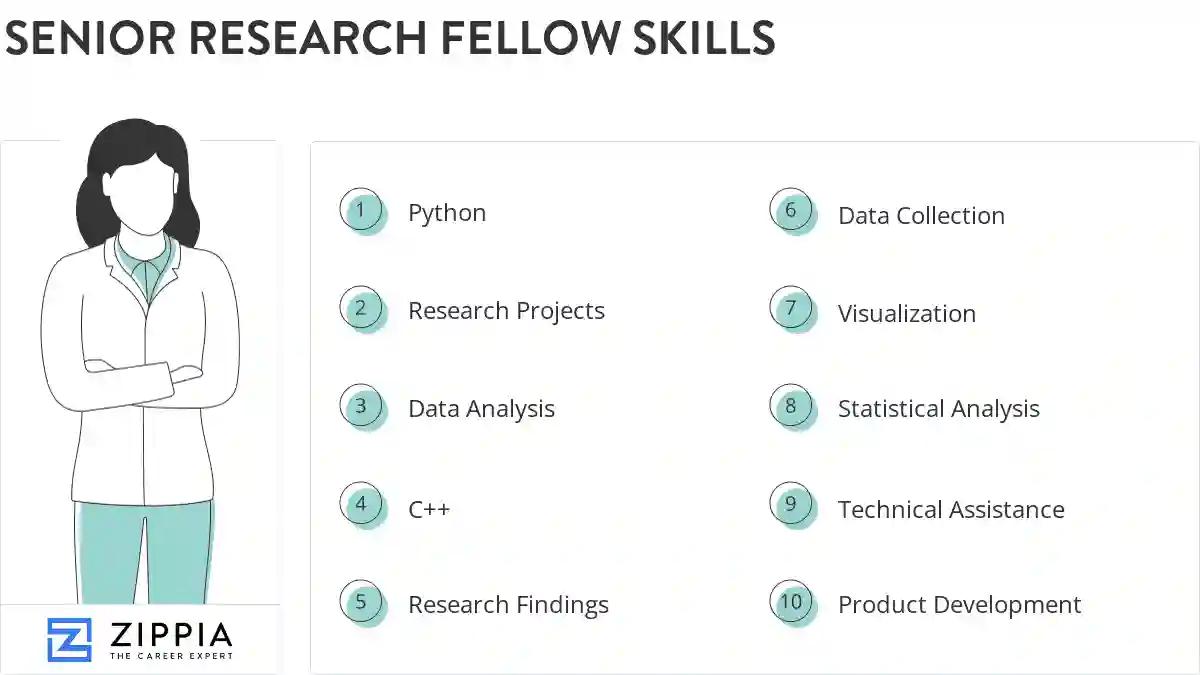
The most important skills for a senior research fellow resume and required skills for a senior research fellow to have include:
- Python
- Research Projects
- Data Analysis
- C++
- Research Findings
- Data Collection
- Visualization
- Statistical Analysis
- Technical Assistance
- Product Development
- Chemistry
- Patients
- Java
- Prototyping
- Synthesis
- SPSS
- SAS
- Project Management
- SQL
- Biotechnology
- Molecular Biology
- Math
- Immunology
- Study Design
- R
- Cell Culture
- Independent Research
- Embedded Systems
- Analyze Data
- Regression
- National Security
- IP
- FDA
- CRISPR
- Cell Lines
- PowerPoint
- Biomarkers
- Cell-Based Assays
- Elisa
- RNA
- Infectious Disease
- Clinical Trials
- DNA
- Literature Reviews
- IRB
- Pharmacokinetics
Updated January 8, 2025
