
Automatically apply for jobs with Zippia
Upload your resume to get started.
Siebel developer skills for your resume and career
15 siebel developer skills for your resume and career
1. UI
- Created new joins and links for the components to display the required data in the UI Layer.
- Executed UI related configuration changes to Accounts, Contacts, Opportunity, Quotations and Orders.
2. Web Services
A web service is software that is available on the internet and uses a specific messaging system. A web service is a kind of service that is not bound to any specific programming language or operating system. Web services help every device to communicate over the world wide web.
- Generated Inbound web services to interact with external application.
- Designed Web Services and their Technical Specification.
3. Business Services
The term business services can refer to a wide range of business functions across airport operations, event management, printing services, and more. Typically, services include organizing, coordinating, administering business functions, coordinating projects, and implementing business trends. These services can help a company with strategic initiatives like reducing costs or identifying revenue sources. For the most efficient business operations, skills like group coherence, creative and analytic thinking,and strong leadership are required.
- Developed Business Services using Browser Script/Server Script for accomplishing the complex functionality around Opportunity Selling and Policy Renewal processes.
- Designed and developed business services and integration objects to interact with external systems.
4. PL/SQL
- Developed Oracle PL/SQL Packages, Procedures and Functions accordance with the business requirements for loading data into database tables.
- Developed lot of PL/SQL & Stored Procedures as part of temporary & permanent data fix for production issues.
5. Java
Java is a widely-known programming language that was invented in 1995 and is owned by Oracle. It is a server-side language that was created to let app developers "write once, run anywhere". It is easy and simple to learn and use and is powerful, fast, and secure. This object-oriented programming language lets the code be reused that automatically lowers the development cost. Java is specially used for android apps, web and application servers, games, database connections, etc. This programming language is closely related to C++ making it easier for the users to switch between the two.
- Implemented New Integration Methodology like Posting the Messages to Queue Tables using middle ware Java Messaging System.
- Created WebService to create activities for Claims from Java based User Interface.
6. CSS
- Created and modified CSS, jQuery for Siebel 16.11.0.0 version.
- Modified the look and feel of the Siebel eCustomer and Siebel eService application by changing CSS files.
Choose from 10+ customizable siebel developer resume templates
Build a professional siebel developer resume in minutes. Our AI resume writing assistant will guide you through every step of the process, and you can choose from 10+ resume templates to create your siebel developer resume.7. Data Models
- Documented business intelligence information and defined subject areas for subsequent data analysis and data modeling.
- Worked closely with Data Architect during Data Model created/modification by utilizing ERWIN.
8. Business Objects
- Modified/created standard business components & business objects.
- Created business components and business objects.
9. Siebel Tools
- Designed and implemented several pick lists, links, joins and Business Object Layer definitions using Siebel Tools.
- Configured the user interfaces for the Business and Data layer object definitions using Siebel Tools 7.8 and 8.0.
10. BI
- Define different data set used for developing the BI publisher reports like SQL and WSDL/Web Service files.
- Designed and developed Reports and Dashboards using Oracle BI Answers as per the Client Requirements.
11. XML
XML is a medium for storing and transporting data that is independent of software and hardware. XML stands for eXtensible Markup Language. XML, like HTML, is a markup language that was created to store and transport data. It was created with the intention of being self-descriptive. There are no predefined tags in the XML language. Another feature is that XML is extensible.
- Involved in debug of inbound XML and in Admin activities (LOV, templates and repository migration).
- Based on status of claim it brings data and send XML using HTTP post back to IVR system.
12. Siebel EIM
- Worked on Data loads and data extractions using Siebel EIM and SQL.
- Design, planning, implementation and support in Siebel EIM module.
13. Windows XP
- Experience in usage of Operating Systems such as UNIX, WINDOWS XP/NT/2000/98/95.
- Prepared a production monitoring and support handbook Environment: Informatica power center 6.1/7.1, Oracle, windows XP, MS office Suite
14. UAT
UAT stands for user acceptance testing, and it is the last phase in the software testing process that determines whether the software is fit for the purpose it was built or not. UAT checks two main things; whether the software fulfills the business requirements and can it be used by the end-users. It is the final and most critical step in the testing stages and it determines whether the software should be introduced in the market or not.
- Involved with the testing team to resolve, fixing and testing problems found during the Systems integration test, UAT Phases.
- Project execution responsibilities include right from preparing technical design documents and UT Test scripts review sessions, Development, UAT.
15. Informatica
Informatica is a cloud data management that provides data integration and transformation. This is an ETL extract, transform and load tool that helps connect and retrieve data from multiple data sources and load it into various target databases and file systems.
- Installed and configured Informatica repository server.
- Worked on the Informatica Design Center to create the mapping by implementing the appropriate Transformations to achieve the business requirement.
5 Siebel Developer resume examples
Build a professional siebel developer resume in minutes. Browse through our resume examples to identify the best way to word your resume. Then choose from 5+ resume templates to create your siebel developer resume.

What skills help Siebel Developers find jobs?
Tell us what job you are looking for, we’ll show you what skills employers want.
List of siebel developer skills to add to your resume
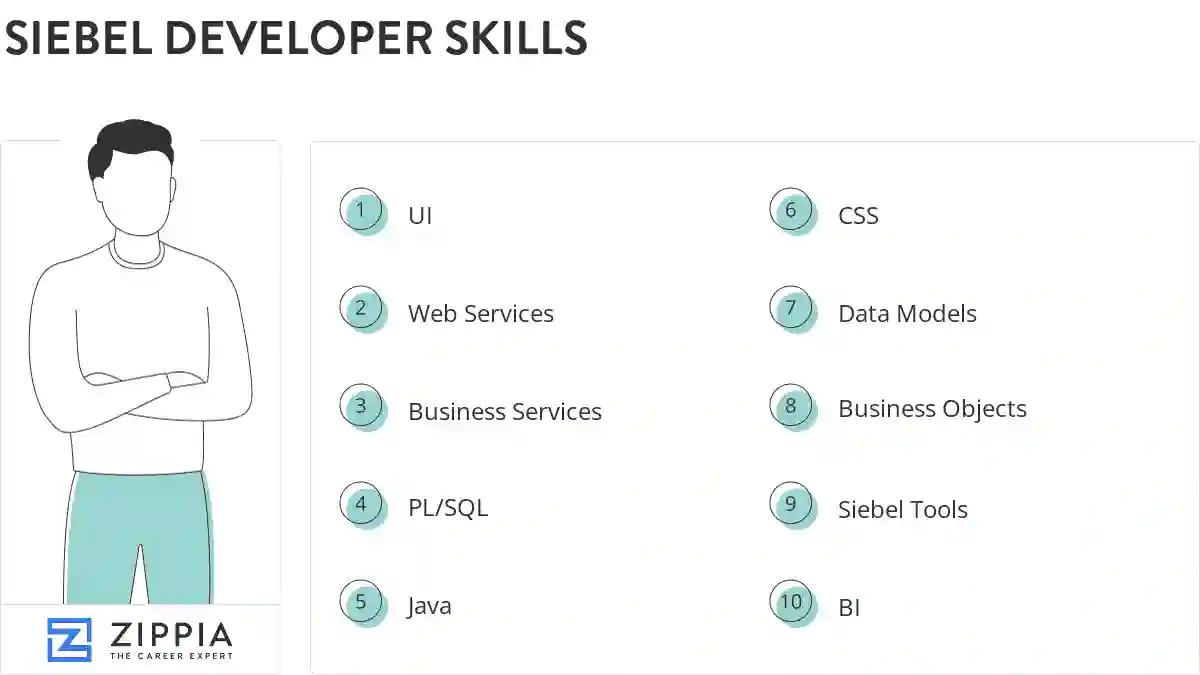
The most important skills for a siebel developer resume and required skills for a siebel developer to have include:
- UI
- Web Services
- Business Services
- PL/SQL
- Java
- CSS
- Data Models
- Business Objects
- Siebel Tools
- BI
- XML
- Siebel EIM
- Windows XP
- UAT
- Informatica
- HTML
- Production Environment
- QA
- Siebel EAI
- Specific Dashboards
- Toad
- Html Css
- Business Components
- Load Data
- External Systems
- Unix
- SQL Server
- Oracle 10G
- ETL
- Order Management
- Test Cases
- Test Scripts
- Legacy Systems
- End Testing
- Physical Layer
- IFB
- User Interface Layer
- Integration Objects
- WSDL
- SQL Loader
- LDAP
- Oracle Bi
- VBC
- Business Analysts
- RPD
- Error Handling
- System Integration Testing
- Oracle 11G
Updated January 8, 2025
