
Automatically apply for jobs with Zippia
Upload your resume to get started.
Sign language teacher skills for your resume and career
15 sign language teacher skills for your resume and career
1. ESL
- Have developed curriculum and taught beginning and low-intermediate ESL, pronunciation and conversation, and citizenship preparation classes to adults.
- Attended and participated in ESL professional development activities, conferences/workshops, curriculum/program planning, & special events and activities.
2. Student Learning
- Administered Student Learning Objectives at the beginning and end of the year, with 95% of students showing measurable growth.
- Participate within various staffing committees in promoting student learning by planning educational activities based on thematic units learned in the classroom.
3. Classroom Management
- Implement classroom management procedures to establish a positive and safe learning environment.
- Performed responsibilities of identifying students' need and develop effective classroom management procedures Used direct point-to-point equipment during student evaluations.
4. Deaf Culture
Deaf culture is referred to as the way of living of the deaf community and includes their beliefs, core values, language, behaviors, and more. The sign language is the main form of communication in the deaf culture. In America, the ASL, American Sign Language, is used while other countries like Australia have their own sign languages. The deaf culture enjoys its own sense of humor, arts, literature and experiences. In culture, deafness is not perceived as a disability. Instead, they are proud of their uniqueness and happy in their skin. Some behaviors common to the deaf culture include eye contact, touch, closeness and thumping on tables or floors.
- Created, and lead, a study group dedicated to American Sign Language and Deaf culture at Colorado State University.
- Encouraged interest in Deaf culture, and respectful interaction with the Deaf and Hard of Hearing.
5. Learning Styles
- Teach students by assisting them in their own learning styles and helping them learn to translate English to American Sign Language.
- Adjust tutoring styles to accommodate different learning styles.
6. Foreign Language
A foreign language is a language that is not the official language spoken in a given state or country. It's a language that is native to another country but can be studied in addition to one's native language as a means of fostering international relationships among countries.
- Attended monthly foreign language department meetings to develop assessments.
- Created a curriculum for American Sign Language that incorporates the Common Core and Foreign Language Standards.
Choose from 10+ customizable sign language teacher resume templates
Build a professional sign language teacher resume in minutes. Our AI resume writing assistant will guide you through every step of the process, and you can choose from 10+ resume templates to create your sign language teacher resume.7. Student Performance
- Integrated multimedia technology into student-centered interdisciplinary practices resulting in improved student performance.
- Analyzed quantitative data collected on individual student performance combined with qualitative evaluation of student to design individual academic growth program.
8. Instructional Techniques
- Modified the general education curriculum for special-needs students based upon a variety of instructional techniques and technologies.
- Utilized a variety of instructional techniques and materials.
9. Physical Health
- Observe students during classroom and play activities to evaluate students' performance, behavior, social development, and physical health.
- Provide support and advocacy services, on and off site, for families concerning: mental and physical health services.
10. Student Interest
- Developed and taught lessons on relevant children's books, poems, movies, songs and themes to promote student interest.
- Created and enforced child-based hands-on curriculum to promote student interest and receptive learning.
11. IEP
- Monitored and implemented special education policies such as: o Conducted annual individualized educational programming (IEP).
- Developed and implemented IEP goals and objectives based on preschool curriculum expectations.
12. Learning Environment
- Cultivated a culturally sensitive learning environment.
- Collaborated with other high school and college instructors to establish a dynamic learning environment focused on community building and professional growth.
13. Children Ages
- Teach Chinese courses to children ages 6 months-5 years.
- Worked with children ages 5 to 12 years old.
14. III
III is often used to describe the level of a class, clearance, or experience in a tiered system. This may mean a class level such as Calculus III or Spanish III, meaning the class may refer to the classes held before; however, there may also be an Engineer III, indicating the engineer can work on more complex issues and understands a great number of engineering principles and procedures.
- Tutored college students in ASL I and ASL III Evaluated modules performed by students Other Work Experience Applebee's
- Initiated and received approval for expansion of Spanish education program to include Spanish III
5 Sign Language Teacher resume examples
Build a professional sign language teacher resume in minutes. Browse through our resume examples to identify the best way to word your resume. Then choose from 5+ resume templates to create your sign language teacher resume.

What skills help Sign Language Teachers find jobs?
Tell us what job you are looking for, we’ll show you what skills employers want.
What skills stand out on sign language teacher resumes?
Nanette Scott Goldman
Senior Lecturer in the Classical Mediterranean and Middle East, Macalester College
What sign language teacher skills would you recommend for someone trying to advance their career?
Dr. Lisalee Egbert
Professor and Coordinator, The University of Texas at Arlington
What type of skills will young sign language teachers need?
Dana Williams Ph.D.
Professor of African American Literature, Interim Dean of the Graduate School, Howard University
What soft skills should all sign language teachers possess?
Julie Glosson
Professor of Language, Union University
-Adaptability
-Ability to be a team player as well as work independently
-Willingness to grow and learn from mistakes
What hard/technical skills are most important for sign language teachers?
Diane Renée Mannone
Associate Professor of English, East Los Angeles College
List of sign language teacher skills to add to your resume
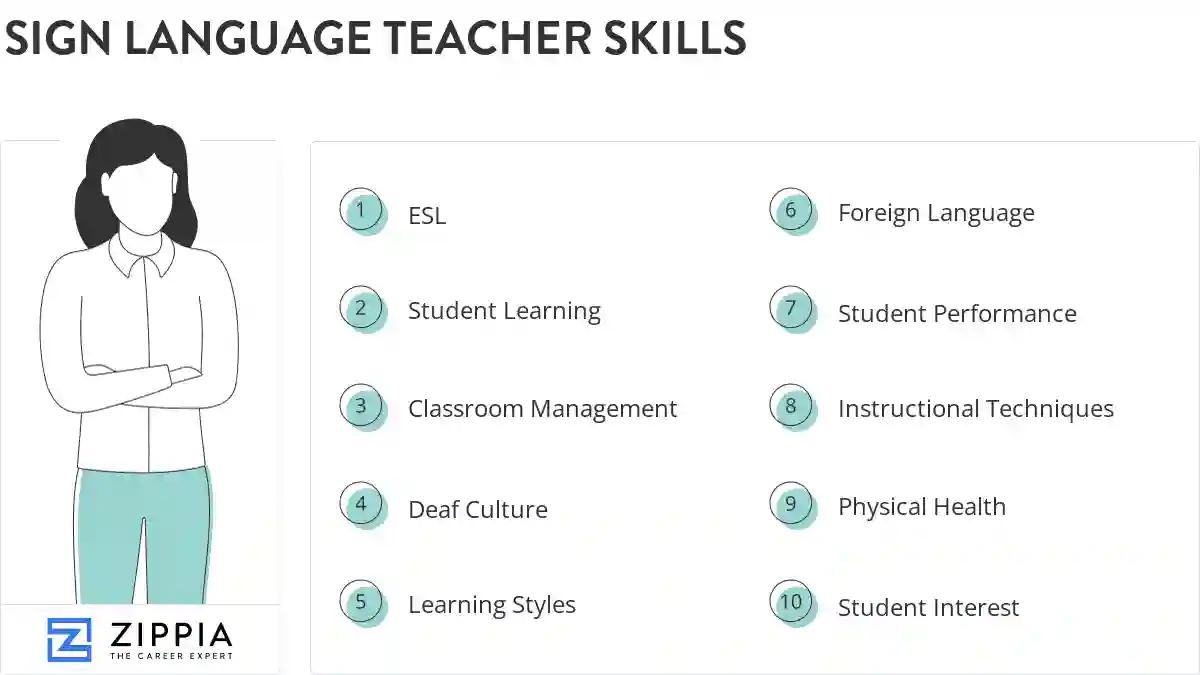
The most important skills for a sign language teacher resume and required skills for a sign language teacher to have include:
- ESL
- Student Learning
- Classroom Management
- Deaf Culture
- Learning Styles
- Foreign Language
- Student Performance
- Instructional Techniques
- Physical Health
- Student Interest
- IEP
- Learning Environment
- Children Ages
- III
- Social Development
- Syllabus
- Language Program
Updated January 8, 2025

15. Social Development