
Automatically apply for jobs with Zippia
Upload your resume to get started.
Site worker skills for your resume and career

13 site worker skills for your resume and career
1. Safety Regulations
- Trained employees in safety matters, procedures and equipment operations and enforced safety regulations.
- Learned and followed specific safety regulations.
2. Technical Support
Technical support or tech support are the services provided by any hardware or software company to users. They help in solving the technical difficulties the customers face with their products or services. Moreover, the tech support employees maintain, manage, and repair the IT faults. They are also responsible for resolving the network problems, installing and configuring hardware and software.
- Provided administrative, logistical and technical support as required with minimal supervision.
3. Safety Procedures
Safety procedures are a set of standardized procedures, that ensures minimal to no risk to people, resources, and the work environment. A company follows the step-by-step safety procedures as it they not only keep the customers and the employees safe, but also help in avoiding legal claims.
- Performed demolition/construction duties including, cleaning, maintenance, machine operating, strategic demo, safety procedures.
- Complied with prescribed safety procedures or federal laws regulating waste disposal methods.
4. Construction Sites
A piece of land where constructional activities are to be conducted is termed as a construction site.
- Worked on large, high-pressure construction sites with strict time frames.
- Prepare invoices * Construction sites include: Wells Fargo Offices: Frederick, MD (Morgan, Keller).
5. Equipment Operation
Equipment operation is the process of managing and maintaining industrial equipment. This involves installing, maintaining, testing, modifying, operating, and managing the equipment's life cycle. Examples of specialized equipment include pressure vessels, industrial pipes, and rotating machinery. Engineering associations such as the EEMUA help companies to be well-versed in equipment operations.
- Light equipment operation operated company vehicles around california for over 300 miles a day
- Skilled in heavy duty equipment operations and maintence of machinery.
6. Hazardous Materials
Any substance or good that is harmful to human health as well as the environment are called hazardous materials. Such materials must be handled carefully to avoid any mishaps. Harmful gases. chemicals, strong medicines or drugs, radioactive elements required for radiation purposes, a human blood sample that carries germs, all of these are considered hazardous materials.
- Acknowledged blueprint and designs- Operated air and electric equipment and pneumatic drills- Removed hazardous materials
- Advised management on potential hazardous materials and made recommendations as required.
Choose from 10+ customizable site worker resume templates
Build a professional site worker resume in minutes. Our AI resume writing assistant will guide you through every step of the process, and you can choose from 10+ resume templates to create your site worker resume.7. RAN
RAN stands for "revenue anticipation note," which refers to a practice where an organization (often the government) borrows money to support a specific project. When these funds are then repaid, the money given to the lenders comes from the profits generated by the business originally funded.
- General cleaning responsibilities; ran cash register and greeted customers.
8. Crisis Calls
- Take crisis calls, distribute personal medications, provide referrals, Review client's goals and Perform room checks.
9. Manual Labor
Any kind of work that is carried out by workers manually instead of using machines is termed manual labor.
- perform all manual labor necessary for completion of construction project.
- Performed manual labor to maintain appearance of public environments Repaired and maintained curbs Operated construction vehicles and heavy machinery
10. DOT
- Drive company equipment on site and over the road adhering to all DOT standards.
- Develop an understanding of DOT, EPA & OSHA regulations and TEIs Health and Safety Practices.
11. Recycle
- Operated the recycle baler machine.
12. PPE
Personal protective equipment is an item of protective clothing such as goggles, helmets, or other garments meant to protect the body from injury.
- Used harnesses, respirators, harness lanyards for support, and PPE.
- Required PPE / OSHA requirements and respirator tests performed.
13. Water Truck
A water truck is a large vehicle that specializes in facilitating water transportation at a worksite.
- Load haul and unload truck water truck, Rig up and rig down frac site .

What skills help Site Workers find jobs?
Tell us what job you are looking for, we’ll show you what skills employers want.
What type of skills will young site workers need?
Becky Roe
Senior Project Coordinator, Shasta College
Technology is integrated at many levels. Equipment cabs are air-conditioned and heated; joystick controls are intuitive, and modern displays provide operators with multiple data sets to assist in making the most efficient and safe decisions when needed. The less tangible skills all job seekers can bring to the table include a strong work ethic supported by a true passion for what he/she is doing. Logging and forest worker careers are not typical 9-5 jobs. The work can be seasonal, and the days are always long. Logging and forest professionals come from diverse backgrounds and are committed to their work, sharing a deep appreciation for the responsibility of stewardship, which they are given. They understand what they are doing in the forest has an impact on the landscape and they value and respect the renewable resources with which they are trusted.
List of site worker skills to add to your resume
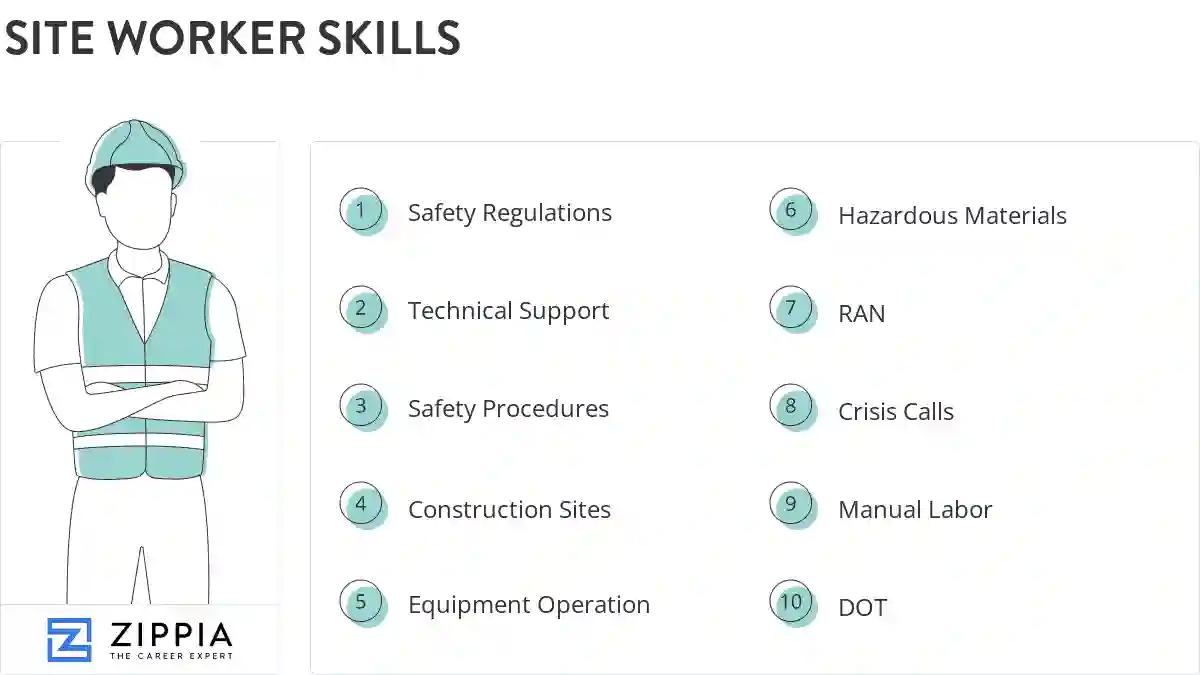
The most important skills for a site worker resume and required skills for a site worker to have include:
- Safety Regulations
- Technical Support
- Safety Procedures
- Construction Sites
- Equipment Operation
- Hazardous Materials
- RAN
- Crisis Calls
- Manual Labor
- DOT
- Recycle
- PPE
- Water Truck
Updated January 8, 2025
