
Automatically apply for jobs with Zippia
Upload your resume to get started.
Software engineering supervisor skills for your resume and career
15 software engineering supervisor skills for your resume and career
1. Software Development
Software development is the mechanism by which programmers create computer programs. The Software Development Life Cycle (SDLC) is a framework for developing applications that follow technological needs and consumer requirements. It consists of many stages. The SDLC establishes an international standard that software developers can use to enhance and create their programs. It provides a well-defined framework for software developers to pursue in the production, maintenance, and design of premium quality software. The aim of the software development process is to create high-quality software on time and within budget.
- Conduct business needs analysis and translate them into written business requirements for software development.
- Supervised the Software Development Team consisting of four developers.
2. C++
C++ is a general-purpose programming language that is used to create high-performing applications. It was invented as an extension to the C language. C++ lets the programmer have a high level of domination over memory and system resources. C++ is an object-oriented language that helps you implement real-time issues based on different data functions
- Develop programs using C++, C#, Python, and scripting process for production, as well as Reverse Engineering.
- Plan, design and implement C++ based deployment software to support software build, release and field installation.
3. Java
Java is a widely-known programming language that was invented in 1995 and is owned by Oracle. It is a server-side language that was created to let app developers "write once, run anywhere". It is easy and simple to learn and use and is powerful, fast, and secure. This object-oriented programming language lets the code be reused that automatically lowers the development cost. Java is specially used for android apps, web and application servers, games, database connections, etc. This programming language is closely related to C++ making it easier for the users to switch between the two.
- Led a team of engineers in gathering requirements and developing a new order placement system with florists in Java and Oracle.
- Developed a new autonomous web product personalization interface in JAVA that incorporates JSON classes for interfacing with JavaScript objects.
4. Linux
Linux is a Unix-like operating system. Just like Windows, Mac OS, and IOS, Linux is an operating system used by millions across the globe. Android itself is powered by the Linux operating system. Linux manages all the hardware resources that are associated with your computer. The software is famous because of the protection it grants from viruses, malware, and crashes. The Linux operating system is entirely free and is an open-source software meaning it can be altered by those equipped with the knowledge to code.
- Released to Linux and Mac servers and environments that host our application and web configuration scripts.
- Worked extensively with PHP developers in making changes to PHP scripts on all Linux servers.
5. Architecture
- Required extensive work with Vendor, Architecture and Local teams to meet legal spin deadline requirements and stay within budget.
- Provided leadership support in planning for data clean up, data conversion, data mapping, and network/connectivity system architecture.
6. Software Applications
A software application is any computer program developed and used by consumers, such as Microsoft's suite of products (Office, Excel, Word, PowerPoint, Outlook, etc.), Internet browsers such as Firefox, Safari, and Chrome, or browser add-ons that Defendant preinstalls or causes to be preinstalled onto a Covered Product. The software application is designed to help the user perform specific tasks - personal, educational, and business functions.
- Developed software applications and tests that improved the efficiency, usability, and quality of manufacturing tests.
- Managed and released all standard and custom software applications for the telecommunications group.
7. Development Environment
- Established and maintained the development environment.
- Implemented a development environment for developing web based applications running on a LAMP platform.
8. Debugging
- Provided support with debugging issues.
- Create and configure virtual machines and environments for testing & debugging activities where actual user-environment equipment is not readily available.
9. SQL Server
- Migrated the database for 40 sites from Access to SQL Server, with a 100% retention of existing customers.
- Write SQL compatible code for an Access Database conversion to SQL Server.
10. MVC
Model-View-Controller (MVC) refers to the method of software development for creating user interfaces.
- Implemented New Enterprise level authentication and authorization level implementation using MVC C#.
- Developed initial proof-of-concept interface implementation using Spring MVC with an embedded Alfresco framework.
11. Technical Leadership
- Provided technical leadership and grew the group into a high-performing team.
- Provided technical leadership for team of 12 developers.
12. GIT
- Experience with Clearcase, CVS, Git for source control and code management.
- Implemented best practices: GIT version-control, automated server-deployment, JIRA project- management and Confluence Knowledge Base (wiki).
13. Development Life
- Interfaced with customer throughout the entire development life-cycle.
- Developed an understanding of software development life cycle.
14. Software Quality
- Participate in SCCB, TQM and Software Quality Management Task Force Activities.
15. Direct Reports
- Conducted periodic One-on-One meetings and prepared and delivered quarterly feedback and annual appraisals for direct reports.
- Conduct regular meetings with direct reports to review goals and policy, provide company updates, and promote teamwork.

What skills help Software Engineering Supervisors find jobs?
Tell us what job you are looking for, we’ll show you what skills employers want.
What software engineering supervisor skills would you recommend for someone trying to advance their career?
Dr. Galen Duree
Head of the Department of Physics and Optical Engineering and Professor, Rose-Hulman Institute of Technology
General reading about technologies or reading available articles about subjects the graduate is interested in will help generate questions they can ask potential graduate schools. This time would also be a chance to improve areas where the graduate may feel weak while an undergraduate. Many online resources can help them brush up on week background topics. Do not worry about transfer credits because that is usually not helpful in graduate school, but improve knowledge and experience in areas where the graduate feels weak. If the graduate has identified a graduate school and program to study in, the graduate school might have some recommendations about what to review. All of this will help improve success in graduate school.
If the next step is a job with a company or lab, taking courses to improve communication will help. Many technically competent or even technically brilliant people struggle with effective communication. Techniques about writing reports, making oral presentations, or communicating technical information will help improve success. The gap year also provides time to investigate technologies that the graduate wants to be involved in and the companies or labs in those areas.
Once the graduate has identified areas of interest and companies or labs that the graduate might want to work for, they can be contacted to either answer questions or point the graduate in a direction for further investigation.
In either case, a gap year can provide a chance to refine the graduate's choice for the next steps and help them prepare other skills overlooked during the undergraduate years.
What type of skills will young software engineering supervisors need?
John Ring
Director Engineering Outreach, Elon University
What technical skills for a software engineering supervisor stand out to employers?
Maria Larrondo Petrie Ph.D.
Professor, Florida Atlantic University
What soft skills should all software engineering supervisors possess?
Christian Hansen Ph.D.
Professor and Department Chair, Eastern Washington University
What hard/technical skills are most important for software engineering supervisors?
Travis Mandel Ph.D.
Assistant Professor, University of Hawaii at Hilo
Another one I'll mention briefly is designing class inheritance diagrams to solve a new problem. The right structure here can allow components to be easily re-used and extended. But the wrong structure can lead to disastrous consequences, so it requires a lot of thought about how things will likely evolve in the future.
List of software engineering supervisor skills to add to your resume
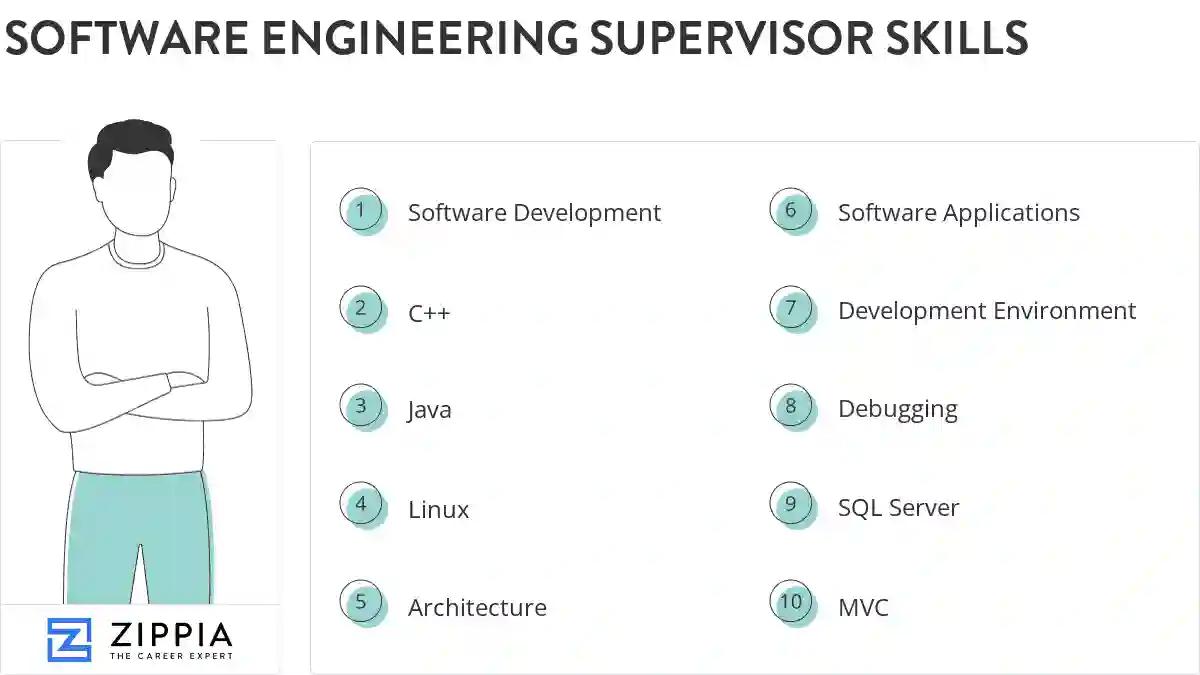
The most important skills for a software engineering supervisor resume and required skills for a software engineering supervisor to have include:
- Software Development
- C++
- Java
- Linux
- Architecture
- Software Applications
- Development Environment
- Debugging
- SQL Server
- MVC
- Technical Leadership
- GIT
- Development Life
- Software Quality
- Direct Reports
- UI
- C Net
- HTML
- Code Reviews
- Jenkins
- Test Cases
- QA
- Technical Direction
- Test Scripts
- R
- Unix
- Perl
- PHP
- Software Design
- Technical Specifications
- Database
- Technical Documentation
- XML
- Software Support
- Windows
- GUI
- Maven
- Software Releases
- ASP
- System Integration
- TCP/IP
- SharePoint
- J2EE
Updated January 8, 2025
