
Automatically apply for jobs with Zippia
Upload your resume to get started.
Software programmer/analyst skills for your resume and career
15 software programmer/analyst skills for your resume and career
1. Java
Java is a widely-known programming language that was invented in 1995 and is owned by Oracle. It is a server-side language that was created to let app developers "write once, run anywhere". It is easy and simple to learn and use and is powerful, fast, and secure. This object-oriented programming language lets the code be reused that automatically lowers the development cost. Java is specially used for android apps, web and application servers, games, database connections, etc. This programming language is closely related to C++ making it easier for the users to switch between the two.
- Developed and implemented GUI Functionality for SSMA, CSMS modules using JSP, Struts, Java Script.
- Web - Designed, coded and implemented applications in JAVA - JSP that utilize an Oracle database.
2. SQL Server
- Configured SQL Server application and file server; set up users permissions and roles; created images and unattended install files.
- Performed as project lead on web based training applications involving ASP, VB, SQL Server, and Oracle.
3. HTML
- Prepared client demos and quote preparation work for web based applications using ASP, and HTML.
- Developed web UI for several projects by utilizing HTML, JavaScript, CSS, and AJAX.
4. JQuery
- Created of interface to manage user menu and Bulk update of Attributes using JS, EXTJS and JQUERY.
- Involved in developing JSP pages with JQUERY and CSS.
5. CSS
- Created custom CSS style sheets to support different web browsers.
- Enhanced customer Account Profile usability by implementing reusable components using JavaScript prototyping and CSS.
6. API
- Used MVC 4 Razor as this client interface along windows azure cloud storage API.
- Developed software and hardware documentation for Nintendo game development platforms, including API references and game developer guidelines.
7. MVC
Model-View-Controller (MVC) refers to the method of software development for creating user interfaces.
- Worked on UI development using JSP on Struts and Spring MVC Frameworks.
- Developed Administrator model in MVC 3.0 using Razor views for metadata driven to facilitate content agility.
8. XML
XML is a medium for storing and transporting data that is independent of software and hardware. XML stands for eXtensible Markup Language. XML, like HTML, is a markup language that was created to store and transport data. It was created with the intention of being self-descriptive. There are no predefined tags in the XML language. Another feature is that XML is extensible.
- Experienced in managing and reviewing Hadoop log files and running Hadoop streaming jobs to process terabytes of xml format data.
- Created Service component to connect to OTMA XML services to create/retrieve/update/delete rewards manager information from Mainframe data bases.
9. PL/SQL
- Designed and supported the Stock Options system used by HR department using ASP and PL/SQL running on Oracle 9i database.
- Used PL/SQL and Oracle Reports 2.0 in charge calculation process, printing bills and generating reports.
10. Web Application
- Create infrastructure test plans and test cards to test applications including web applications, client foundations, server utilities etc.
- Developed a task scheduling system which includes a windows service and a web application to configure scheduled tasks.
11. Architecture
- Received MQ training from IBM and worked with team to implement MQSeries (WebSphere) as a core IT architecture.
- Participated in design and implementation new Windowsinterface and underlying architecture as well and installation software for Windowsversion.
12. Web Services
A web service is software that is available on the internet and uses a specific messaging system. A web service is a kind of service that is not bound to any specific programming language or operating system. Web services help every device to communicate over the world wide web.
- Create and access REST and SOAP based Web Services, to access internal and secured applications inside and outside the intranet.
- Developed Web Services for applications that consume Web Methods using C#.
13. Application Development
- Assisted in monitoring and adjusting application development objectives, to help insure appropriate team activities.
- Supervised work flow processes, assessed project requirements and schedules to meet application development deadlines.
14. Ajax
- Developed Ajax Technology functions and implement in the project.
- Implemented AJAX in the Web Forms.
15. DB2
The DB2, known as the Relational Database Management System, is a type of procedure developed by IBM to run and operate software applications such as Windows, Unix, and the Linux System. This type of system is designed mainly for IBM but was innovated to run in various operating systems. The main feature of the DB2 is to handle and manage a big chunk of data while allowing the users to enter the database engine without any problem.
- Create structured COBOL programs to use DB2 files instead of flat files, or modify existing.
- Work on production tickets created by the user of the DB2 systems.

What skills help Software Programmer/Analysts find jobs?
Tell us what job you are looking for, we’ll show you what skills employers want.
What skills stand out on software programmer/analyst resumes?
Dr. Brock LaMeres Ph.D.
Professor, Electrical & Computer Engineering, Director, Montana Engineering Education Research Center (MEERC), Montana State University
What soft skills should all software programmer/analysts possess?
Sal Aurigemma Ph.D.
Associate Professor of CIS, J. Bradley Oxley Professor of Computer Information Systems, University of Tulsa
What hard/technical skills are most important for software programmer/analysts?
Sal Aurigemma Ph.D.
Associate Professor of CIS, J. Bradley Oxley Professor of Computer Information Systems, University of Tulsa
What software programmer/analyst skills would you recommend for someone trying to advance their career?
Dr. Tao Ju
Vice Dean for Research & Professor, Washington University in St. Louis
What type of skills will young software programmer/analysts need?
Dr. Ted Junseok Song
Associate Professor of Engineering, John Brown University
What technical skills for a software programmer/analyst stand out to employers?
Bob Sweeney Ph.D.
Associate Professor, University of South Alabama
List of software programmer/analyst skills to add to your resume
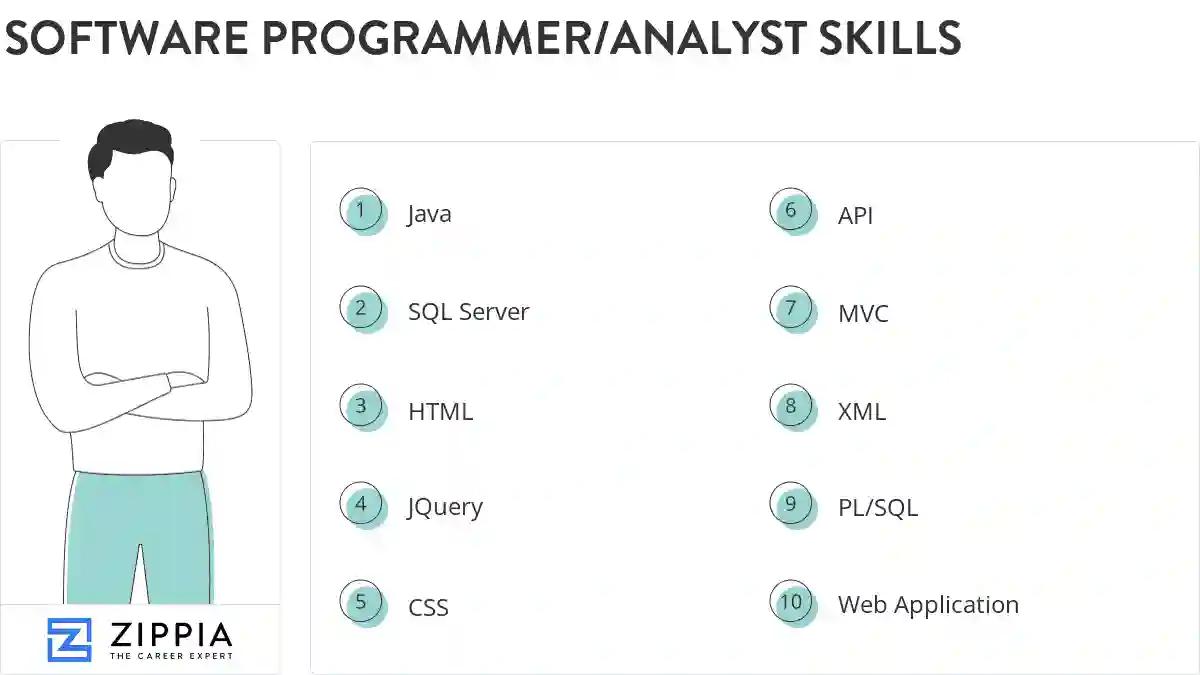
The most important skills for a software programmer/analyst resume and required skills for a software programmer/analyst to have include:
- Java
- SQL Server
- HTML
- JQuery
- CSS
- API
- MVC
- XML
- PL/SQL
- Web Application
- Architecture
- Web Services
- Application Development
- Ajax
- DB2
- Unix
- UI
- SharePoint
- Junit
- Linux
- IIS
- ASP
- Windows NT
- Database Tables
- User Interface
- UML
- J2EE
- JSP
- COBOL
- Microsoft Visual Studio
- Management System
- Visual C++
- EJB
- Test Cases
- C
- C++
- PeopleSoft
- Oracle Sql
- GUI
- ORM
- C Net
- QA
- SQR
- PHP
- VBA
Updated January 8, 2025
