Explore jobs
Find specific jobs
Explore careers
Explore professions
Best companies
Explore companies
What is a soil scientist and how to become one
A soil scientist studies soil samples to obtain information about the soil's physical composition, chemical properties, microorganism content, and potential for various applications in the agricultural, construction, or industrial industry.
The day-to-day duties of soil scientists are to conduct tests on various soil samples, record the results of their analyses, prepare soil feasibility studies, model information on specialized computer programs, and present their study findings. They are also responsible for basic laboratory management, which includes keeping their work area clean, monitoring inventory levels, and ensuring that hazardous chemicals are kept in safe places.
To become a soil scientist, you need to have a bachelor's or master's degree in soil science, environmental science, plant science, or another relevant scientific field. Many employers also require proven experience working with soil and/or previous studies conducted on soil. Moreover, employers look for candidates with great skills in analysis, communication, laboratory management, and computer applications.
On average, a soil scientist takes home around $63,000 per year. If you want to pursue this career, you can find abundant opportunities in industries like soil biology, agriculture, research, and mining.
What general advice would you give to a soil scientist?
Daniel Hirmas
Professor and B.L. Allen Endowed Chair of Pedology, Texas Tech University
Avg. Salary $91,463
Avg. Salary $59,228
Growth rate 8%
Growth rate 0.3%
American Indian and Alaska Native 0.24%
Asian 12.05%
Black or African American 4.07%
Hispanic or Latino 8.06%
Unknown 2.75%
White 72.83%
Genderfemale 29.44%
male 70.56%
Age - 38American Indian and Alaska Native 3.00%
Asian 7.00%
Black or African American 14.00%
Hispanic or Latino 19.00%
White 57.00%
Genderfemale 47.00%
male 53.00%
Age - 38Stress level is manageable
7.1 - high
Complexity level is advanced
7 - challenging
Work life balance is poor
6.4 - fair
Soil scientist career paths
Key steps to become a soil scientist
Explore soil scientist education requirements
Start to develop specific soil scientist skills
Skills Percentages GPS 17.36% Data Collection 17.04% GIS 14.38% EPA 7.99% Technical Assistance 5.34% Complete relevant soil scientist training and internships
Accountants spend an average of 6-12 months on post-employment, on-the-job training. New soil scientists learn the skills and techniques required for their job and employer during this time. The chart below shows how long it takes to gain competency as a soil scientist based on U.S. Bureau of Labor Statistics data and data from real soil scientist resumes.Research soil scientist duties and responsibilities
- Manage study protocols and study conduct, intimately involve in the toxicology and pharmacokinetic study protocol development process.
- Apply remote sensing techniques and geographic information system (GIS) for land use studies and environmental management plans.
- Used soil augers and pH meters.
- Produce detailed soil maps using GIS computer software.
Prepare your soil scientist resume
When your background is strong enough, you can start writing your soil scientist resume.
You can use Zippia's AI resume builder to make the resume writing process easier while also making sure that you include key information that hiring managers expect to see on a soil scientist resume. You'll find resume tips and examples of skills, responsibilities, and summaries, all provided by Zippi, your career sidekick.
Choose from 10+ customizable soil scientist resume templates
Build a professional soil scientist resume in minutes. Browse through our resume examples to identify the best way to word your resume. Then choose from 10+ resume templates to create your soil scientist resume.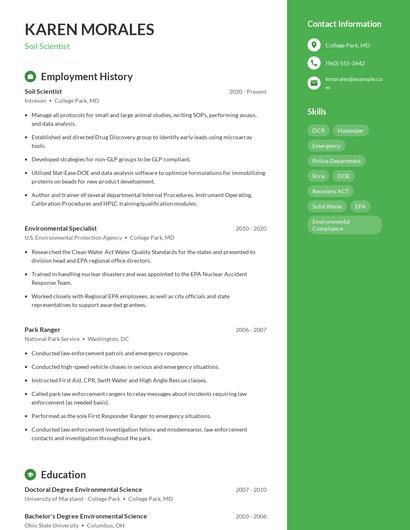


Apply for soil scientist jobs
Now it's time to start searching for a soil scientist job. Consider the tips below for a successful job search:
- Browse job boards for relevant postings
- Consult your professional network
- Reach out to companies you're interested in working for directly
- Watch out for job scams
How did you land your first soil scientist job
Tiara Oceananda
Soil Scientist
My interest in soil science, especially chemistry, started from an internship at Nuclear Energy Regulatory Agency Yogyakarta that I was assisted research project as interns as well as research asistants in identifying the effect of H2SO4 concentration on ilmenite leaching and the levels of elemental oxides produced. And then at campus I focused on studying soil chemistry research, land remediation became a topic that I liked so my research as a student at that time was about polluted solid lime waste soil (Lime Mud) from a former paper factory in Probolinggo.
Because my educational background is in agriculture, especially soil chemistry and with the laboratory skills that I have, I applied for a job in my company as a Soil Scientist in the Biotech department. Since joining PT. BISI International Tbk., the research that I did was a collaboration between sustainable agriculture and biotechnology such as soil nutrients and abiotic stress screening for field and horticultural crops. I think to become a soil scientist what is needed is a strong aptitude in the sciences, the ability to pay attention to details and to make careful observations. It's helpful to enjoy working outdoors.
Average soil scientist salary
The average soil scientist salary in the United States is $91,463 per year or $44 per hour. Soil scientist salaries range between $60,000 and $137,000 per year.
What am I worth?

How do soil scientists rate their job?
Updated January 8, 2025
