What does a sound editor do?
Sound editor responsibilities
Here are examples of responsibilities from real sound editor resumes:
- Manage international man-made fiber market research/publishing company and supervise editorial content and sales of industry statistical journal.
- Add in sound effects, music, and ADR as needed.
- Gain experience in assisting with analog soundboard and stage lighting.
- Mix vocals and music from a DJ for a fashion presentation, (volunteer only )
- Review submitted manuscripts, brainstorm & implement promotional strategies, track community involvement, and plan literary events with the editor-in-chief.
- Deliver exported versions for Facebook and Instagram.
Sound editor skills and personality traits
We calculated that 15% of Sound Editors are proficient in ADR, Video Games, and SFX. They’re also known for soft skills such as Computer skills, Manual dexterity, and Problem-solving skills.
We break down the percentage of Sound Editors that have these skills listed on their resume here:
- ADR, 15%
Edited Sound FX, Dialog, BG, ADR, Foley, Music and Supervised for various film and television shows.
- Video Games, 15%
Freelance dialogue editor, sound editor, worked on dialogue for several video games.
- SFX, 14%
Mixed multiple SFX together to creating complex sounds and appropriate audio levels.
- Pro Tools, 10%
Use Pro Tools to edit dialog, sound effects, design and occasionally mix short and feature length films.
- Feature Film, 7%
Spearheaded Music and Post Audio teams for 3 feature films and 4 short films within a year.
- Adobe Premiere, 6%
Produced twenty video and multimedia packages for the newspaper YouTube page using Adobe Premiere, Apple Motion and Final Cut Pro.
Common skills that a sound editor uses to do their job include "adr," "video games," and "sfx." You can find details on the most important sound editor responsibilities below.
Computer skills. To carry out their duties, the most important skill for a sound editor to have is computer skills. Their role and responsibilities require that "technicians use computer systems to program equipment and edit audio and video recordings." Sound editors often use computer skills in their day-to-day job, as shown by this real resume: "oversee all aspects of the production process of computer training video programs. "
Manual dexterity. Many sound editor duties rely on manual dexterity. "some technicians set up audio and video equipment and cables, a job that requires a steady hand and good hand-eye coordination," so a sound editor will need this skill often in their role. This resume example is just one of many ways sound editor responsibilities rely on manual dexterity: "created and developed a media management manual for the program's specificstandards. "
Problem-solving skills. This is an important skill for sound editors to perform their duties. For an example of how sound editor responsibilities depend on this skill, consider that "technicians need to recognize equipment problems and propose possible solutions to them." This excerpt from a resume also shows how vital it is to everyday roles and responsibilities of a sound editor: "managed and resolved conflicts between fiction and poetry readers and editors. ".
Communication skills. For certain sound editor responsibilities to be completed, the job requires competence in "communication skills." The day-to-day duties of a sound editor rely on this skill, as "technicians need to communicate with supervisors and coworkers to ensure that clients’ needs are met and that equipment is set up properly before broadcasts, live performances, and presentations." For example, this snippet was taken directly from a resume about how this skill applies to what sound editors do: "founded under direct development design + communications, main street marlboro is a hyperlocal news website serving marlboro township, nj. "
The three companies that hire the most sound editors are:
- The Walt Disney Company2 sound editors jobs
- Modis1 sound editors jobs
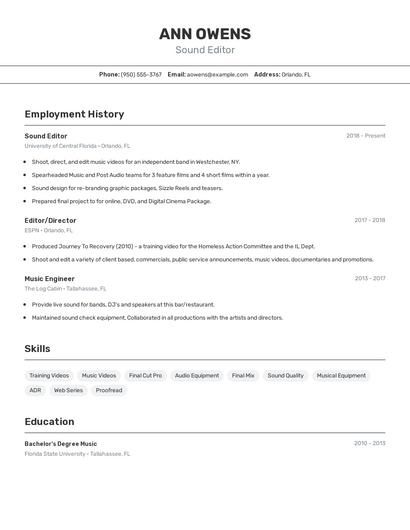
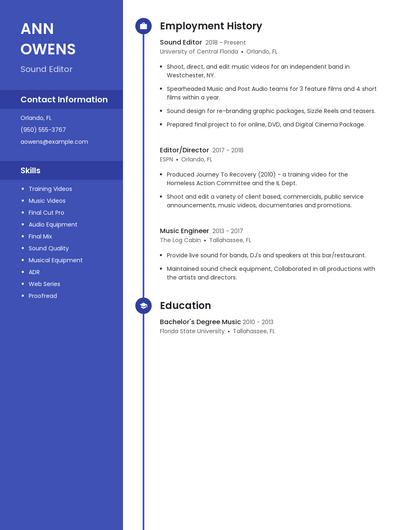
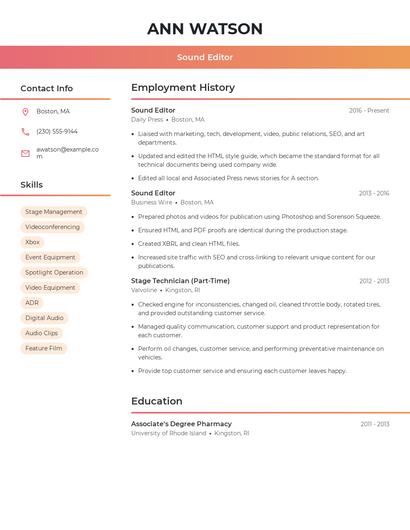
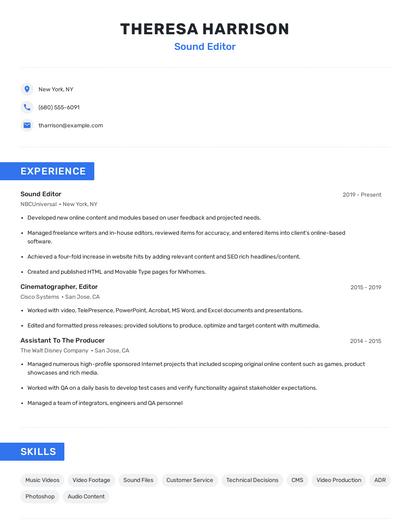
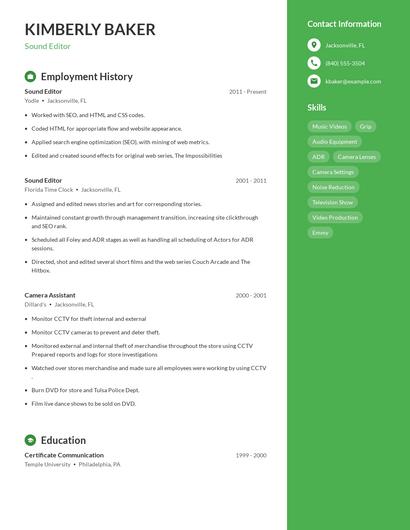
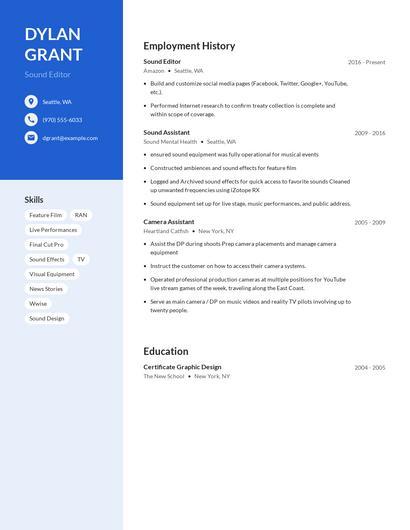
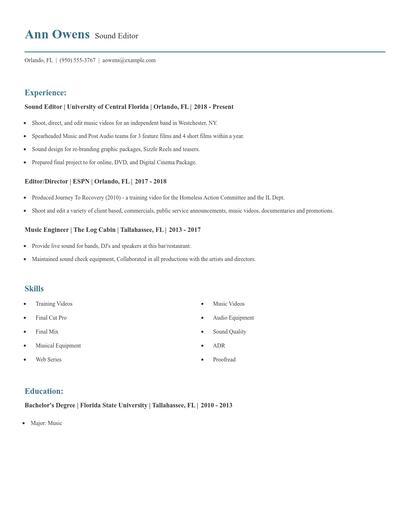
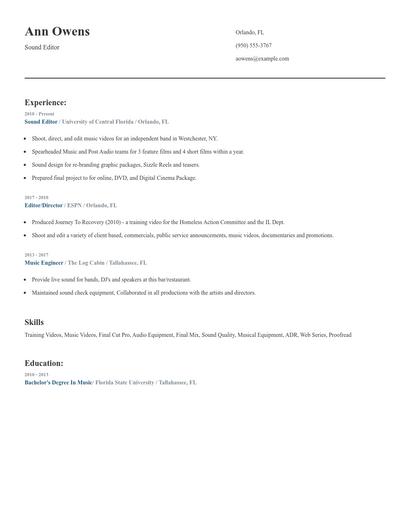
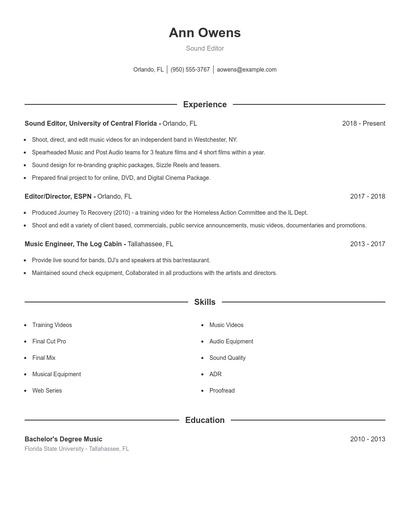
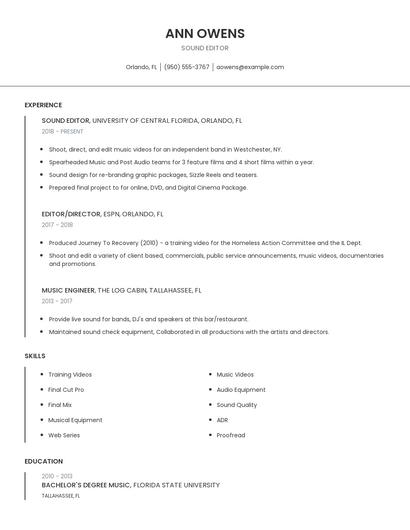
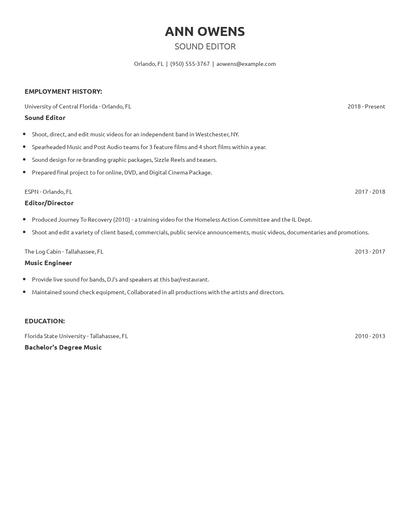
Choose from 10+ customizable sound editor resume templates
Build a professional sound editor resume in minutes. Our AI resume writing assistant will guide you through every step of the process, and you can choose from 10+ resume templates to create your sound editor resume.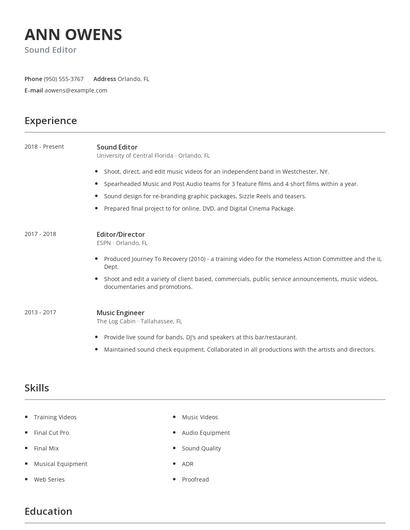
Compare different sound editors
Sound editor vs. Assistant audio engineer
A freelance videographer/editor is responsible for processing and editing video contents, usually on a project basis. Freelance videographer/editors create their footage using their shooting equipment, utilize various design and editing software, and finish the project based on the clients' specifications and deliverables. They should also have a good grasp of digital marketing to produce impactful videos to the target audience. A freelance videographer/editor must be detail-oriented and have excellent communication skills to coordinate with the production team for content plans and perform adjustments as needed.
While similarities exist, there are also some differences between sound editors and assistant audio engineer. For instance, sound editor responsibilities require skills such as "video games," "pro tools," "r," and "feature film." Whereas a assistant audio engineer is skilled in "video production," "visual equipment," "analog," and "signal flow." This is part of what separates the two careers.
The education levels that assistant audio engineers earn slightly differ from sound editors. In particular, assistant audio engineers are 2.6% less likely to graduate with a Master's Degree than a sound editor. Additionally, they're 0.0% less likely to earn a Doctoral Degree.Sound editor vs. Audio recording engineer
In addition to the difference in salary, there are some other key differences worth noting. For example, sound editor responsibilities are more likely to require skills like "video games," "sfx," "r," and "feature film." Meanwhile, an audio recording engineer has duties that require skills in areas such as "equipment maintenance," "dat," "audio-visual equipment," and "live events." These differences highlight just how different the day-to-day in each role looks.
In general, audio recording engineers achieve lower levels of education than sound editors. They're 5.1% less likely to obtain a Master's Degree while being 0.0% less likely to earn a Doctoral Degree.Sound editor vs. Freelance videographer/editor
Some important key differences between the two careers include a few of the skills necessary to fulfill the responsibilities of each. Some examples from sound editor resumes include skills like "adr," "video games," "sfx," and "pro tools," whereas a freelance videographer/editor is more likely to list skills in "training videos," "video content," "video production," and "camera operation. "
When it comes to education, freelance videographer/editors tend to earn similar degree levels compared to sound editors. In fact, they're 4.6% less likely to earn a Master's Degree, and 0.1% less likely to graduate with a Doctoral Degree.Sound editor vs. Mixing engineer
Types of sound editor
Updated January 8, 2025
