
Automatically apply for jobs with Zippia
Upload your resume to get started.
Speech and language specialist skills for your resume and career

15 speech and language specialist skills for your resume and career
1. SLP
SLP stands for speech-language pathologists. It is a field of experts in the language and speech sector. A speech-language pathologist diagnoses, assesses, communicates with clients, treats, and offers assistance to avoid communication and swallowing disarray in kids and grownups. A master's degree specializing in language speech pathology is a requirement to qualify in this field. Communication, compassionate, persistent, resourceful, adaptability, time management, and sensitivity include in the set skills necessary to operate in this field.
- Collaborated with SLP in identifying any discrepancies with commercial thickeners vs. readymade hospital standard.
- Key Projects & Accomplishments: Provided direct backup support to SLP.
2. IEP
- Produce IEP and function as a member of the child study team in order to produce a specialized IEP for students.
- Hold meetings with parents, teachers, and necessary child study team members to create and maintain all IEP's.
3. Autism
- Work with students diagnosed with Autism Spectrum Disorders, auditory processing disorders, and articulation and phonological processing disorders.
- Conducted supervised behavioral training for two preschoolers with autism.
4. Asha
ASHA is an acronym for American Speech-Language-Hearing Association. It's an American organization responsible for promoting the growth and interest of audiologists, speech professionals, speech-language pathologists, and the interest of people with hearing disabilities. They are also the regulatory body for audiologists, speech-language pathologists, and every other professional in the audio and speech industry around the United States.
- Adhered to all ASHA policies and rules, Arizona Revised Statutes, and federal regulations pertaining to education.
- Perform tasks prescribed, directed, and supervised by ASHA certified speech language pathologist.
5. Therapy Sessions
- Incorporated classroom objectives into speech therapy sessions to reinforce academic learning.
- Regulated proper coordination of group therapy sessions.
6. Group Therapy
Group psychotherapy or group therapy is the practice of treating a group of clients together in one sitting throughout multiple sessions. This practice allows people to receive encouragement and support from their peers who are taking the same group therapy.
- Provide individual and group therapy for children ranging from kindergarten through fifth grade.
- Provided one to one and group therapy in a K-2nd grade elementary.
Choose from 10+ customizable speech and language specialist resume templates
Build a professional speech and language specialist resume in minutes. Our AI resume writing assistant will guide you through every step of the process, and you can choose from 10+ resume templates to create your speech and language specialist resume.7. Auditory
- Maintained FM Auditory training devices and trained staff to use devices.
- Created a total sensory "black-room" experience for summer program, affording the students heightened visual, auditory and tactile input
8. Language Disorders
- Conduct evaluations to assess students with speech language disorders to determine eligibility for services.
- Managed and Conducts Therapy -Collaborated/consulted with classroom teachers in the management of speech-language disorders.
9. School-Age Children
- Treated and evaluated preschool-age children with speech and language delays/impairments at Burnley-Moran and Clark Elementary schools.
- Performed assessments and treatment for school-age children with a variety of communication deficits.
10. Communication Disorders
Those mental disorders that inhibit or weaken the ability to detect, listen, comprehend speech in an individual are called communication disorders. Such individuals have trouble using language as a discourse to express themselves. The extent of the disability varies in people, some may have a difficulty in detecting sound properly while others might be completely unable to understand speech.
- Managed a caseload of approximately 50 students with mild to severe communication disorders.
- Participate in ARD committees to assist in interpretation of data, placement, and goals for students with communication disorders.
11. Language Development
- Conduct assessments and design individual programs in the areas of articulation, language development and voice therapy.
- Collaborate with teachers and other school professionals on strategies to maintain progress with language development.
12. K-12
K12 is a term that incldues all 12 years of education in the US education system. It includes the education offered at the primary stage, middle stage, and secondary stage. It includes children of ages as young as 5 to 18 years. The grades included in K12 are Kindergarten, the initial 5 stages, grades 6 to 8, and 9 to 12. This system is followed specifically followed in the US and may vary in other countries.
- Diagnosed and treated communication issues of k-12 students.
- Conducted therapy with students K-12.
13. Language Evaluations
- Provided speech and language evaluations and therapeutic services for elementary school-aged children in individual and group sessions.
- Administered preschool speech and language evaluations for the BOE.
14. Public Schools
Public schools are available for everyone. They are funded and controlled by the government. With state guidance, each school board determines the curricula, finances, and jobs for schools within its borders. The government also decides on academic standards and standardised tests.
- Conducted parent interviews and parent/teacher in-service training Designed and implemented a conceptual language curriculum for Cleveland Public Schools Head Start Program
- Provided language/literacy intervention and hearing screenings to Boston Public Schools.
15. Language
- Evaluate students with language assessments and determine their eligibility for special education and/or Speech and Language therapy as a related service.
- Participated in evaluating the concerns and developing specific speech and language treatment plans for children with communication difficulties.
5 Speech And Language Specialist resume examples
Build a professional speech and language specialist resume in minutes. Browse through our resume examples to identify the best way to word your resume. Then choose from 5+ resume templates to create your speech and language specialist resume.

What skills help Speech And Language Specialists find jobs?
Tell us what job you are looking for, we’ll show you what skills employers want.
What skills stand out on speech and language specialist resumes?
Brian O'Sullivan Ph.D.
Associate Professor and Chair, St. Mary's College of Maryland
What soft skills should all speech and language specialists possess?
Jason Rosas
Assistant Professor, Adelphi University
What hard/technical skills are most important for speech and language specialists?
Jason Rosas
Assistant Professor, Adelphi University
What speech and language specialist skills would you recommend for someone trying to advance their career?
Christopher Blackwell
Furman University
What type of skills will young speech and language specialists need?
Daniel Martin Ph.D.
Professor of English, Rockhurst University
List of speech and language specialist skills to add to your resume
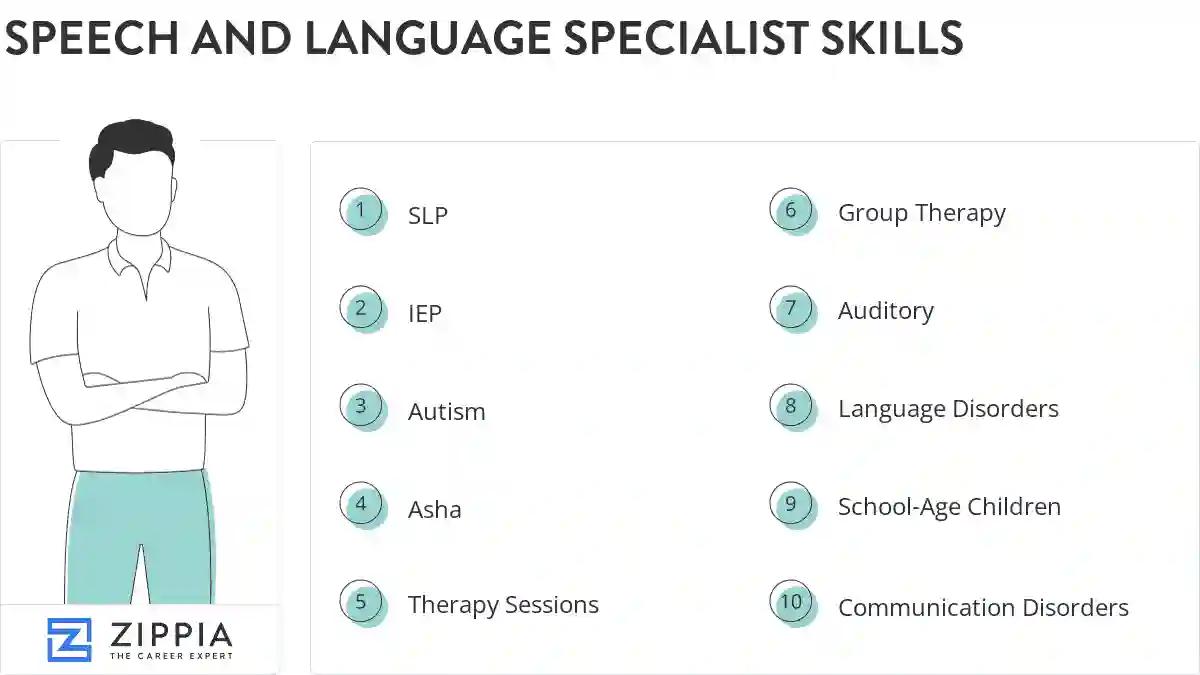
The most important skills for a speech and language specialist resume and required skills for a speech and language specialist to have include:
- SLP
- IEP
- Autism
- Asha
- Therapy Sessions
- Group Therapy
- Auditory
- Language Disorders
- School-Age Children
- Communication Disorders
- Language Development
- K-12
- Language Evaluations
- Public Schools
- Language
- Standardized Testing
- Diagnostic Evaluations
- ABA
- English Language
- Speech Therapy
- Language Therapy
- Educational Programs
- Applied Behavior Analysis
- Learning Disabilities
- Diagnostic Reports
- Pre-K
- ELL
- Developmental Disabilities
- AAC
- Language Goals
- Group Sessions
- Language Assessments
- ASD
- Education Plan
- Language Delays
- Data Collection
- Evaluation Reports
- Elementary Schools
- K-8
- Fluency Disorders
- Voice Disorders
- Early Intervention
- Communication Difficulties
Updated January 8, 2025
