
Automatically apply for jobs with Zippia
Upload your resume to get started.
Stacker operator skills for your resume and career
15 stacker operator skills for your resume and career
1. Safety Rules
Principles or regulations that ensure the protection of people, objects, or the environment are called safety rules. These rules can be governing actions, devices, or procedures that help in minimizing the risks of loss, injury, or damage.
- Assure employees follow all safety rules, regulations, and wear all protective clothing and equipment necessary for jobs performing.
- Responded to safety issues for compliance with applicable safety rules and standards according to company policies and procedures.
2. Quality Checks
Quality checks are a component of quality control aimed at ensuring that quality requirements are met. Internally, quality checks provide assurance to managers, and externally, it provides assurance to clients, federal departments, authorities, and certifiers.
- Record quality checks, print load tags, assure rejected material does not reach the next department.
- Preform hourly checks to ensure other operators in department is preforming production and quality checks.
3. Math
- Produced and maintained accurate documentation for production reports using math and computer skills.
- Job required a variety of skills including general math and communication with management.
5. Assembly Line
Assembly line is a process used in industries to ensure the production of products in a cost effective manner by dividing up the responsibilities of each labor. Assembly lines enabled industries to hire more workers, therefore providing more employment opportunities to labors. This is possible because in this process the burden of all the tasks related to production are not laid on a single person, they are divided into small baby steps for each labor.
- Assist assembly line team member with various job duties to ensure productivity goals are meant.
- Moved batteries from the assembly line and scan them into the system then palletized them for shipping.
6. Tape Measure
A tape measure is a thin, flexible strip of plastic or metal that can be rolled up when it is not being used. The tape measure has numbers marked on it linearly which is used for measuring length.
- Verify material conformance to specifications, using measuring devices such as micrometers tape measures and/or calipers.
- Utilized blueprints and measured angles using a calculator, caliper and fractional-decimal tape measure.
Choose from 10+ customizable stacker operator resume templates
Build a professional stacker operator resume in minutes. Our AI resume writing assistant will guide you through every step of the process, and you can choose from 10+ resume templates to create your stacker operator resume.7. Pallet Jack
- Operated electric pallet jack to bring poultry from one area to another in the warehouse.
- Machine Operator for vitamins* Protein powders* Collected and prepared capsules* Bottled vitamins* Use of pallet jacks* Operated forklift when needed
8. Stackers
- Operate Rough Finish Stacker and Press Machine Maintain Stackers in proper operating condition Prepare daily work reports
- Maintain operations of mechanical stackers.
9. Quality Issues
- Communicate all quality issues with roller operator so that the roller operator can correct the problem.
- Monitored conveyor belt for quality issues with product.
10. Machine Operators
Machine operators, also known as machinists, refer to workers responsible for various machines with specific functions. Their duties include setting up equipment, loading materials, and operating machinery. The machine operators also monitor and optimize their operations for efficiency.
- Cut custom flags and flag parts for the machine operators to assemble.
- Assisted Press and Binder machine operators as needed for production and maintenance.
11. Dry End
- Handled all paperwork in regard to dry end production; unit count, production waste and production quality tests.
- Assisted in machine set up and safety for all dry end operations.
12. Clamp Truck
- Skilled in forklift and clamp truck operation.
- Clamp Truck Operator- Loaded/Unloaded Railcars.
13. Stack Boxes
- Stack boxes, Line Operator, Change Die and Prints as well as Ink.
- Stack boxes and a downline operator
14. General Maintenance
General maintenance is the regular check-up and repairs of machinery, buildings, and other mechanical equipment. General maintenance is performed by repair workers who are skilled to handle the day-to-day defects produced in the machinery. General maintenance aims to make sure the items remain in the best operational conditions. Usually, a set of planned activities are performed regularly by an expert to monitor the maintenance.
- Fork lift operator and general maintenance and labor.
- Operate automated stacker, banders and shipping tables; troubleshoot equipment and general maintenance, housekeeping.
15. Product Quality
Product quality is the basic element of a business. It means to add features in a product or service in such a way that it meets the needs and wants of the customers. Enhancing the product quality also means improve the goods from any existing defects to ensure customer satisfaction.
- Stack sheets of corrugated paper Run warp tests on the paper Ensures product quality Completes inventory
- Performed product quality inspections, demonstrating a commitment to continuous improvement, in preparation for air bag distribution and shipping.
5 Stacker Operator resume examples
Build a professional stacker operator resume in minutes. Browse through our resume examples to identify the best way to word your resume. Then choose from 5+ resume templates to create your stacker operator resume.

What skills help Stacker Operators find jobs?
Tell us what job you are looking for, we’ll show you what skills employers want.
List of stacker operator skills to add to your resume
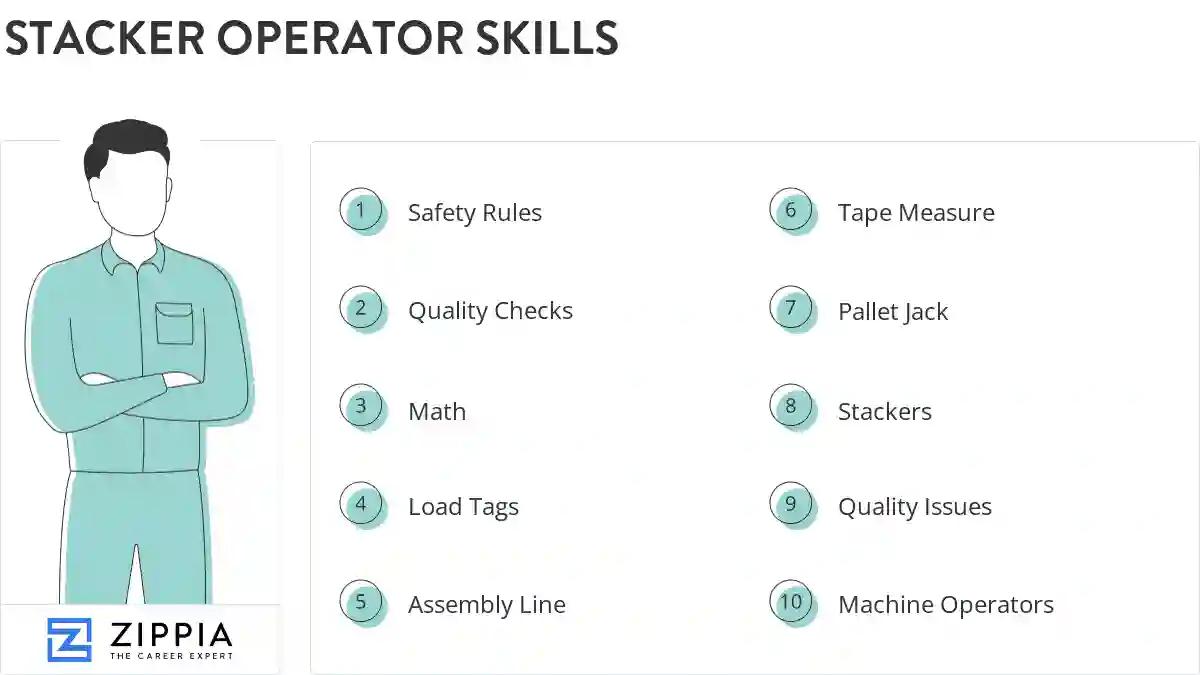
The most important skills for a stacker operator resume and required skills for a stacker operator to have include:
- Safety Rules
- Quality Checks
- Math
- Load Tags
- Assembly Line
- Tape Measure
- Pallet Jack
- Stackers
- Quality Issues
- Machine Operators
- Dry End
- Clamp Truck
- Stack Boxes
- General Maintenance
- Product Quality
- Hoists
- Bundling
- Production Process
- Safety Procedures
- Customer Specifications
- Control Panels
- PPE
- Wet End
Updated January 8, 2025
