
Automatically apply for jobs with Zippia
Upload your resume to get started.
Station captain skills for your resume and career
15 station captain skills for your resume and career
1. Emergency Response
- Prepared daily reports, maintenance records, and supervised emergency response personnel.
- Disseminated clear and concise information to responding crews during emergency responses.
2. Occupational Safety
Occupational safety, also known as occupational health, deals with preventing diseases, injuries, and deaths that arise because of working conditions.
- Enforced Fire Department Occupational Safety and Health Program.
3. Firefighting
- Administered operational policies and procedures in the direction of eight firefighting crews.
- Provide advanced firefighting management techniques and supervise rescue operations.
4. Incident Command
- Performed Incident Commander during Maxwell AFB Operational Readiness Inspection (ORI) which included an aircraft crash with multiple victims.
- Served as the Incident Commander and Emergency Operations Center's liaison for disaster mitigation.
5. Fire Protection
- Conducted and evaluated training on specialized fire protection equipment and procedures.
- Managed fire protection programs essential to effective fire fighting operations.
6. Haz-mat
- Assigned to Ladder One, HAZ-MAT Task Force and Water Rescue Task Force
- Responded to exercises, structural/crash emergencies, Haz-Mat incidents and wild land incidents both on and off base.
Choose from 10+ customizable station captain resume templates
Build a professional station captain resume in minutes. Our AI resume writing assistant will guide you through every step of the process, and you can choose from 10+ resume templates to create your station captain resume.7. Emergency Vehicle
- Assigned firefighter to emergency vehicles, station details, and emergency standbys.
- Operated and maintained emergency vehicles in a safe, efficient manner while obeying all traffic laws.
8. NFPA
- Direct, train, and develop up to 50 personnel - emphases on emergency mitigation with compliance with NFPA codes.
- Ensured that subordinates' training and development needs were met IAW NFPA standards.
9. Fire Safety
- Prepared all necessary documentation of noted fire safety deficiencies and conducted public fire prevention education.
- Provided base population training in fire extinguishers and general fire safety.
10. Emergency Operations
- Command initial emergency incidents (including hazardous materials incidents) and assist in the command of larger-scale emergency operations.
- Skilled in maneuvering vehicles to strategic locations to obtain optimal positions for emergency operations.
11. EMT
Emergency Medical Technicians (EMTs) provide urgent and emergent patients who enter the emergency medical services (EMS) system for out-of-hospital emergency medical treatment and transportation. EMTs are trained to stabilise and evacuate patients in a variety of situations, from non-emergency to regular hospital transports to life-threatening emergencies. Under the supervision of a physician, EMTs work as part of a robust EMS response scheme.
- Assisted in teaching classes at the fire academy to new recruits and taught EMT to high school students.
- Review of EMT and Paramedic treatment skills, triage decisions, transportation decisions and documentation skills.
12. Rescue Operations
- Conducted search and rescue operations and administers emergency first aid.
- Instruct fire and rescue classes as needed, update manuals pertaining to rescue operations and standard operating procedures as necessary.
13. Fire Station
- Maintained operational readiness of fire station and housed equipment.
- Ensured 100% response capability for assigned fire station equipment and personal; protective clothing and station facilities.
14. Equipment Maintenance
Equipment maintenance is any process that includes the use of maintenance methods and procedures to keep the organization's equipment in good and reliable working condition. This may include routine maintenance as well as corrective repairs. The practice takes place in a variety of settings, including catering establishments, industrial factories, manufacturing facilities, hotels, etc.
- Assist with dispatching, equipment maintenance, and training of new personnel.
15. Training Classes
A training class is a series of classes/lessons designed to impart skills and knowledge for a specific job or activity or to develop skills and knowledge or fitness to specific useful skills in oneself or others. There are a variety of benefits for the trainee, including improved self-esteem, motivation, and confidence, acquiring a new skill or qualification, updating skills, and keeping in touch with new developments in the field.
- Instructed CPR, first aid, and fire extinguisher training classes.
- Directed and participated in practicedrills and training classes for assigned station.
5 Station Captain resume examples
Build a professional station captain resume in minutes. Browse through our resume examples to identify the best way to word your resume. Then choose from 5+ resume templates to create your station captain resume.

What skills help Station Captains find jobs?
Tell us what job you are looking for, we’ll show you what skills employers want.
List of station captain skills to add to your resume
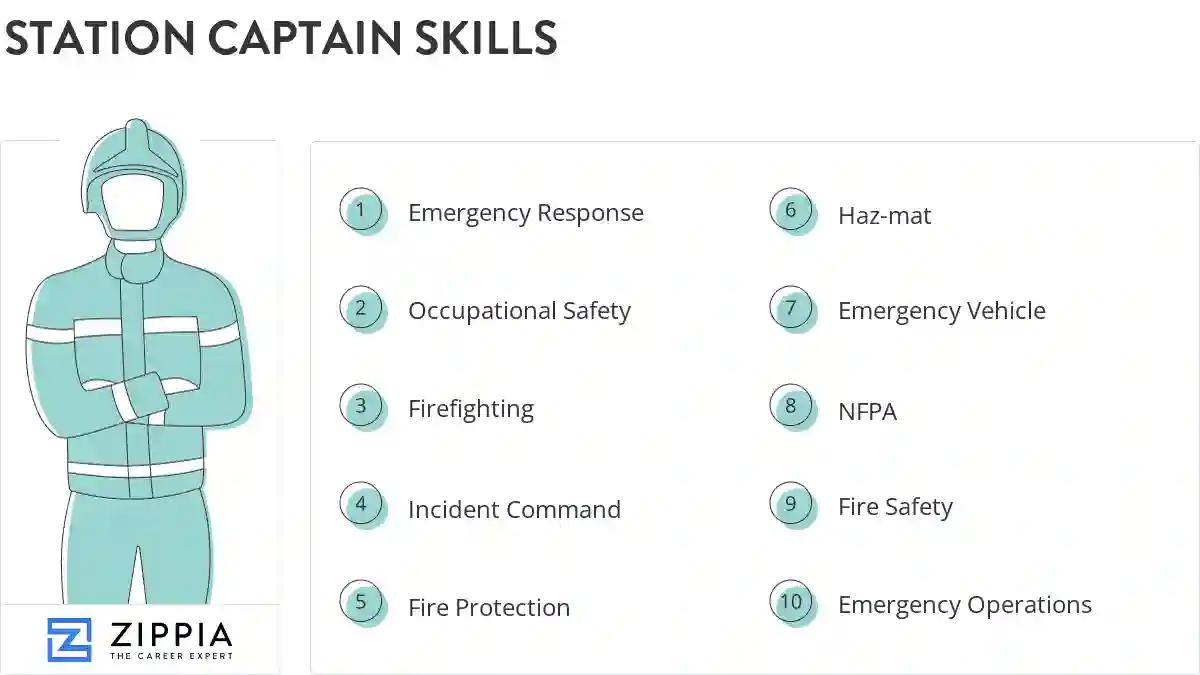
The most important skills for a station captain resume and required skills for a station captain to have include:
- Emergency Response
- Occupational Safety
- Firefighting
- Incident Command
- Fire Protection
- Haz-mat
- Emergency Vehicle
- NFPA
- Fire Safety
- Emergency Operations
- EMT
- Rescue Operations
- Fire Station
- Equipment Maintenance
- Training Classes
- Emergency Situations
- Fire Apparatus
- Performance Evaluations
- Fire Inspections
- DOD
- EMS
- Administrative Functions
- Pre-Fire Planning
- Fire Alarms
- Medical Care
Updated January 8, 2025
