
Automatically apply for jobs with Zippia
Upload your resume to get started.
Statistics tutor skills for your resume and career
15 statistics tutor skills for your resume and career
1. Math
- Helped students with assignments and enhanced general understanding of concepts and approaches associated with General Math and Statistics.
- Assisted 10 undergraduate student-athletes in one-on-one tutorial sessions in Math and Statistics.
2. R
R is a free software environment and a language used by programmers for statistical computing. The R programming language is famously used for data analysis by data scientists.
- Provided tutoring in statistics and assistance in the use of statistical software including: R, SPSS, and STATA 12.
- Teach students statistical concepts, R programming, and study techniques for homework and exam preparation.
3. Mathematical Concepts
- Tutored beginning level mathematics to advanced mathematical concepts while utilizing training techniques to advance knowledge, and self learning disciplines.
- Displayed an exceptional level of patience while explaining complex mathematical concepts to students
4. SPSS
- Tutored and coached students in statistics by completing statistical analyses in both SPSS and Microsoft Excel for students and professors
- Introduce students to computer programs, such as Excel and SPSS, to aid in statistical processes.
5. Calculus
- Tutored American and international undergraduate students in mathematics including calculus, statistics and differential equations.
- Tutored over twenty undergraduate students in Algebra, Calculus, Statistics and Microeconomics.
6. Research Methods
Research methods are tools, strategies, processes, or techniques that are used to collect and analyze data to discover new information or better understand a topic. Developing a research method is an integral part of research design. There are different types of research methods that use different data collection tools. These can be qualitative, quantitative, or mixed.
- Tutored undergraduates in research methods and statistics
- Teach psychology students with research methods and statistics classes Assist with homework and class assignments Develop new techniques on teaching students
Choose from 10+ customizable statistics tutor resume templates
Build a professional statistics tutor resume in minutes. Our AI resume writing assistant will guide you through every step of the process, and you can choose from 10+ resume templates to create your statistics tutor resume.7. Linear Algebra
Linear algebra is a subcategory of mathematics that deals with linear equations, which includes linear maps and their representations in vector spaces through matrices. Since linear algebra is vital to almost all areas of math, it's used mostly in science and engineering fields. Typically, this particular type of math is used for functional analysis, studying complex systems, scientific computation, and geometry of ambient space.
- Provided instruction for individuals and small groups in courses ranging from introductory calculus to upper division linear algebra
- Tutor undergraduate students in mathematics courses including: calculus, differential equations, linear algebra
8. Statistical Concepts
- Assisted students with test preparation and daily work-Mentored students on sociological and statistical concepts-Educated students on study techniques and note-taking strategies
- Work effectively with students with diverse learning needs and cultural backgrounds on psychological and statistical concepts.
9. Business Statistics
- Assisted college student in understanding Business statistics concepts and preparing her for exams
- Tutored and mentored graduate and undergraduate students with regard to business statistics.
10. Statistical Analysis
- Provided tutoring for students in Introduction to Statistical Analysis and Regression Analysis.
- Tutor students on an individual basis for classes in statistical analysis and writing
11. Learning Styles
- Provided additional assistance to student in Statistics understanding and appreciating the unique learning styles of students with disabilities
- Familiarized myself with different teaching techniques and learning styles to choose the appropriate style for each student
12. Hypothesis
- Tutored students in statistical courses, specific topics including hypothesis testing, sampling, distributions, and conditional probability.
- Articulated concepts of probability, descriptive statistics, hypothesis testing and regression models.
13. Economics
- Tutored students within economics and statistics fields.
- Sole tutor for all applied statistics courses (Statistics for the Social Sciences, Business & Economics, and Sociology)
14. Data Analysis
- Consulted with graduate students from all departments regarding data analysis and statistical research.
- Tutor in Social statistics and Data Analysis
15. Anova
- Focused on z-tests, t-tests, regression analysis, chi-square tests, and ANOVA.
- Instructed them on how to use ANOVA, ANCOVA, linear and non-linear regression techniques in SAS and Minitab.
5 Statistics Tutor resume examples
Build a professional statistics tutor resume in minutes. Browse through our resume examples to identify the best way to word your resume. Then choose from 5+ resume templates to create your statistics tutor resume.

What skills help Statistics Tutors find jobs?
Tell us what job you are looking for, we’ll show you what skills employers want.
What skills stand out on statistics tutor resumes?
Cheryl McDonald
Faculty & Coordinator, Education Specialist and Dual Credential programs, California State University - Fresno
I recommend that applicants approach their resumes in three ways. First, place yourself in the shoes of the potential employer. What qualifications, experience, and additional skills would you would want in someone you hire for the job? Second, think about what you want to convey and how you wish to represent yourself. Third, because English is read from the left to the right, mentally divide the resume page into quadrants, and place your most relevant information in the upper left quadrant first and then move to the upper right quadrant. This format is also appropriate for eye or word recognition software, used in many large-scale businesses and school districts, to scan the many resumes they receive.
What statistics tutor skills would you recommend for someone trying to advance their career?
Amy Belcastro Ph.D.
Professor of Education, Southern Oregon University
What type of skills will young statistics tutors need?
Niki Weller Ph.D.
Associate Professor of Sociology, Chair, Indiana University Kokomo
What technical skills for a statistics tutor stand out to employers?
Claude Mona
Professor, Assistant Chair, San Diego Mesa College
List of statistics tutor skills to add to your resume
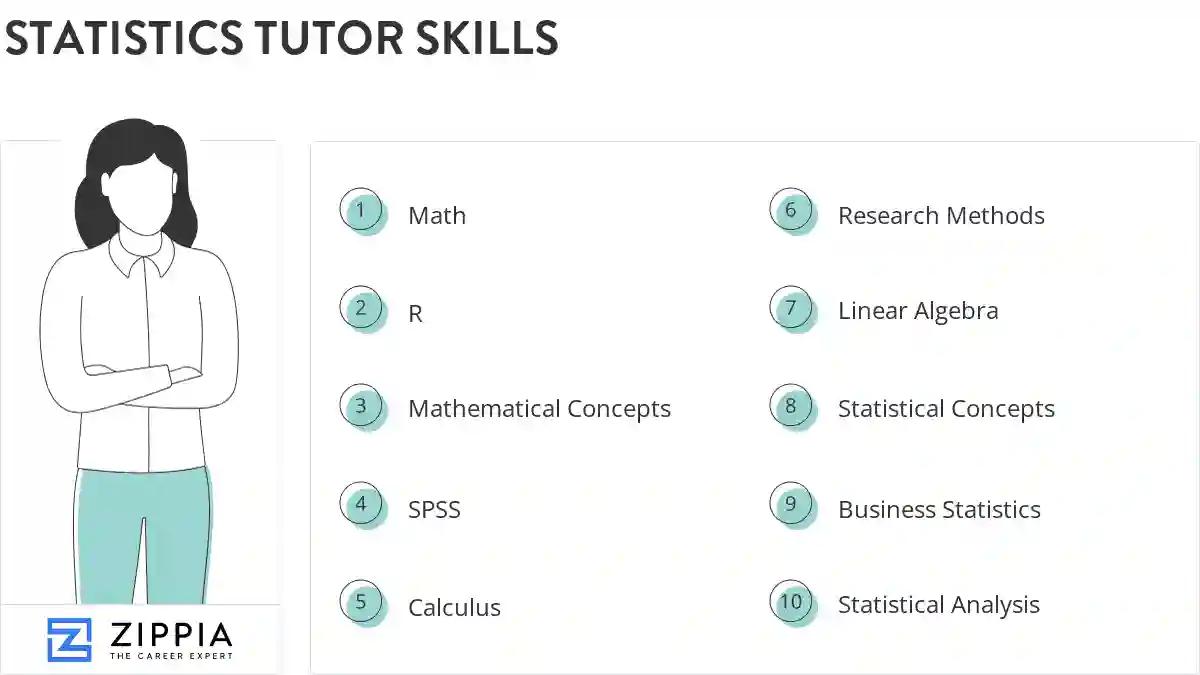
The most important skills for a statistics tutor resume and required skills for a statistics tutor to have include:
- Math
- R
- Mathematical Concepts
- SPSS
- Calculus
- Research Methods
- Linear Algebra
- Statistical Concepts
- Business Statistics
- Statistical Analysis
- Learning Styles
- Hypothesis
- Economics
- Data Analysis
- Anova
- Study
- Student Athletes
- SAS
- Course Materials
- Statistical Methods
- Review Sessions
- Linear Regression
- Statistical Software
- Study Strategies
- GPA
- Academic Support
- Regression Analysis
- PowerPoint
- Test Preparation
- Differential Equations
- Minitab
- Social Science
- Mentoring Students
- Class Material
- Academic Performance
- Course Concepts
- Homework Assignments
- One-On-One Sessions
- Exam Preparation
- Cultural Backgrounds
- APA
- Easy-To-Understand Terms
Updated January 8, 2025
