
Automatically apply for jobs with Zippia
Upload your resume to get started.
Steel inspector skills for your resume and career
15 steel inspector skills for your resume and career
1. AWS
- Inspect Structural Steel for conformance with AISC, AWS D1.1, and other applicable codes and standards.
- Perform AWS Guided Bend Testing of weld coupons for welder performance qualification (WPQ).
2. PT
PT which stands for Prothrombin Time is a test to evaluate the body's ability to properly form blood clots using one's blood sample. PT results are used to calculate the International Normalized Ratio (INR) which detects the effectiveness of blood-thinning medications like Warfarin taken by patients that have blood-clotting disorders.
- Performed were physical non-destructive tests on storage tanks utilizing MT, PT, UT, and VT prior to coating application.
- Level II Inspector in UT, MT, PT, and RT performing nondestructive testing in accordance with ASME.
3. Level II
Level II often marks a grade of experience one gains in the workplace. Depending on the field, a Level II certification may require a certain class or number of years of on-site work and training. For instance, in a medical or therapeutic field, a Level II designation is applied to individuals that achieve professionalism in their career, who demonstrate a higher level of clinical reasoning, and that help a certain number of clients.
- Level II inspector in liquid Penetrant, Magnetic Particle, and Radiographic Testing.
- Detailed and Conscientious Certified Quality Inspector level II with extensive knowledge of industry specifications and standards.
4. AISC
- Perform visual inspections of welded and bolted connections of commercial steel structures as per AWS D1.1 and AISC codes.
- Verified the erection, bolting and welding of structural framing to AWS, AISC, CBC and other requirements.
5. NDT
Non-Destructive Testing, NDT, is a combination of different test techniques used individually or collectively to evaluate the integrity and properties of a material, component, system, or structure without permanently altering it. NDT is important for safe operation, as well as for quality control and lifetime evaluation of the system. It is used in industries such as aerospace, oil, and gas, nuclear, power generation, medical, rail, general manufacturing, etc.
- Implemented the use of NDT on deficiencies to ensure design characteristics of piping is upheld.
- Performed NDT (UT & MT) in accordance with contract documents.
6. NDE
Nondestructive evaluation (NDE) is a term used in describing quantitative measurements and locating a defect. It helps identify material properties like formability and fracture toughness. Majority of people know the technology used in NDE from the medical industries such as x-ray and ultrasound.
- Coordinated effective communication between management, NDE and Welding sub contractors.
- Supervised and directed NDE inspections at major turnaround activities.
Choose from 10+ customizable steel inspector resume templates
Build a professional steel inspector resume in minutes. Our AI resume writing assistant will guide you through every step of the process, and you can choose from 10+ resume templates to create your steel inspector resume.7. ACI
American Concrete Institute (ACI) is an institution known for its consensus-based standards, educational, technical, and training programs, certification programs, and adept individuals involved in construction in choosing quality materials to pursue the best use of concrete. ACI publishes more than 400 standards that can be used in the manufacturing, maintenance of concrete in different usage. These standards also determine systems or methods for inspection, test, and building code requirements. With ACI, the standards ensure the product reliability, adoption of new uses, and improved up keeping.
- Monitor /sample concrete pours and compression test concrete cylinders per American Concrete Institute (ACI) requirements.
- harness card, aci cert.
8. Asphalt
- Project also involved utility relocation drainage modifications, subsoil removal sub grade base, asphalt placement and bridge widening.
- Monitored independent testing and inspection of concrete and asphalt.
9. Destructive Testing
- Perform and document destructive testing of test coupons for various procedures and qualification of certification of procedures and welder certification.
- Completed all necessary education and testing requirements to become SNT-TC-1A practice certified in 4 nondestructive testing methods.
10. Magnetic Particle
Magnetic Particle testing, also known as Magnetic Particle Inspection, is a method or examination used to determine the flaws of the surface and subsurface materials like nickel, iron, cobalt, and alloy.
- Performed magnetic particle and liquid penetrant testing on structural weldments.
- Inspect new manufactured flight control components for various military and commercial aircraft using magnetic particle and liquid penetrate testing.
11. ASNT
- Certified in accordance with ASNT SNT-TC-1A Level II in UT performing inspection of composite aerospace structures
- Performed Commercial and Industrial Structural Steel and Mechanical Inspections Qualified as an ASNT Level II Ultrasonic Inspector.
12. Inspection Reports
An inspection report is a written document provided after a thorough evaluation of a specific procedure/ process.
- Provided written inspection reports on the quality of welding performed.
- Directed three-man section; team standardized 1000 critical compliance items --significantly improved CEO's final Compliance/Operational Readiness Inspection reports.
13. Structural Steel Inspection
- Project manager of the structural steel inspection department.
14. Non-Destructive
- Perform evaluation and remaining life assessments through metallurgical and non-destructive measurement techniques for fixed equipment.
- Manage Non-Destructive Testing and time/cycle data acceptance and requirements.
15. RT
- Level II FPI/Level I RT Processed and interpreted daily product on FPI line Assist in x-ray when workload demanded it
- Perform all phases of inspection, excluding eddy current, IRIS testing and RT inspection.
5 Steel Inspector resume examples
Build a professional steel inspector resume in minutes. Browse through our resume examples to identify the best way to word your resume. Then choose from 5+ resume templates to create your steel inspector resume.

What skills help Steel Inspectors find jobs?
Tell us what job you are looking for, we’ll show you what skills employers want.
List of steel inspector skills to add to your resume
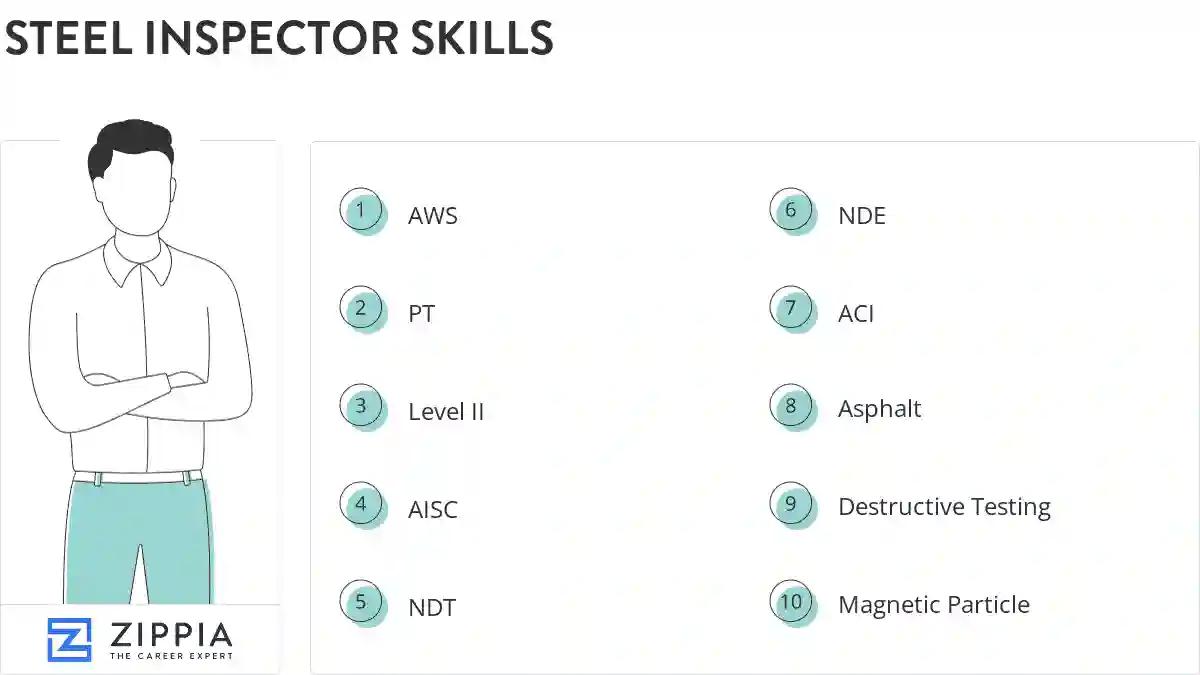
The most important skills for a steel inspector resume and required skills for a steel inspector to have include:
- AWS
- PT
- Level II
- AISC
- NDT
- NDE
- ACI
- Asphalt
- Destructive Testing
- Magnetic Particle
- ASNT
- Inspection Reports
- Structural Steel Inspection
- Non-Destructive
- RT
- Carbon Steel
Updated January 8, 2025
