
Automatically apply for jobs with Zippia
Upload your resume to get started.
Stitcher operator skills for your resume and career
15 stitcher operator skills for your resume and career
1. Machine Operation
- Manage a team between 2 and 7 people in machine operations * Conduct quality inspections during changeovers and throughout the evening.
- Machine Setter(Set-up) Machine Operator, Machine Repair/Maintenance, Machine Operation, Offline mailers.Back up Lead person.
2. Stitching
- Operated and Maintained Book Stitching Machine In Charge of between 3-6 other employees on line Electric Pallet Jack
- Set up and operator Polar guillotines and Muller Martini 335 Stitching equipment.
3. Collating
- Handle bindery orders that involve, folding, collating, stapling, gluing, cutting, and drilling.
- Fed covers, sheets and signatures in various machines for collating, stitching, trimming and perforating operations.
4. Magazines
- Set up and Operation of Saddle Stitch binding of magazines.
- Assembled Magazines Worked In Mailing-name and addressing pamphlets
5. MBO
- Set up and operate McCain & Muller E90 saddle stitchers, MBO folder, and Polar flatbed cutters
- Maintain operation of MBO folders, Polar Cutters, Muller and McCain stitchers
6. RAN
RAN stands for "revenue anticipation note," which refers to a practice where an organization (often the government) borrows money to support a specific project. When these funds are then repaid, the money given to the lenders comes from the profits generated by the business originally funded.
- Changed over, setup and ran a McCain 6 pocket stitcher and a Muller 6 pocket stitcher
- Performed quality control checks on all product ran on bindery machinery
Choose from 10+ customizable stitcher operator resume templates
Build a professional stitcher operator resume in minutes. Our AI resume writing assistant will guide you through every step of the process, and you can choose from 10+ resume templates to create your stitcher operator resume.7. USPS
- Followed USPS mailing regulations to ensure proper delivery.
- Handled shipping and receiving of all UPS and USPS mailings, including bulk mailings.
8. Quality Checks
Quality checks are a component of quality control aimed at ensuring that quality requirements are met. Internally, quality checks provide assurance to managers, and externally, it provides assurance to clients, federal departments, authorities, and certifiers.
- Maintain machine and make quality checks to see that everything is running properly and keep materials filled.
- Performed quality checks hourly to ensure quality standards are met.
9. Customer Orders
- Organize customer orders for shipping.
- Deliver customer orders to internal customer service department collaborate with colleagues to ensure appropriate fulfillment of customer order.
10. Quality Products
A quality product satisfies the client's intended need and matches the cost the consumer paid for it.
- Worked cooperatively with the Quality Assurance department to ensure the delivery of high quality products.
- Followed product specifications to complete quality products.
11. Customer Specifications
A Customer Specification is a document that describes the general requirement of an expected service from a contractor. It outlines the key requirements of the customer. Customer specifications should be written in simple and general language so that the contractor clearly understands the expectations of the customer. It is also known as a User Specification.
- Job set up according to customer specifications and equipment capabilities.
- Operated a stitcher machine Followed customer specifications to ensure quality product Gained various experience in warehouse/manufacturing practices
12. Competitive Rates
- Learn to use a serger machine on a daily basis while working at a competitive rate.
13. Product Samples
- Examined product samples for defects.
- Examined product samples for defects including imperfect bindings, ink spots, torn or loose pages and loose and uncut threads.
14. Stackers
- Managed mail heads, stackers and print pockets and trained crew members on same.
- Set up and maintained various catalog binding machine equipment including trimmers, stackers, inkjet equipment and bundling machines.
15. Troubleshoot
Troubleshooting is the process of analyzing and fixing any kind of problem in a system or a machine. Troubleshooting is the detailed yet quick search in the system for the main source of an issue and solving it.
- Run, maintain, troubleshoot, and operate a collator, shrink wrapping, paper cutting, and a folding machine.
- Run daily Manifest reports, generate orders via satellite, troubleshoot problems electronically and mechanically on the assembly line.
5 Stitcher Operator resume examples
Build a professional stitcher operator resume in minutes. Browse through our resume examples to identify the best way to word your resume. Then choose from 5+ resume templates to create your stitcher operator resume.

What skills help Stitcher Operators find jobs?
Tell us what job you are looking for, we’ll show you what skills employers want.
List of stitcher operator skills to add to your resume
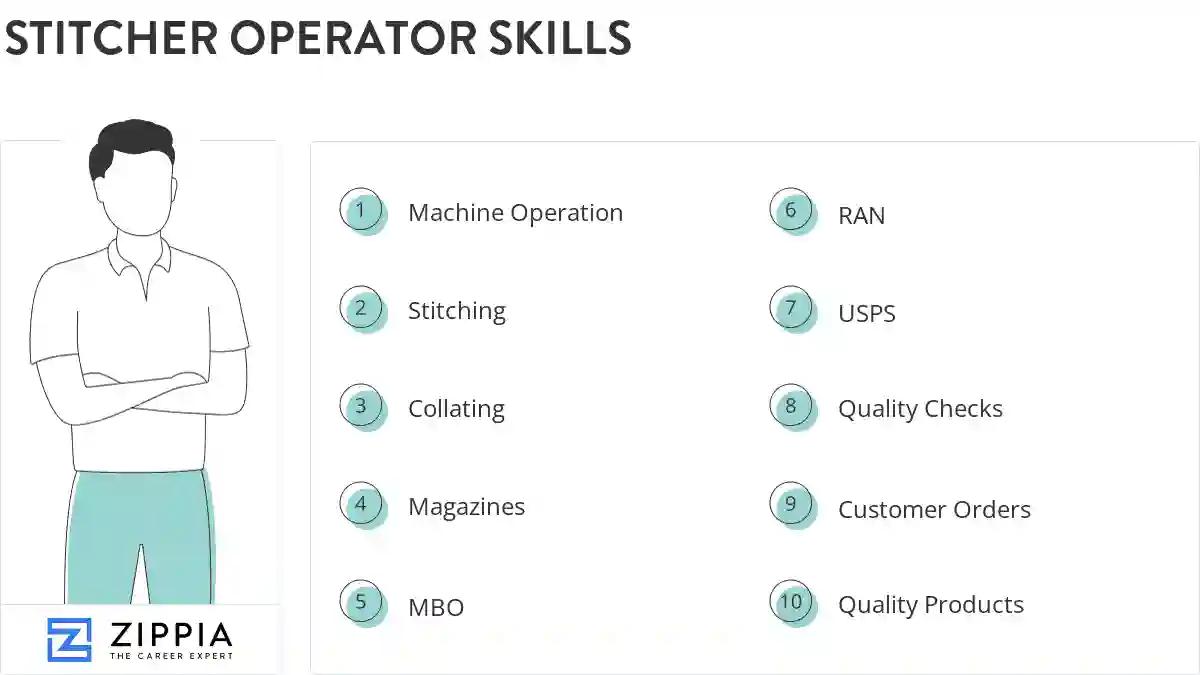
The most important skills for a stitcher operator resume and required skills for a stitcher operator to have include:
- Machine Operation
- Stitching
- Collating
- Magazines
- MBO
- RAN
- USPS
- Quality Checks
- Customer Orders
- Quality Products
- Customer Specifications
- Competitive Rates
- Product Samples
- Stackers
- Troubleshoot
- Numerical Order
- Assembly Line
- EMC
Updated January 8, 2025
