
Automatically apply for jobs with Zippia
Upload your resume to get started.
Structural analysis engineer skills for your resume and career
15 structural analysis engineer skills for your resume and career
1. Structural Analysis
A structural analysis is a type of method or process determining the condition and situation of a particular structure. Engineers, architect and other related professional often use it to study and review the behavior, dynamics, issues, and failures encountered during a project. It is the key to engineering design structure that identifies the system's performance and integrity and its effect. The purpose of the analysis is to assess the stresses, deformations, acceleration, internal forces, and stability.
- Led a structural analysis team substantiating FAR Part 25 certification requirements for design modifications within a composite technology development program
- Performed finite element structural analysis in considering complex loading phenomena associated with major piping ruptures.
2. Analysis Tools
Analysis tools primarily help an aerodynamics engineer ensure facilities and equipment function efficiently and safely according to industry standards and safety regulations. An aerodynamics engineer is skilled at utilizing analysis tools to conduct research and analyses, test the design and structure of products, check the pressure and gauge levels of machines, and identify the strengths and weaknesses of different areas, developing strategies to improve the equipment.
- Used VBA to program several analysis tools to make tasks more efficient, reduce cost, and standardize the analysis.
- Used VBA to fix, rewrite, and update stress analysis tools to speed up analysis.
3. Structural Integrity
- Performed analysis in a variety of fields to provide customers with a verification of structural integrity.
- Reviewed analyzed and coordinated with Liaison Engineering to find functionality and structural integrity of parts.
4. Test Results
- Defined and documented certification and test results to substantiate for customers and regulatory agencies that requirements were satisfied.
- Analyzed test results to verify accuracy of developed models.
5. Finite Element Analysis
Finite Element Analysis is a simulated or computerized method of predicting a product's reaction to real-world forces, such as heat, vibration, fluid flow and other physical effects. FEA runs a computer simulation to determine whether a product will effectively work, break, or wear out based on the way it's designed. Developers can test the efficiency or durability of a product through FEA before going into mass-production.
- Utilized hand calculations to develop thermal boundary conditions for finite element analysis of the global assembled rig.
- Employed finite element analysis, hand calculations and similarity for analysis and proposed design changes.
6. System Design
System design refers to the electronic structural component of a system.
- Developed, integrated, and documented structural requirements to establish the system design.
- Developed thermal control system designs for Space Shuttle propulsion and power subsystems.
Choose from 10+ customizable structural analysis engineer resume templates
Build a professional structural analysis engineer resume in minutes. Our AI resume writing assistant will guide you through every step of the process, and you can choose from 10+ resume templates to create your structural analysis engineer resume.7. Product Design
Product design can be described as a process of imagining, creating, and iterating products that solve user's problems and talk about the specific needs of users in the market. Product design is an engineering disciple and it is the basic design and idea that goes before the mass production of the product.
- Analyzed and simulated drive axle components, improved new product design and modified existing product to meet customer requirements.
- Improved product design, reduced cost of prototype and time of testing by simulating lab fixture tests.
8. Finite Element Models
- Created and analyzed finite element models under both kinematic and dynamic conditions.
- Developed finite element models to generate interface loads for interiors structures.
9. Python
Python is a widely-known programming language. It is an object-oriented and all-purpose, coding language that can be used for software development as well as web development.
- IMPACT: Developed several Python scripts to greatly increase the productivity and insure the checking results.
- Developed scripts and Tools using ABAQUS/Cae, Python and MS-Excel.
10. MATLAB
- Explored a mathematical model to predict power loss for horizontal axis wind turbine with MATLAB.
- Performed structural reliability analysis of simple truss structure in fire effect using MATLAB.
11. Abaqus
- Performed nonlinear analysis using NASTRAN and ABAQUS to determine permanent Deformations and residual strains and develop guidelines for the same.
- Design and Analysis of assembly tooling and support structure using SolidWorks and ABAQUS.
12. Stress Analysis
- Performed static/dynamic stress analysis of metallic structures, including linear and non-linear analysis using ANSYS to ensure structure safety.
- Performed stress analysis for structural substantiation of 787 aircraft interior commodities including fairings, closets and secondary structures.
13. Airframe
Airframes are a type of mechanical structure used for an aircraft. This part usually consists of the wings, tail assembly, fuselage, undercarriage, and landing gear. It has a monolithic component in it that has ribs, frames, stringers, bulkheads and others. The Airframe is created, designed, and used to endure all the air force every time the aircraft takes off. It helps withstand the aerodynamics as well the pressure of the payload, crew, and the fuel.
- Support Thermoplastic Welding Project and Test Matrix development Support Composite Airframe Life Extension - Durability Program
- Coordinated with design and manufacturing engineers to optimize the airframe design of the JSF concept demonstration and existing F-16 aircraft.
14. CAD
- Support Both CAD and Stress Monthly working group meetings to contribute to department standards practices.
- Modified NX CAD models to study redesign and optimization opportunities.
15. Ansys
Ansys is a company that offers software that facilitates engineering simulation for product design, service and quality tests, and system development.
- Imported the model to perform simulation in ANSYS to procure the optimum design of a typical high mach air-frame structure.
- Performed three dimensional finite element STRESS and DYNAMICS analysis of nuclear reactors using ANSYS and other in-house computer programs.
5 Structural Analysis Engineer resume examples
Build a professional structural analysis engineer resume in minutes. Browse through our resume examples to identify the best way to word your resume. Then choose from 5+ resume templates to create your structural analysis engineer resume.

What skills help Structural Analysis Engineers find jobs?
Tell us what job you are looking for, we’ll show you what skills employers want.
What skills stand out on structural analysis engineer resumes?
Marco Salviato Ph.D.
Assistant Professor in Aeronautics & Astronautics, Adjunct Assistant Professor in Materials Science and Engineering, University of Washington
My advice to students to nurture these skills is to engage as early as possible with student clubs such as UW Design Build Fly (DBF) or SARP (Society for Advanced Rocket Propulsion). Another good idea is to get involved as soon as possible in research activities conducted by faculty in the Department. Finally, I cannot stress enough the importance of participating in summer internships at aerospace companies. For all these activities to be relevant, it is important to make sure there are tangible outcomes and the contribution of the student is evident. A sentence such as, "I worked in a team of twenty people to design a new concept of bracket for an aerospace hydraulic fuel system. I was the leader of a team of five people in charge of the structural design. Leveraging Finite Element Analysis we were able to reduce the weight of the bracket of more than 50 percent compared to legacy design. In addition to the FEM simulations, my responsibilities included organizing weekly meetings with the team to discuss progress, deliverables, and timeline, presenting the results to the company, and writing monthly scientific reports" really stands out in a resume. All the industrial partners I work with told me that having these experiences with tangible outcomes in the resume is one of the key deciding factors for a new hire.
What structural analysis engineer skills would you recommend for someone trying to advance their career?
Saeed Khan
Professor of Engineering Technology, Website
List of structural analysis engineer skills to add to your resume
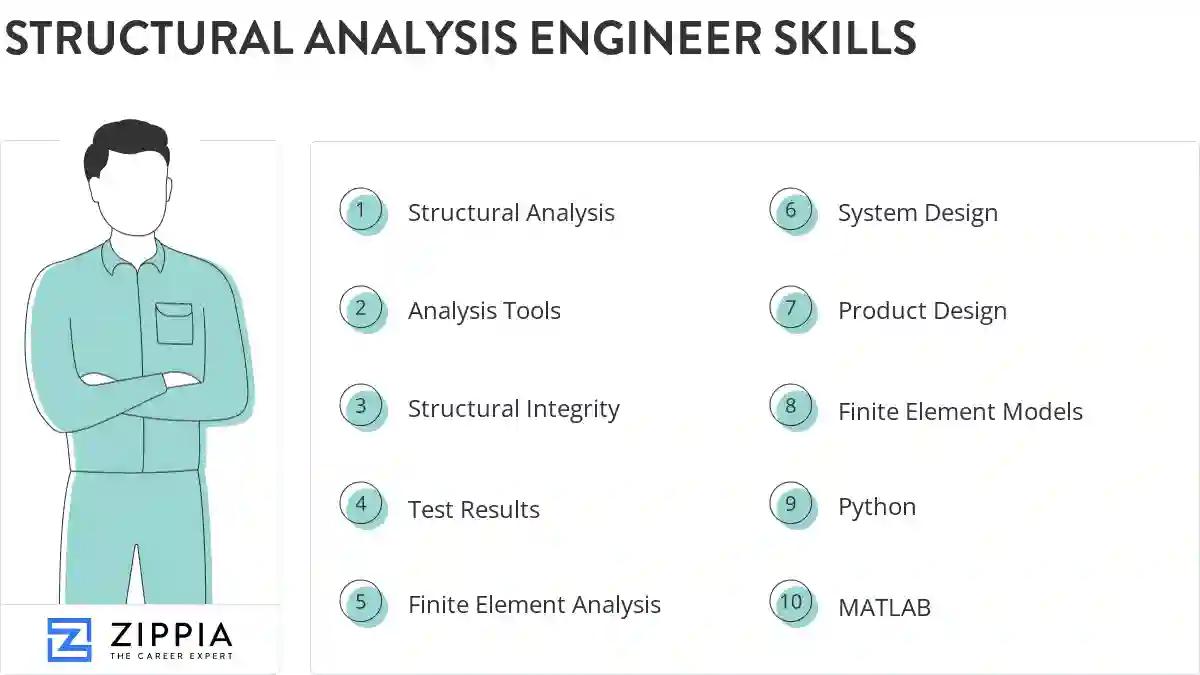
The most important skills for a structural analysis engineer resume and required skills for a structural analysis engineer to have include:
- Structural Analysis
- Analysis Tools
- Structural Integrity
- Test Results
- Finite Element Analysis
- System Design
- Product Design
- Finite Element Models
- Python
- MATLAB
- Abaqus
- Stress Analysis
- Airframe
- CAD
- Ansys
- Structural Design
- Static Analysis
- FEMAP
- PowerPoint
- Fatigue Analysis
- Data Analysis
- Calculation
- Hypermesh
- VBA
- Analysis Results
- Structural Components
- Design Reviews
- Damage Tolerance Analysis
- Dynamic Analysis
- Composite Materials
- Emerging Technologies
- Thermal Analysis
- Fortran
- FE
- NASA
- Solidworks
- Test Data
- Nastran
- Patran
- CAE
- Internal Loads
- Catia V5
- FAA
- Java
- Trade Studies
- Failure Analysis
- Post Processing
- Technical Reports
Updated January 8, 2025
