
Automatically apply for jobs with Zippia
Upload your resume to get started.
Structures engineer skills for your resume and career
15 structures engineer skills for your resume and career
1. Structural Analysis
A structural analysis is a type of method or process determining the condition and situation of a particular structure. Engineers, architect and other related professional often use it to study and review the behavior, dynamics, issues, and failures encountered during a project. It is the key to engineering design structure that identifies the system's performance and integrity and its effect. The purpose of the analysis is to assess the stresses, deformations, acceleration, internal forces, and stability.
- Performed structural analysis on models to study static and dynamic effect of aerodynamic loads on parts and determine optimal design configurations.
- Performed structural analysis and design of buildings, bridges and marine structures and prepared construction documents and technical specifications.
2. Revit
Revit, also known as Autodesk Revit, is computer software used by architects, structural engineers, and designers to perform building modeling tasks. Revit was designed to facilitate users, draw building modeling structures in a 2D and 3D format. Creating such models allows architects and engineers to pre-planning, scheduling, estimating the life of the structure and the entire cost of construction.
- Performed detail structural drawings, layouts, and specification using Auto-CAD and REVIT
- Plotted Design drawings on AUTOCAD and REVIT.
3. RISA
- Designed a 40 foot pedestrian bridge, steel stairs and seismic bolts for computer equipment including calculations and drawings using RISA.
- Run dynamic analysis on buildings components for seismic qualification according to Unified Facilities Criteria (UFC) using RISA 3D.
4. CAD
- Designed and implemented different aircraft interior seating configuration on regular basis using CAD tools including cost estimates for wet lease.
- Modified CAD drawings of seat layout and emergency equipment distribution as required by local and international authorities.
5. ACI
American Concrete Institute (ACI) is an institution known for its consensus-based standards, educational, technical, and training programs, certification programs, and adept individuals involved in construction in choosing quality materials to pursue the best use of concrete. ACI publishes more than 400 standards that can be used in the manufacturing, maintenance of concrete in different usage. These standards also determine systems or methods for inspection, test, and building code requirements. With ACI, the standards ensure the product reliability, adoption of new uses, and improved up keeping.
- Prepared calculation and reviewed drawings which provided modifications for the concrete building to meet ACI and building code requirements.
- Designed and analyzed highway bridge structures using AASHTO, ASTM, AISC Steel Manual, and ACI design specifications.
6. Engineering Design
Engineering design is defined as the method that engineers use to recognize and solve problems. It is an extensive and flexible approach to problem-solving and provides the necessary information needed regarding every step of the process. An engineering design is a collaborative effort of the team to identify problems underlying a process and find out ways to solve them.
- Review engineering design packages required to support projects in accordance with applicable federal, state and local codes and regulatory requirements.
- Executed application of value-engineering concepts to increase overall project cost effectiveness and improved engineering design efficiency.
Choose from 10+ customizable structures engineer resume templates
Build a professional structures engineer resume in minutes. Our AI resume writing assistant will guide you through every step of the process, and you can choose from 10+ resume templates to create your structures engineer resume.7. Masonry
Masonry refers to stonework, which can be a fairly simplistic process or one far more complex. Simple masonry work may involve brick laying, delivering stone for a pathway or wall, or smoothing out the brick mortar. More complicated masonry work would involve scaffolding or other elevated construction.
- Instituted an innovative method in testing seismic resistance of masonry bearing walls that improved efficiency and accuracy of the assessment.
- Field services included probing and inspecting deteriorated brick and limestone masonry exteriors to identify underlying causes for the deterioration.
8. Project Management
- Project Management responsibilities included developing schedules, budgets, organizing work effort and tracking team performance.
- Provided guidance and recommendations to project management concerning the project's structural requirements.
9. ASCE
- Recommended retrofitting consisted in replacing existing gypsum shear wall to 1.2 in plywood in accordance with ASCE 41-13 and IBC 2015
- Computer-aided seismic analysis and design using ASCE 7 equivalent lateral force, response spectra and time history methods.
10. AISC
- Performed quantitative analysis and provided engineering judgment for appropriate AISC steel member substitution.
- Design was primarily done per the requirements of AISC 9th edition for combined axial loads and bending loads where appropriate.
11. Finite Element Analysis
Finite Element Analysis is a simulated or computerized method of predicting a product's reaction to real-world forces, such as heat, vibration, fluid flow and other physical effects. FEA runs a computer simulation to determine whether a product will effectively work, break, or wear out based on the way it's designed. Developers can test the efficiency or durability of a product through FEA before going into mass-production.
- Detail and assembly level stress analyses utilizing classical and finite element analysis techniques on a variety of metal and composite structures.
- Performed 3D Finite Element Analysis with maximum design operation loads and determined collapsed vacuum loads by elastic-plastic failure model analysis.
12. Design Software
Design software is used to create, edit, and display various types of graphics and images, including but not limited to photography, 3D design, and the website interface. It enables users to create a wide variety of visual files and offers various tools and functions to enhance the user's artistic skills and techniques. Some features include design, image editing, and digital illustration. Design software might also reference the actual act of creating a piece of software or application with a larger business or product goal in mind.
- Developed construction documents and technical specifications using AASHTO and bridge design software.
- Collected and reviewed data from existing drawings to form a 3D model for existing and new structures using RISA-3D design software.
13. MathCAD
- Set up a MathCAD program to calculate the load diagram for Projects Louisa and Plum Point.
- Prepared new templates in MathCAD for engineers to use such as anchor bolts and weld design.
14. Rehabilitation
- Designed repair procedures for structures under distress or to correct improper construction, and provided structural design associated with rehabilitation.
- Consult and provide complete structural design and guidance for rehabilitation and retrofit of existing buildings.
15. IBC
- Performed dynamic analysis & seismic design of under- & above-ground structures based on IBC standards and local building codes.
- Worked with composite beams, snow loads, personnel tie-offs, 1-way concrete slabs and IBC building code.
5 Structures Engineer resume examples
Build a professional structures engineer resume in minutes. Browse through our resume examples to identify the best way to word your resume. Then choose from 5+ resume templates to create your structures engineer resume.

What skills help Structures Engineers find jobs?
Tell us what job you are looking for, we’ll show you what skills employers want.
What skills stand out on structures engineer resumes?
Sherif Ishak Ph.D.
Professor and Department Chair, Old Dominion University
What structures engineer skills would you recommend for someone trying to advance their career?
Esber Andiroglu PhD, PE, LEED AP
Associate Professor of Practice, Dept. of Civil & Architectural Engineering, Director of Construction Management Programs, University of Miami
What type of skills will young structures engineers need?
Nick Hudyma PhD PE
Professor and Chair, Boise State University
In my opinion, visualization skills will begin to become very important. I can envision a coupled work environment, having technical analyses and designs working behind the scenes with visualizations being presented to clients. Civil engineers will need to present their work, not using traditional 2D blueprints and plan sets, but using 3D and 4D visualizations, which will include either virtual reality or augmented reality. This is especially important as our designs become more complex, and we continue in-fill development in dense urban areas.
What technical skills for a structures engineer stand out to employers?
Norb Delatte Ph.D.
M.R. Lohmann Endowed Professor of Engineering and Head, Oklahoma State University
What soft skills should all structures engineers possess?
James Albrecht
Professor of Criminal Justice and Homeland Security, retired NYPD Captain/Commanding Officer, Pace University
List of structures engineer skills to add to your resume
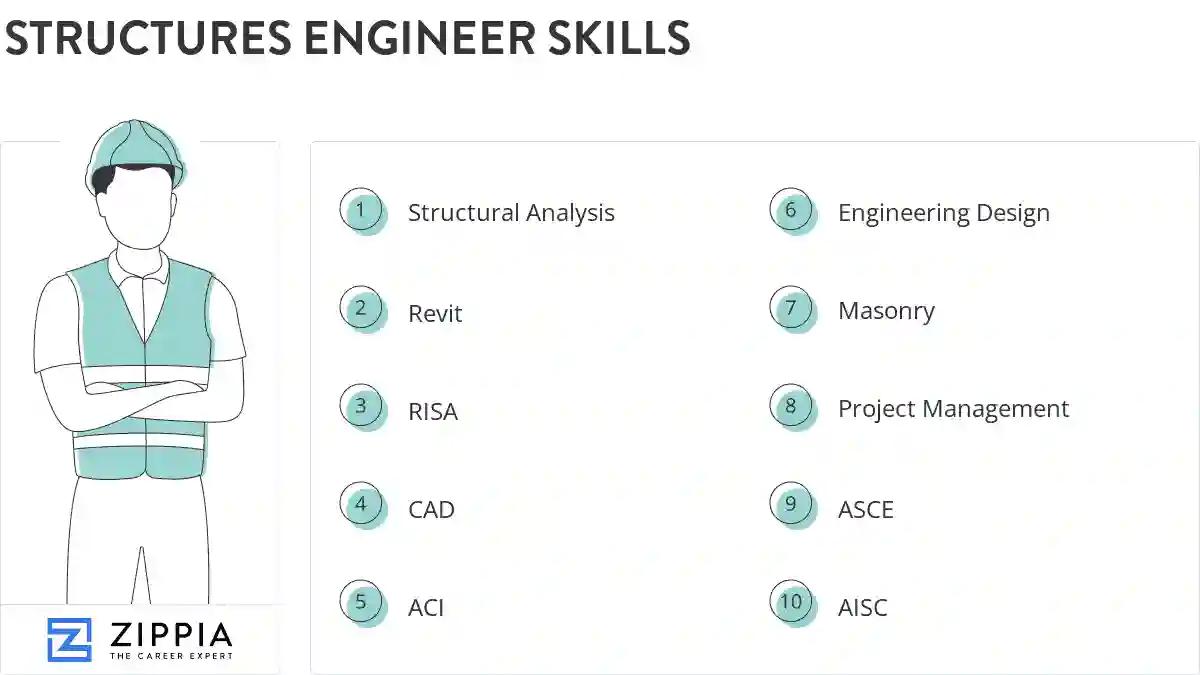
The most important skills for a structures engineer resume and required skills for a structures engineer to have include:
- Structural Analysis
- Revit
- RISA
- CAD
- ACI
- Engineering Design
- Masonry
- Project Management
- ASCE
- AISC
- Finite Element Analysis
- Design Software
- MathCAD
- Rehabilitation
- IBC
- Structural Systems
- Cost Estimates
- Ansys
- Reinforced Concrete
- Calculation
- Construction Drawings
- Stress Analysis
- Nastran
- Steel Structures
- Steel Design
- Design Criteria
- Technical Reports
- Solidworks
- MATLAB
- Design Drawings
- Hand Calculations
- Retaining Walls
- SAP2000
- Construction Administration
- Structural Integrity
- AASHTO
- Abaqus
- Concrete Structures
- Oil Gas
- Staad Pro
- Ladders
- Structural Components
- Geotechnical
- Foundation Design
- Retrofit
- Commercial Buildings
- Technical Support
- Engineering Drawings
- FAA
Updated January 8, 2025
