Explore jobs
Find specific jobs
Explore careers
Explore professions
Best companies
Explore companies
Job outlook for student services coordinators in the United States
Student services coordinator job growth summary. After extensive research, interviews, and analysis, Zippia's data science team found that:
The projected student services coordinator job growth rate is 10% from 2018-2028.
About 32,400 new jobs for student services coordinators are projected over the next decade.
Student services coordinator salaries have increased 7% for student services coordinators in the last 5 years.
There are over 9,510 student services coordinators currently employed in the United States.
There are 94,242 active student services coordinator job openings in the US.
The average student services coordinator salary is $41,385.
Are student services coordinator jobs in demand?
Student services coordinator job and salary trends over time
Student services coordinator jobs over time
Student services coordinator job growth rate over time
| Year | # of jobs | % of population |
|---|---|---|
| 2021 | 9,510 | 0.00% |
| 2020 | 9,377 | 0.00% |
| 2019 | 9,513 | 0.00% |
| 2018 | 9,160 | 0.00% |
| 2017 | 8,707 | 0.00% |
Average student services coordinator salary over time
Student services coordinator salary by year
| Year | Avg. salary | Hourly rate | % Change |
|---|---|---|---|
| 2026 | $41,385 | $19.90 | +1.9% |
| 2025 | $40,616 | $19.53 | +1.3% |
| 2024 | $40,096 | $19.28 | +1.6% |
| 2023 | $39,455 | $18.97 | +1.6% |
| 2022 | $38,850 | $18.68 | +1.7% |
Student services coordinator jobs by state
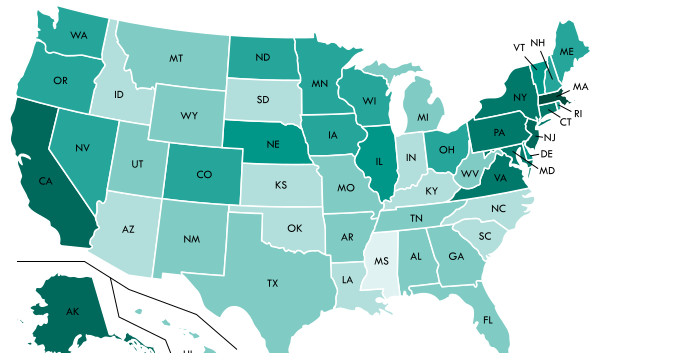
Most common states for student services coordinators
| Rank | State | Population | # of jobs | Employment/ 1000ppl |
|---|---|---|---|---|
| 1 | District of Columbia | 693,972 | 278 | 40% |
| 2 | Delaware | 961,939 | 289 | 30% |
| 3 | North Dakota | 755,393 | 196 | 26% |
| 4 | Maine | 1,335,907 | 329 | 25% |
| 5 | Alaska | 739,795 | 183 | 25% |
| 6 | Minnesota | 5,576,606 | 1,257 | 23% |
| 7 | Iowa | 3,145,711 | 734 | 23% |
| 8 | Massachusetts | 6,859,819 | 1,525 | 22% |
| 9 | Idaho | 1,716,943 | 381 | 22% |
| 10 | West Virginia | 1,815,857 | 375 | 21% |
| 11 | South Dakota | 869,666 | 184 | 21% |
| 12 | New Mexico | 2,088,070 | 423 | 20% |
| 13 | Vermont | 623,657 | 112 | 18% |
| 14 | Wyoming | 579,315 | 102 | 18% |
| 15 | Washington | 7,405,743 | 1,157 | 16% |
| 16 | Alabama | 4,874,747 | 800 | 16% |
| 17 | Montana | 1,050,493 | 164 | 16% |
| 18 | Virginia | 8,470,020 | 1,261 | 15% |
| 19 | Nebraska | 1,920,076 | 291 | 15% |
| 20 | Rhode Island | 1,059,639 | 158 | 15% |
Most common cities for student services coordinators
| Rank | City | # of jobs | Employment/ 1000ppl | Avg. salary |
|---|---|---|---|---|
| 1 | Kenosha | 2 | 2% | $41,507 |
| 2 | Alexandria | 1 | 2% | $35,092 |
| 3 | Bowling Green | 1 | 2% | $31,850 |
| 4 | Fort Wayne | 2 | 1% | $34,431 |
| 5 | Metairie | 2 | 1% | $35,128 |
| 6 | Cambridge | 1 | 1% | $60,163 |
| 7 | Flagstaff | 1 | 1% | $32,633 |
| 8 | Lafayette | 1 | 1% | $35,233 |
| 9 | Lakewood | 1 | 1% | $52,120 |
| 10 | Provo | 1 | 1% | $35,532 |
| 11 | Santa Monica | 1 | 1% | $52,365 |
| 12 | Boston | 2 | 0% | $60,187 |
| 13 | Indianapolis | 2 | 0% | $32,591 |
| 14 | Baltimore | 1 | 0% | $51,992 |
| 15 | Chicago | 1 | 0% | $45,584 |
| 16 | New York | 1 | 0% | $49,134 |
Student Services Coordinator job outlook: Expert opinions
Our panel of student services coordinator experts
Angelo State University
University of Houston - Clear Lake

Beloit College
Lake Superior State University
California State University - Los Angeles

High Point University

Brigham Young University

Humboldt State University

Monmouth University
Butler University
Lycoming College
Southern Methodist University

University of Wisconsin - Madison
.jpg)
Montana State University

Rutgers School of Public Health
University of Arkansas
Colorado State University
Emory University School of Law
Florida International University

University of Arkansas
Jeremy St. John
Associate Professor of Management Information Systems and Department Chair of Accounting, Economics, and FinanceAngelo State University
Accounting And Related Services
What Student Services Coordinator skills would you recommend for someone trying to advance their career?
Jeremy St. John: I think reliability has become one of the most sought-after skills. Showing up on time and having a good work ethic are highly sought after skills. More and more I am hearing from my students that the employers want them to be able to use AI at work. Students able to work with AI are telling me things like "my boss says I am the most productive employee, and it is because I use AI to help me do the work." If the ability to work with AI can make you the most productive employee in the eyes of your employer, that is an important skill to have. Technical skills should continue to be in demand. People-skills, critical thinking, and systems thinking are already in demand and I think they will grow in importance simply because they complement AI.
Antonio Corrales
Doctoral Program Coordinator and Associate Professor of Educational LeadershipUniversity of Houston - Clear Lake
College of Education
What skills stand out on Student Services Coordinator resumes?
Antonio Corrales: Educational adviser resumes need to focus on skills transferable to students. Specifically, aspects that can be transferable and relatable to student success. For example, advising, admissions, registration, testing center, student orientation, student activities, recreational sports, ability services, veterans, students with disabilities, grants, financial aid, and student discipline.
What soft skills should all Student Services Coordinators possess?
Antonio Corrales: It is critical to show for how long one has served as a student advisor in one way or another. Also, it is important to show how many students one has advised, which academic programs, what degree plans, and the level of success within that advising.
What hard/technical skills are most important for Student Services Coordinators?
Antonio Corrales: Understanding state and federal requirements, specific degree plans, credits validations, transfers, and financial aid requirements.
What skills will help Student Services Coordinators earn the most?
Antonio Corrales: Showing the capacity and experience to work with students and move them forwards with their careers.
Jingjing Lou Ph.D.
Chair and Associate ProfessorBeloit College
Department of Education & Youth Studies
What skills stand out on Student Services Coordinator resumes?
Jingjing Lou Ph.D.: Apart from other common skills and characters you often see in education majors, our graduates from the education program stand out from other education graduates because they are trained to think interdisciplinarily and internationally. Specifically, our graduates learn different perspectives about teaching, learning, youth, and society from international and interdisciplinary perspectives. They have an in-depth understanding of social justice in different cultural contexts concerning different social groups -elite or marginalized, urban or rural, majority or minority. Some of the institutional learning outcomes of Beloit College are listed below, and these are all soft skills our graduates are proud to be equipped with and help them to be successful candidates of the positions they are applying for in teaching or other jobs in the broad field of education studies, including but not limited to education policy, counseling, school psychology, social work, international education, etc. We even have education graduates working for Facebook.
What soft skills should all Student Services Coordinators possess?
Jingjing Lou Ph.D.: 1) Productive Collaboration
2) Effective Communication
3) Creative Problem Solving
4) Intellectual and Professional Agility
What hard/technical skills are most important for Student Services Coordinators?
Jingjing Lou Ph.D.: To go along with these soft skills, our students master hard skills such as communications (writings and presentations), quantitative thinking (a requirement for all requirements), and intercultural literacy (understanding and working with people from different contexts).
Dr. Sally Childs
Faculty/Advisor Parks and Recreation DegreeLake Superior State University
Exercise & Sport Science departmen
What will help Student Services Coordinators increase their earning potential?
Dr. Sally Childs: As with most professional fields, parks and recreation and outdoor recreation providers seek potential employees with a strong history of experience in the precise area they are hiring for. Fortunately, this is an industry that actually seeks out a young, enthusiastic, and relatively unskilled labor force for many of the entry level positions. An interested and dedicated individual can start working in a variety of outdoor recreation settings while they are still in high school. That seasonal work can continue through college, and by the time that person completes their college degree, they will not only have the academic credentials, but they will also have acquired a strong resume of job/career related experience and possibly, a history of agency affiliation. This period of time, as a student is matriculating through their college degree, becomes the time for the prospective professional to experiment and engage in self study. The parks and recreation/outdoor recreation spectrum is so expansive and diverse that it may take several different seasonal placements, working in a variety of areas of responsibility, in order to discover the best fit for the "perfect" career.
What soft skills should all Student Services Coordinators possess?
Dr. Sally Childs: Some of the most essential skills that will be necessary for professionals in this field to be successful are frequently identified as "soft skills." These skills are often difficult to quantify. Regardless of the setting, professionals working in this field need to be very comfortable working with all people of all ages and abilities. Communication skills are essential; active listening, patience, tolerance, and being able to present a non-threatening, non-judgemental demeanor has a strong positive impact on being able to successfully respond to visitor/client needs and wants. Problem solving is essential. Being task oriented but concurrently, being able to easily deviate from routine is important. Professionals in this field frequently need to make decisions without having immediate access to supervisors. These people need to be very aware of agency goals, policies and protocols and be confident in their ability to independently represent these through their behavior and the behavior that they encourage/enforce in others. The "hard skills" that are required will depend in part on the particular job/agency/setting. Computer and IT skills will be essential for everyone, although there certainly will be a fair amount of latitude regarding the degree of expertise required. Basic construction skills; plumbing, framing, concrete, and electrical will be an asset for anyone working in a park or an area that has been even moderately developed for outdoor recreation purposes. Mechanical skills, everything from small engine repair all the way to vehicle upkeep and maintenance will also be a skill set which is in demand. A basic understanding of the requirements for maintaining a healthy resource base; forestry, watersheds, ecosystems, wildlife habitat, will also be necessary for professionals managing everything from campgrounds to wilderness areas. Many Parks have a strong historical and or cultural component. Facilitation and Interpretation skills will be needed if the professional chooses this portion of the Parks and Recreation continuum. If the professional is intent on becoming an instructor or guide, then whatever technical skills are associated with "best practices" in that particular activity will be essential. It is also likely that they would be expected to be credentialed in Wilderness First Aid, and other backcountry "survival and safety" skills. Law enforcement skills are also in demand in parks and recreation settings.
How have salaries changed over time for Student Services Coordinators?
Dr. Ambika Raj Ph.D.: Unfortunately, salaries have not changed significantly at all. The pandemic has made all teachers/professors and instructors jobs triple - but the compensation is about the same. In fact, I would say many of the schools furloughed their teachers.
What are the biggest trends we'll see in the Student Services Coordinator job market given the pandemic?
Dr. Ambika Raj Ph.D.: Given the pandemic, the biggest trend we are seeing in the job market for the field of curriculum and instruction is the need for qualified teachers who are comfortable teaching on an online platform. Last May, some colleges and universities included technology training such as a ACUE micro-credential in online teaching, promoting engaged and active online learning etc. These are nationally accredited credentials. And teachers/students who have taken these are at a definite advantage.
Another trend that we are seeing - everyone who has a computer and computer skills are offering classes of one sort or the other - they realize they can set up "office" simply by opening their computer. I know of at least a few teenagers who have done this with great success. High school seniors offering to teach/coach younger students, dance, music, theater, PE teachers having a side business teaching classes in the weekends online.
Currently, LAUSD in looking for qualified substitute teachers because schools have opened up in the larger LA area and only a few students can attend at a time. So in order to manage the days and not burnout teachers, many substitute teachers are being hired.
What certifications/licenses/courses can have the biggest impact for Student Services Coordinators?
Dr. Ambika Raj Ph.D.: Certainly certifications that say that you have an online credential have the most impact. Our College has a wonderful online teaching program that they offer to students. Last summer we saw a rise in the number of applicants who wanted to become teachers - both in the credential as well as bachelors/masters programs.
William (Bill) Gentry Ph.D.
Assistant Vice PresidentHigh Point University
Career and Professional Development
What will help Student Services Coordinators increase their earning potential?
William (Bill) Gentry Ph.D.: Philosophy majors are employable in a variety of fields such as education, law, ethics, business, religious-affiliated areas, community services, government, and communications to name a few. A 538 article in 2015 showed that philosophy majors have the fourth-highest median earnings for those with only undergraduate degrees. The Winter 2020 National Association of Colleges and Employers (NACE) salary survey indicated philosophy majors have the highest mean and median salary across all humanities majors and is comparable to other majors as well. To increase their earning potential, we encourage our students to focus on life skills that can separate themselves from all the others who are applying to the job. How can you showcase pertinent life skills that philosophy majors are known for - such as resiliency, the flexibility and capacity for growth, analytical, organizational and research skills like idea generation, problem formulation and problem solving, persuasion, and communication skills - on your brand documents like your resume, cover letter, LinkedIn, or in interviews? Specifically, how can you display that you have learned and developed those skills inside and outside the classroom in strong bullet points on your resume or in your cover letter? How can you clearly articulate how you've displayed or enhanced those skills through your classwork, internships, jobs, volunteer work, or other experiences in answering interview questions like "Tell me about yourself" or "What are your strengths?" or "Tell me about a time you had to influence others?" A GPA will likely get your foot in the door, but the ability to demonstrate these important like skills on paper, online, and in person in networking and interviewing will show others that you will be successful not just on day one of the job, but be seen as a high potential in your fist year, five years, and beyond.
What soft skills should all Student Services Coordinators possess?
Dr. Stephen Duncan Ph.D.: Graduates should know how to get along collaboratively, having strong interpersonal skills, empathy for others' circumstances. In the School of Family Life, we not only stress thinking, writing, and numeracy skills and data organization, but interpersonal skills of clear speaking and listening, engaging with others, and working collaboratively on a team.
How have salaries changed over time for Student Services Coordinators?
Dr. Stephen Duncan Ph.D.: The human sciences continue to be at the lower salary ranges of professional positions. Never will they rival our friends in engineering and other technical fields. Starting salaries at the bachelor's level are similar to elementary and secondary school teachers, and have followed their pattern over a number of years.
Loren Collins
Faculty support Coordinator for Service Learning and Career EducationHumboldt State University
Academic and Career Advising Center
What are the biggest trends we'll see in the Student Services Coordinator job market given the pandemic?
Loren Collins: Service sector, hospitality, and travel have been and will continue to be impacted negatively but we will see a huge boom in employment and growth coming at the end of the pandemic. People will trend back into higher education as we begin coming out of the pandemic and when more face-to-face opportunities are available at universities and community colleges. Typically in a recession this happens earlier, but the nature of the pandemic has probably delayed this effect.
As we exit the pandemic, I believe federal and state programs will focus on increasing the number of people entering all sorts of trades, leveraging the end of the pandemic and work programs to close an increasing gap in the number of people in the trades. Meaning a boom in logistics, management, and project management related jobs as well lots of focus on sustainability.
What's a day at work look like for a Student Services Coordinator?
William Hill: That's hard to say because different jobs will have different requirements both now and post-COVID. Some jobs, like sales,will probably revert to more in-person activities, while other may be able to remain mostly or partially remote. Yes, a typical day might mean working from home more often than in the past. Technology, especially AI, will become a large influence. I suspect more professional/office jobs will evolve in to a hybrid model, with some in-person activity blended with remote.
What soft skills should all Student Services Coordinators possess?
William Hill: Problem solving skills are essential in the workplace for new grads, especially now. They will find it increasingly difficult to engage more experienced co-workers for helpful problem solving advice in a virtual workspace. You can't just stroll over to someone's office for a quick chat anymore. They will be more often "on their own" when it comes to analyzing a challenge and crafting a solution. Verbal and written communication skills remain important in a workspace dominated by Zoom and email.
Julie Schrader
Sr. Associate DirectorButler University
Career and Professional Success
What's a good job out of college for Student Services Coordinators?
Julie Schrader: I don't define a job as "good" only if it matches a student's area of study. It is great if it does, but to me the definition of "good job" is that the individual is fulfilled and utilizing skills, strengths, and interests and the position matches their value set. A good job can be one that also provides some sense of financial stability. The hope is that during college, students are exploring and discovering various career paths and participating in experiential learning such as internships, co-ops, rotations, case studies, informational interviews, and more. As they learn more about potential career paths, they can start to narrow what they think they would enjoy. I believe that a good job out of college includes an opportunity to be mentored and supported, provides the opportunity for growth and training, and engages the individual's strengths and abilities to make a positive impact. I think of an example of a young graduate with a Finance degree who started in an entry-level finance role. He liked the position and the people, but wasn't sure he wanted to stay with the organization when he was offered a promotion to a sales role. He said he was working in finance because that was his degree and he thought that is what he should be doing. But he longed to be active and outdoors, and reminisced about his time studying abroad in Australia and surfing. He saw a surf camp manager position in the country of Norway and was deciding if he should apply. I encouraged him to go for it. He did. And he got it. He has since returned to the states and in a sales role now, but has no regrets. To me, that was a good job because he followed his heart.
What skills stand out on Student Services Coordinator resumes?
Career Advisors of the CEAE : Applicants need to connect their skills and experience with what an employer is looking for. With that being said, flexibility, adaptability, and experience with various technology is increasingly important during a pandemic. Quantifiable achievements are always important as well as leadership, presentation/communication skills, and teamwork ability.
John Potter
Clinical Associate ProfessorSouthern Methodist University
Department of Dispute Resolution and Counseling
Will there be an enduring impact of the coronavirus pandemic on Student Services Coordinators?
John Potter: Indeed. Current students have experienced multiple ways of learning, which they would not necessarily experience otherwise. And this provides more skills and a broader understanding of the modalities to use to help others in the future.
How do you envision technology impacting Student Services Coordinators in the next 5 years?
John Potter: Faster. Disputes and conflicts will escalate more rapidly because of the speed of information. And, information can be gathered more quickly to help disputants engage more constructively and sooner. So, people who work in this field need to think faster and act quickly, and those needs will only increase with time and technology.
Will there be an increase or decrease in demand for Student Services Coordinators in the next 5 years?
Pamela Garcia-Rivera: I surely don't think there will be a decrease in demand for graduates, but the field of journalism has been evolving and changing and will continue to do so. There is a strong need for journalists, especially journalists who represent this country and are from diverse backgrounds, who can better share the stories and report on everyone's issues.
What are the biggest trends we'll see in the Student Services Coordinator job market given the pandemic?
Pamela Garcia-Rivera: Some of the trends that seem to be growing are the ability to work remotely, connect with people that we may not have been able to communicate with in-person (and do so virtually), and flexibility in one's work schedule. The pandemic has led to innovative ways of performing one's job function by using various technology forms and being more self-reliant. It also provides organizations an opportunity to think of ways of saving overhead costs - and operating at a lower budget. Freelance opportunities also seem to be growing as organizations' budgets may have been reduced, and hiring employees full-time may not be feasible.
Are there any particularly good places in the United States for Student Services Coordinators to find work opportunities?
Mariah Stopplecamp: Right now, we see companies in larger metropolitan areas being the hubs of employment for recent grads. These are the companies that are large enough to survive the fiscal challenges that COVID has provided. These larger metro areas are working remotely, currently, and are providing recent grads the flexibility to stay located where they are.
How do you envision technology impacting Student Services Coordinators in the next 5 years?
Mariah Stopplecamp: We have already seen a boom in the use of technology due to COVID. People are now proficient at virtual meetings, Zoom or WebEx, electronic signatures, and more efficient document storage and organization. In the future, hopefully, we will have a strong job force that can embrace and adapt to changes in technology. This allows industries and companies to positively grow and become more creative in their designs and problem-solving skills.
Claire Brown
Assistant Director of Student Support Services and Head of Career ServicesRutgers School of Public Health
Will there be an enduring impact of the coronavirus pandemic on Student Services Coordinators?
Claire Brown: Yes, in a myriad of ways. The most significant impact we see right now is employment opportunities and work availability across the board, but even as we inch back towards economic recovery, there are going to be long-lasting impacts in our day-to-day working lives. Norms and expectations around productivity, workplace social support and connection, work-life balance, family and sick leave, and occupational health and safety have and will continue to require transformational change, and this has important implications for personal and public health.
How do you envision technology impacting Student Services Coordinators in the next 5 years?
Claire Brown: As the COVID-19 pandemic has created a demand for innovative, effective, and secure technology-driven methods of conducting contact tracing, communicating health risks to the public, and staying in touch with each other personally and professionally, I think that we'll see a greater emphasis on how public health shapes technology and how technology shapes public health. The general public's awareness of and investment in the scope of public health has also increased, and with that, I think public health data visualization, integrity, accessibility, and transparency-all of which depend heavily on good technology-will become a professional priority for many working in the public health field.
How do you envision technology impacting Student Services Coordinators in the next 5 years?
Terri Dill Chadick: Zoom is here to stay. As a result, graduates are not limited by the geographic boundaries that existed pre-pandemic. Remote legal internships are becoming more common, and I expect that trend to continue. We are also seeing an increase in video interviewing, which makes it easier for graduates to pursue opportunities outside their current location. Similarly, virtual job fairs are commonplace this year, and I expect they will be in the future. The move to virtual will follow graduates as they enter practice, as judges are expected to continue virtual court proceedings in situations where it makes sense, long after the pandemic ends.
Will there be an enduring impact of the coronavirus pandemic on Student Services Coordinators?
Terri Dill Chadick: It's impossible to predict what the long-term impact of the pandemic will be, but I do not expect law graduates to be harder hit than other graduates.
Leanna Biddle
Career Education ManagerColorado State University
Career Center and Warner College of Natural Resources
Will there be an enduring impact of the coronavirus pandemic on Student Services Coordinators?
Leanna Biddle: Last March, with COVID-19 and the shift to virtual business and engagement, the economy was negatively impacted, shown by high unemployment rates and business closures. Though this was unforeseen for many, jobs in this field have started to recover. As a Career Education Manager, I have seen the following: employers actively attending and engaging in virtual career fairs, job opportunities available for graduates, and the advertisement of internship opportunities for current students, offered both in-person and virtually.
In the career world, the new word I use is pivoting, looking for different ways to stand out as a candidate. It may not be as simple as applying for opportunities - there are different strategies to consider: attending networking events offered at your institution and/or in the community, making connections with faculty and staff in the field, and leaning into engagement opportunities, whether that be nationwide with an organization, like the American Fisheries Society, or volunteering in your city.
We don't know what the lasting impact will be. The landscape is still changing by the day, with hiring fluctuations and changing employer needs. I do know that graduates are not alone in this process; many institutions offer career support for recent graduates and alum.
Natasha Pate
Senior DirectorEmory University School of Law
Center for Professional Development & Career Strategy
Will there be an enduring impact of the coronavirus pandemic on Student Services Coordinators?
Natasha Pate: Members of the class of 2020 have seen jobs postponed and bar exams delayed, in addition to suffering the health impact of the pandemic personally and on their loved ones. Moreover, the manner in how legal services provided to clients has also changed during the pandemic, with courts holding virtual hearings and M&A deals closing over secured software platforms. Some of these changes could become the new standard for the industry because they reduce the cost of delivering legal services to clients. This could negatively impact some entry-level legal positions.
Will there be an enduring impact of the coronavirus pandemic on Student Services Coordinators?
Katherine Martin: This epidemic will impact everyone in the future in ways we are not clear about yet. However, even though the pandemic has greatly affected the hospitality industry throughout the latter part of spring and through the summer, many companies and sectors within the hospitality industry have been recovering well and seeing an increase in guest reservations for the fall and upcoming winter. With that, our upcoming graduates should be able to find more opportunities in the hospitality industry as well in non-traditional hospitality companies that are seeking our students' guest service, creative problem solving, and leadership skills and experiences.
Are there any particularly good places in the United States for Student Services Coordinators to find work opportunities?
Donna Graham: Working for the University of Arkansas, I would be remiss if I did not respond with Northwest Arkansas as my answer. Agriculture is the largest industry in Arkansas, and the University of Arkansas is fortunate to have leading companies like Tyson Foods, Simmons Foods, and George's Inc. in our backyard.
How do you envision technology impacting Student Services Coordinators in the next 5 years?
Donna Graham: People commonly underestimate the sophistication of modern agriculture and the amount of technology involved. Faced with the challenge to feed a growing world population, a technology that improves sustainability, efficiency, and production is essential and widely used. While agricultural technology is often misunderstood, optimization software and other advances used in agriculture will make it possible to feed the world while remaining good stewards to our environment. I predict that this technology, which is part of the curriculum for many of our majors, will accelerate quickly in the next five years.