
Automatically apply for jobs with Zippia
Upload your resume to get started.
Study coordinator skills for your resume and career

15 study coordinator skills for your resume and career
1. Patients
- Coordinated and conducted pharmaceutical clinical research studies, working collaboratively with patients, pharmaceutical companies, institutional review boards and physicians.
- Educated patients on medical procedures and detailed requirements while organizing and coordinating medical research to bring new pharmaceuticals to market.
2. Informed Consent
- Coordinated visits including proper recording of medical histories, eligibility criteria, and informed consent.
- Developed communication skills through recruiting and obtaining informed consent of potential study participants.
3. IRB
An institutional review board (IRB), is a form of committee that applies research ethics by vetting research procedures to ensure they are ethical. In order to decide whether or not research can be undertaken, they often perform a kind of risk-benefit analysis. The IRB's function is to ensure that adequate safeguards are in place to protect the interests and health of humans who are participants of a research sample.
- Coordinated day-to-day study activities including data collection and statistical analysis, protocol development/implementation, IRB relations, and staff development.
- Maintained accurate IRB, regulatory and study documentation to insure compliance with protocol and good clinical practice guidelines.
4. Data Collection
Data collection means to analyze and collect all the necessary information. It helps in carrying out research and in storing important and necessary information. The most important goal of data collection is to gather the information that is rich and accurate for statistical analysis.
- Performed patient eligibility evaluations, registrations, data collection, query resolution, and completed routine internal quality control audits.
- Educated clinic/hospital personnel for participation in protocol conduct, data collection process, and related conceptual issues as applicable.
5. FDA
The Food and Drug Administration (FDA) is a division of the US Department of Health and Human Services that regulates the production and sale of food, pharmaceutical products, medical equipment, and other consumer goods, as well as veterinary medicine. The FDA is now in charge of overseeing the manufacture of products like vaccines, allergy treatments, and beauty products.
- Maintained all required documentation for the Study protocol and for FDA regulations ensuring accurate completion of all technical requirements.
- Maintained regulatory binders and study documentation in accordance with FDA regulations.
6. Clinical Trials
- Recognized by sponsoring agencies for clinical trial recruitment and enrollment success, protocol adherence, data integrity, and effective communication.
- Organized and served on Clinical Trials Office Research Feasibility Review Committee assessing new studies being considered for activation.
Choose from 10+ customizable study coordinator resume templates
Build a professional study coordinator resume in minutes. Our AI resume writing assistant will guide you through every step of the process, and you can choose from 10+ resume templates to create your study coordinator resume.7. Data Entry
Data entry means entering data into a company's system with the help of a keyboard. A person responsible for entering data may also be asked to verify the authenticity of the data being entered. A person doing data entry must pay great attention to tiny details.
- Maintain communication with designated Data Coordinating Center to ensure the accuracy of data entry and timely completion of data queries.
- Performed data entry into pharmaceutical databases and physician initiated study databases including patient medical history and treatment regimens.
8. GCP
Google Cloud Platform (GCP) is a collection of cloud computing services that allow users to develop, deploy, and operate original applications on the web. GCP carries a cloud computing infrastructure that facilitates it in keeping track of the resources (e.g., storage, processing speed, and power, network connectivity, database queries, etc.) of an application or a website, whenever it is run on the cloud platform.
- Acquired a thorough understanding and working knowledge of Good Clinical Practice (GCP) guidelines and achieved a proprietary GCP-trained certificate.
- Maintain in-depth knowledge of protocol requirements and GCP (Good Clinical Practices) as set forth by federal regulations.
9. Research Data
- Reviewed patient charts and clinical research data and completed visit reports and maintaining study-related databases.
- Designed and build research databases for optimal data analysis.
10. Data Management
The administrative process that involves collecting and keeping the data safely and cost-effectively is called data management. Data management is a growing field as companies rely on it to store their intangible assets securely to create value. Efficient data management helps a company use the data to make better business decisions.
- Make recommendations and participate in Policy and Procedure development regarding particular areas of team assignment and general data management issues.
- Performed accurate and timely data management duties by maintaining detailed source documentation and accurately completing study CRF s.
11. Patient Care
Patient care entails the diagnosis, recovery, and control of sickness as well as the maintenance of physical and emotional well-being through the use of healthcare providers' services. Patient care is described as services provided to patients by health practitioners or non-professionals under guidance.
- Coordinate patient care including lifestyle counseling, laboratory testing, medication management, and interpretation of body composition testing.
- Collaborated with dialysis clinic staff to coordinate study interventions and patient care.
12. Excellent Interpersonal
- Participate in team meetings and the ability to demonstrate excellent interpersonal skills and work effectively within the team.
- Demonstrated excellent interpersonal skills ensuring smooth collaboration with CROs, Quintiles, RPS & inVentive Health.
13. Institutional Review
- Assisted in the preparation of research protocols/consents for approval and renewal by applicable Institutional Review Boards and Hospital Research Committees.
- Ensured preparation and submission of required regulatory documents to appropriate Institutional Review Board representative.
14. Medical History
- Study liaison with clinic participants to make medical history clarification inquires.
- Reviewed medical history, and provided essential medical advice for subjects.
15. Home Health
- Managed all aspects of patient care, including interaction with social workers, home health care and discharge planning.
- Worked as a case manager in adult home health and hospice (7 months).
5 Study Coordinator resume examples
Build a professional study coordinator resume in minutes. Browse through our resume examples to identify the best way to word your resume. Then choose from 5+ resume templates to create your study coordinator resume.

What skills help Study Coordinators find jobs?
Tell us what job you are looking for, we’ll show you what skills employers want.
What technical skills for a study coordinator stand out to employers?
Marianela Rivera Ph.D.
Assistant Professor of Spanish, Foreign Languages Division Coordinator, Faculty Affiliate, Center for Critical Race & Ethnic Studies, Florida Gulf Coast University
What soft skills should all study coordinators possess?
Dr. Ionut Florescu
Research Professor Financial Engineering, Director Hanlon Laboratories, Director Financial Analytics program, Stevens Institute of Technology
List of study coordinator skills to add to your resume
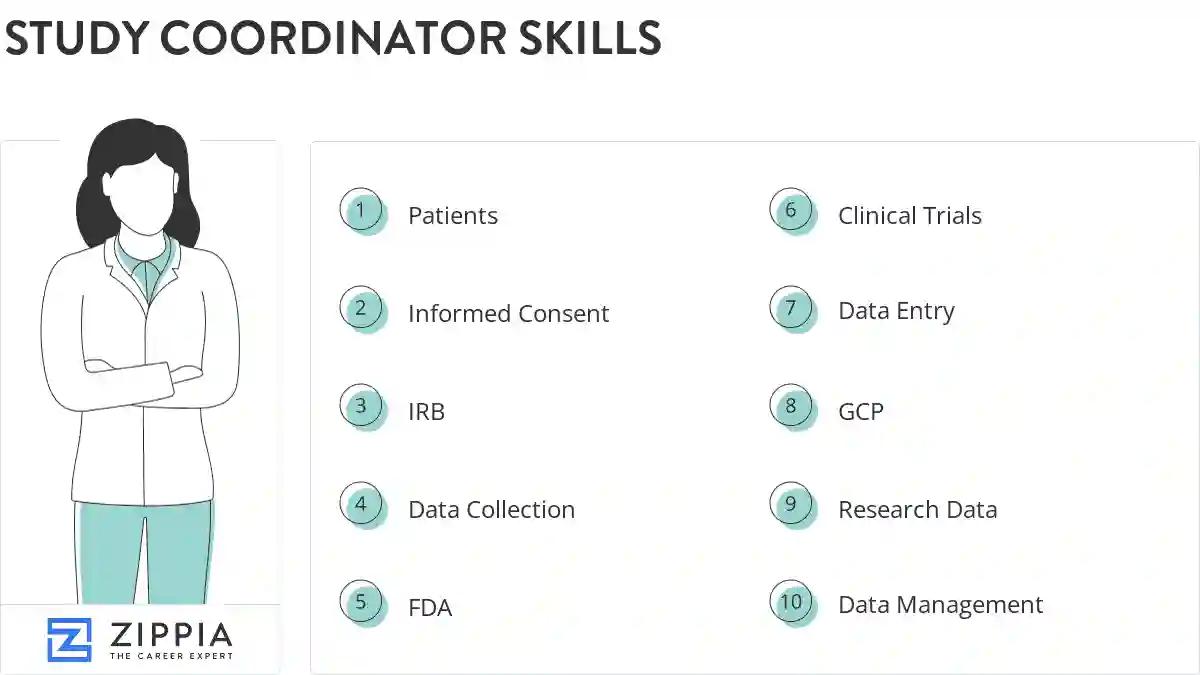
The most important skills for a study coordinator resume and required skills for a study coordinator to have include:
- Patients
- Informed Consent
- IRB
- Data Collection
- FDA
- Clinical Trials
- Data Entry
- GCP
- Research Data
- Data Management
- Patient Care
- Excellent Interpersonal
- Institutional Review
- Medical History
- Home Health
- Consent Forms
- NIH
- ICH
- Study Procedures
- Human Subjects
- Clinical Practice
- Oncology
- Excellent Organizational
- Data Analysis
- GLP
- Clinical Research Studies
- Study Subjects
- Efficacy
- SPSS
- HIPAA
- IV
- Vital Signs
- Research Assistants
- CRO
- Patient Recruitment
- Consent Process
- Research Subjects
- Electronic Data
- Study Activities
- QA
- EKG
- Clinical Data
- Diabetes
- HIV
- Patient Data
- CRF
- ECG
- Clinical Trial Management
- Study Sponsors
Updated January 8, 2025
