Explore jobs
Find specific jobs
Explore careers
Explore professions
Best companies
Explore companies
What is a surveillance operator and how to become one
Surveillance operators are responsible for operating all surveillance computer equipment. They monitor all areas of the property and closely observe a target game, staff member, or customer. They report improper activity or disturbances to the supervisor or security team for further investigation while ensuring compliance with applicable gaming regulations. They also check whether all the equipment, such as cameras and video storage systems, are working correctly.
Surveillance operators earn an average salary of $32,000 annually or $15 per hour. Their duties include acting as oversight and security agent for management and customers, as well as observing casino or casino hotel operations for irregular activities such as cheating or theft by either employees or patrons. They direct security personnel to intervene whenever they observe issues. They also monitor other problems such as disorderly conduct.
Surveillance operators typically hold a high school diploma or GED. The most important requirements are excellent observational skills and the ability to multitask without getting distracted. They are expected to have some years of experience in a similar role. Some employers prefer candidates with good written and verbal communication skills.
What general advice would you give to a surveillance operator?
Dr. Latarcia Barnes PhD
Chair of the Department of Criminal Justice and Sociology, Associate Professor
Avg. Salary $32,930
Avg. Salary $59,228
Growth rate 3%
Growth rate 0.3%
American Indian and Alaska Native 1.58%
Asian 6.10%
Black or African American 10.87%
Hispanic or Latino 20.54%
Unknown 5.29%
White 55.62%
Genderfemale 34.28%
male 65.72%
Age - 43American Indian and Alaska Native 3.00%
Asian 7.00%
Black or African American 14.00%
Hispanic or Latino 19.00%
White 57.00%
Genderfemale 47.00%
male 53.00%
Age - 43Stress level is very high
7.1 - high
Complexity level is challenging
7 - challenging
Work life balance is excellent
6.4 - fair
Surveillance operator career paths
Key steps to become a surveillance operator
Explore surveillance operator education requirements
Start to develop specific surveillance operator skills
Skills Percentages CCTV 10.87% Patrol 10.46% Table Games 10.30% Zoom 7.75% Internal Controls 6.60% Complete relevant surveillance operator training and internships
Accountants spend an average of 1-3 months on post-employment, on-the-job training. New surveillance operators learn the skills and techniques required for their job and employer during this time. The chart below shows how long it takes to gain competency as a surveillance operator based on U.S. Bureau of Labor Statistics data and data from real surveillance operator resumes.Research surveillance operator duties and responsibilities
- Develop and manage SAS and SQL programs to monitor hepatitis surveillance data quality.
- Authore procedures and work instructions and implement training programs relative to complaint handling, CAPA, investigation and risk assessment.
- Maintain payroll and record keeping.
- Prepare periodic reports to FDA.
Prepare your surveillance operator resume
When your background is strong enough, you can start writing your surveillance operator resume.
You can use Zippia's AI resume builder to make the resume writing process easier while also making sure that you include key information that hiring managers expect to see on a surveillance operator resume. You'll find resume tips and examples of skills, responsibilities, and summaries, all provided by Zippi, your career sidekick.
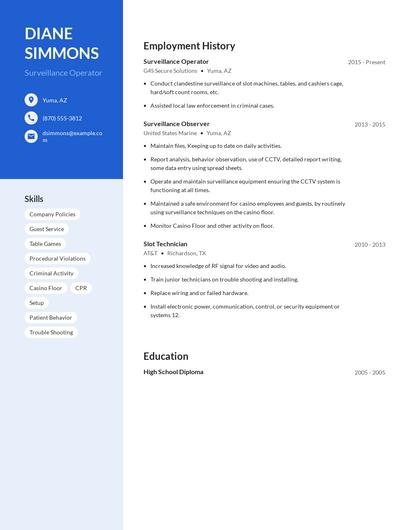
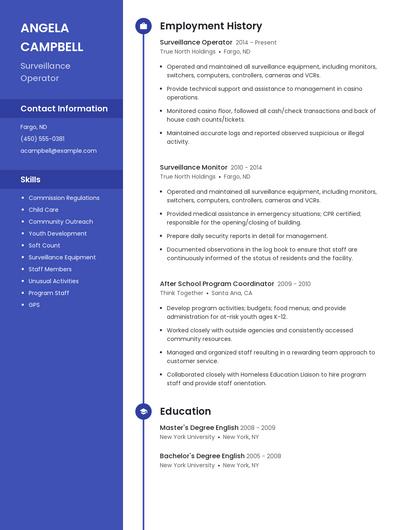
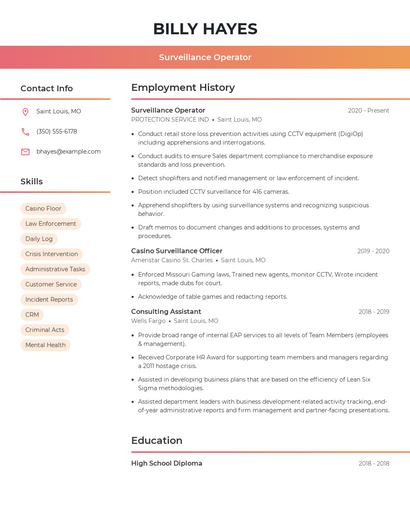
Choose from 10+ customizable surveillance operator resume templates
Build a professional surveillance operator resume in minutes. Browse through our resume examples to identify the best way to word your resume. Then choose from 10+ resume templates to create your surveillance operator resume.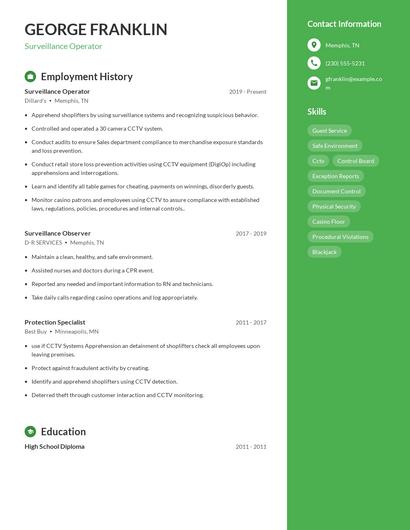

Apply for surveillance operator jobs
Now it's time to start searching for a surveillance operator job. Consider the tips below for a successful job search:
- Browse job boards for relevant postings
- Consult your professional network
- Reach out to companies you're interested in working for directly
- Watch out for job scams
How did you land your first surveillance operator job

Are you a surveillance operator?
Share your story for a free salary report.
Average surveillance operator salary
The average surveillance operator salary in the United States is $32,930 per year or $16 per hour. Surveillance operator salaries range between $21,000 and $50,000 per year.
What am I worth?

How do surveillance operators rate their job?
Surveillance operator reviews

The pay is not worth what you have to do sometimes
Dirty officers, mistreatment of I/M's, lack of help from higher up management, being required to work days off because we can't keep staff.
Pay and benefits are good for a family provider. The friendships with fellow officers lasts a lifetime. With overtime, I earned in pay and benefits, $3.5 million. I retired at 59.
Updated January 8, 2025
