Explore jobs
Find specific jobs
Explore careers
Explore professions
Best companies
Explore companies
Job outlook for system development managers in the United States
System development manager job growth summary. After extensive research, interviews, and analysis, Zippia's data science team found that:
The projected system development manager job growth rate is 16% from 2018-2028.
About 82,400 new jobs for system development managers are projected over the next decade.
System development manager salaries have increased 11% for system development managers in the last 5 years.
There are over 27,390 system development managers currently employed in the United States.
There are 191,514 active system development manager job openings in the US.
The average system development manager salary is $122,528.
Are system development manager jobs in demand?
System development manager job and salary trends over time
System development manager jobs over time
System development manager job growth rate over time
| Year | # of jobs | % of population |
|---|---|---|
| 2021 | 27,390 | 0.01% |
| 2020 | 25,918 | 0.01% |
| 2019 | 24,742 | 0.01% |
| 2018 | 20,154 | 0.01% |
| 2017 | 18,626 | 0.01% |
Average system development manager salary over time
System development manager salary by year
| Year | Avg. salary | Hourly rate | % Change |
|---|---|---|---|
| 2026 | $122,528 | $58.91 | +3.3% |
| 2025 | $118,645 | $57.04 | +2.7% |
| 2024 | $115,541 | $55.55 | +2.4% |
| 2023 | $112,857 | $54.26 | +2.5% |
| 2022 | $110,085 | $52.93 | +3.2% |
System development manager jobs by state
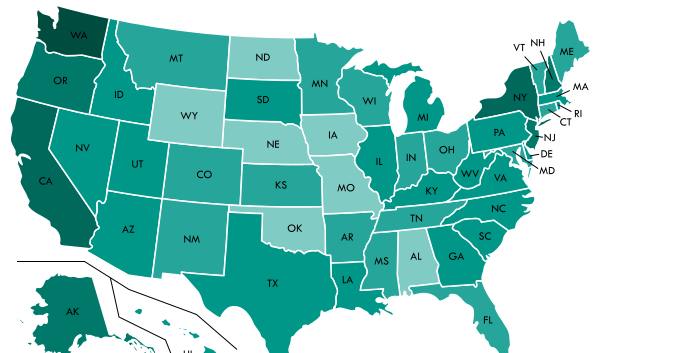
Most common states for system development managers
| Rank | State | Population | # of jobs | Employment/ 1000ppl |
|---|---|---|---|---|
| 1 | District of Columbia | 693,972 | 712 | 103% |
| 2 | Washington | 7,405,743 | 2,558 | 35% |
| 3 | North Dakota | 755,393 | 254 | 34% |
| 4 | Wyoming | 579,315 | 199 | 34% |
| 5 | Minnesota | 5,576,606 | 1,766 | 32% |
| 6 | Alaska | 739,795 | 237 | 32% |
| 7 | Virginia | 8,470,020 | 2,591 | 31% |
| 8 | Massachusetts | 6,859,819 | 2,146 | 31% |
| 9 | South Dakota | 869,666 | 234 | 27% |
| 10 | Maryland | 6,052,177 | 1,567 | 26% |
| 11 | New Mexico | 2,088,070 | 551 | 26% |
| 12 | Nebraska | 1,920,076 | 499 | 26% |
| 13 | Rhode Island | 1,059,639 | 275 | 26% |
| 14 | Oregon | 4,142,776 | 1,038 | 25% |
| 15 | Vermont | 623,657 | 152 | 24% |
| 16 | Pennsylvania | 12,805,537 | 2,892 | 23% |
| 17 | Georgia | 10,429,379 | 2,363 | 23% |
| 18 | Arizona | 7,016,270 | 1,636 | 23% |
| 19 | Utah | 3,101,833 | 700 | 23% |
| 20 | New Hampshire | 1,342,795 | 283 | 21% |
Most common cities for system development managers
| Rank | City | # of jobs | Employment/ 1000ppl | Avg. salary |
|---|---|---|---|---|
| 1 | Annapolis | 2 | 5% | $108,572 |
| 2 | Diamond Bar | 2 | 4% | $131,555 |
| 3 | Herndon | 1 | 4% | $114,470 |
| 4 | Manhattan Beach | 1 | 3% | $131,980 |
| 5 | Los Angeles | 1 | 0% | $132,144 |
| 6 | San Jose | 1 | 0% | $142,250 |
| 7 | Washington | 1 | 0% | $113,562 |
System Development Manager job outlook: Expert opinions
Our panel of system development manager experts

University of Pittsburgh at Johnstown
University of South Florida

DePaul University
.jpg)
Dalton State
NCWIT
Loyola University Chicago
Travis Stouffer
Assistant Professor of Information Systems, ChairUniversity of Pittsburgh at Johnstown
Department of Information Systems
What skills stand out on System Development Manager resumes?
Travis Stouffer: -Agile Project Management
-Scrum
-Product Roadmapping
-Product Backlog Management
-Requirement Elicitation Techniques
What soft skills should all System Development Managers possess?
Travis Stouffer: -Conflict Resolution
-Attention to Detail
-Active Listening
What hard/technical skills are most important for System Development Managers?
Travis Stouffer: -Human-Centered Design
-UI/UX Design
-Rapid Prototyping (Wireframes, Mockups)
-User Story Writing
-PM Tools (Azure DevOps, Jira)
-Data Management: SQL, ERD's, Normalization
What skills will help System Development Managers earn the most?
Travis Stouffer: -Agile Project Management
-Human-Centered Design
-Data Analytics
Ehsan Sheybani Ph.D.
ProfessorUniversity of South Florida
School of Information Systems and Management
What skills stand out on System Development Manager resumes?
Ehsan Sheybani Ph.D.: Analytical and problem-solving skills, Strong technical skills, The ability to work well under pressure, attention to detail, teamwork skills, organization and time management, interpersonal and communication skills, management and leadership skills.
What soft skills should all System Development Managers possess?
Ehsan Sheybani Ph.D.: Leadership, motivation, communication, conflict management, trust-building, decision-making, organization, and time management.
What hard/technical skills are most important for System Development Managers?
Ehsan Sheybani Ph.D.: Negotiation, relevant technical skills, prioritization and goal setting, project planning, delegating, and budget management.
What type of skills will young System Development Managers need?
Delvin Grant: The ability to problem solve, which requires an understanding of the problem and a structured approach towards the solution. The ability to apply concepts learned in one discipline to another. Quite often, students are unable to see how a concept translates from one domain to another, and this stifles innovation.
Are there any particularly good places in the United States for System Development Managers to find work opportunities?
Delvin Grant: It is not about the geographic area but more about the skills they possess. Many MIS/IT-related jobs could be done remotely, if you wanted to pin down areas that will include areas of the USA where technology is heavily used (NY, IL, CA, MA, Huntsville AL, Parts of the Midwest, and the south, with vibrant health care and manufacturing industries. Any where industries require a healthy dose of technology are good locations.
How do you envision technology impacting System Development Managers in the next 5 years?
Delvin Grant: It is always difficult to predict the future impact of tech. However, one area that will increase is the ability to analyze and interpret data. Then use the info to impact strategic and operational decision making. COVID-19 will change how people work. It will not be business as usual, and this requires the ability to work remotely. Therefore, those who master the use of remote technology, and find ways to use it innovatively, will outperform others. This is true for companies and individuals.
What are the biggest trends we'll see in the System Development Manager job market given the pandemic?
Cortnee Young: I believe work-from-home/virtual job opportunities will become more available. For recent graduates, this comes with pros and cons. I believe a big pro is the availability to more opportunity (versus narrowing down their search to specific geographic locations). A major con that I see would be the inability to learn hands-on skills and teachable moments from being in the office, for their first job.
Are there any particularly good places in the United States for System Development Managers to find work opportunities?
Adriane Bradberry: Technology increasingly permeates every aspect of society and provides the foundation for most modern innovation. Young graduates with computing skills will be able to apply to some of the most fastest-growing and highest-paying jobs over the next decade-jobs that are available in nearly every industry, including art, finance, healthcare, and entertainment. Students can establish and develop necessary skills by exploring computing programming apps, taking Computer Science or IT courses (online or at a local community college, if these classes are not offered at school), taking math classes, and joining after-school computing clubs. Graduates who develop these skills will contribute to meaningful work-developing innovative solutions that save lives, solve health problems, improve the environment, and keep us connected.
What type of skills will young System Development Managers need?
Peter Dordal Ph.D.: I'm leaving off software developers, and answering about our Information Technology graduates.
IT students entering the business world will need to know how to get the maximum leverage out of business systems. In many cases, this will mean writing their own specialized queries to extract the precise business intelligence needed; general-purpose "canned" queries just won't cut it. They will need a broad understanding of what software can accomplish for the enterprise and how to deploy new software effectively; this applies to software used in the office as well as to software used in manufacturing and shipping. And they will need to understand how to lease storage and computing resources from the cloud to meet not only predictable, long-term demands but also sudden short-term business projects.
Students working in database administration and management will need to be able to manage much larger volumes of data than a few years ago. They will need to be familiar with the great variety of new databases in order to pick the best tool for the job.
Students working in network management will need to be able to ensure that everyone has the bandwidth and server access they need, as those demands expand to include extensive video, low-latency real-time connectivity, and the regular transfer of huge amounts of data.
Students in cybersecurity will need to be fully acquainted with all the recommended best practices. However, they will also have to be able to anticipate and guard against potential new vulnerabilities. "By the book" protection is no longer sufficient.