Explore jobs
Find specific jobs
Explore careers
Explore professions
Best companies
Explore companies
Job outlook for system hardware engineers in the United States
Are system hardware engineer jobs in demand?
System hardware engineer job and salary trends over time
System hardware engineer jobs over time
System hardware engineer job growth rate over time
| Year | # of jobs | % of population |
|---|---|---|
| 2021 | 1,403 | 0.00% |
| 2020 | 1,231 | 0.00% |
| 2019 | 1,291 | 0.00% |
| 2018 | 1,156 | 0.00% |
| 2017 | 1,270 | 0.00% |
Average system hardware engineer salary over time
System hardware engineer salary by year
| Year | Avg. salary | Hourly rate | % Change |
|---|---|---|---|
| 2026 | $117,196 | $56.34 | +2.0% |
| 2025 | $114,902 | $55.24 | +2.3% |
| 2024 | $112,334 | $54.01 | --0.5% |
| 2023 | $112,844 | $54.25 | +0.0% |
| 2022 | $112,804 | $54.23 | +3.0% |
System hardware engineer jobs by state
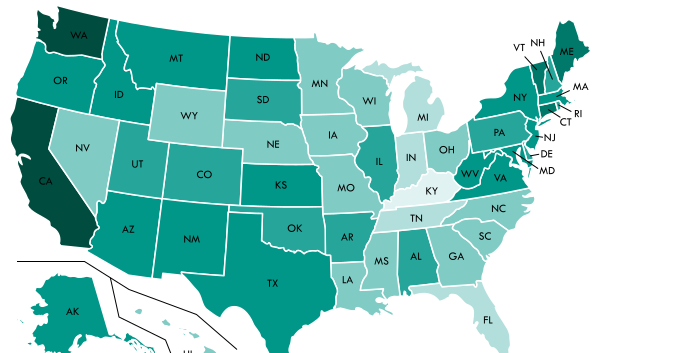
Most common states for system hardware engineers
| Rank | State | Population | # of jobs | Employment/ 1000ppl |
|---|---|---|---|---|
| 1 | District of Columbia | 693,972 | 465 | 67% |
| 2 | Virginia | 8,470,020 | 2,369 | 28% |
| 3 | Maryland | 6,052,177 | 1,685 | 28% |
| 4 | Colorado | 5,607,154 | 1,152 | 21% |
| 5 | Massachusetts | 6,859,819 | 1,299 | 19% |
| 6 | Washington | 7,405,743 | 1,202 | 16% |
| 7 | California | 39,536,653 | 5,940 | 15% |
| 8 | Utah | 3,101,833 | 464 | 15% |
| 9 | New Hampshire | 1,342,795 | 172 | 13% |
| 10 | Delaware | 961,939 | 124 | 13% |
| 11 | Oregon | 4,142,776 | 509 | 12% |
| 12 | Arizona | 7,016,270 | 771 | 11% |
| 13 | Alabama | 4,874,747 | 553 | 11% |
| 14 | Vermont | 623,657 | 66 | 11% |
| 15 | Rhode Island | 1,059,639 | 104 | 10% |
| 16 | Minnesota | 5,576,606 | 507 | 9% |
| 17 | Texas | 28,304,596 | 2,184 | 8% |
| 18 | New Mexico | 2,088,070 | 175 | 8% |
| 19 | Alaska | 739,795 | 58 | 8% |
| 20 | Wyoming | 579,315 | 45 | 8% |
Most common cities for system hardware engineers
| Rank | City | # of jobs | Employment/ 1000ppl | Avg. salary |
|---|---|---|---|---|
| 1 | Mountain View | 3 | 4% | $141,927 |
| 2 | Sunrise | 3 | 3% | $73,528 |
| 3 | Cupertino | 2 | 3% | $141,778 |
| 4 | Kokomo | 1 | 2% | $73,828 |
| 5 | San Diego | 3 | 0% | $121,043 |
| 6 | Houston | 2 | 0% | $102,860 |
| 7 | Aurora | 1 | 0% | $92,838 |
| 8 | Los Angeles | 1 | 0% | $127,934 |
System Hardware Engineer job outlook: Expert opinions
Our panel of system hardware engineer experts
Gonzaga University
Stevens Institute of Technology
University of Michigan - Ann Arbor
University of Alabama at Birmingham
San Diego State University
University of Utah
Xavier University

East Tennessee State University

Old Dominion University

University of Washington

Bakersfield College
Portland State University
University of Colorado at Colorado Springs

University of New Hampshire

Kennesaw State University

University of Nebraska–Lincoln

Liberty University

Pennsylvania State University - Great Valley

Rose-Hulman Institute of Technology
What System Hardware Engineer skills would you recommend for someone trying to advance their career?
Steven Schennum Ph.D. P.E.: The most important skill is the ability to learn new things, and especially to unlearn things you “know” after evidence demonstrates that these things are not true. Learn how to analyze information. Your intuition, simulations, and results should all be in alignment. If they are not, then dig deeper. Learn the terminology and jargon specific to your company and your projects. Spend time reading. Don’t be afraid to ask questions. Don’t be intimidated by new software.
What System Hardware Engineer skills would you recommend for someone trying to advance their career?
Min Song: Communication skills and innovative thinking skills. As emerging technologies continue to be complex and multidisciplinary, it’s important to be able to communicate with professionals in diverse disciplines. Taking robotics, for example, the electrical engineer must be able to work with mechanical and biomechanical engineers, computer engineers, software engineers, artificial intelligence experts, cognitive scientists, system engineers, etc. A person will be able to generate innovative ideas only if the person has a complete and comprehensive understanding of the entire system and can work well with other individuals with a range of expertise.
What System Hardware Engineer skills would you recommend for someone trying to advance their career?
Todd Allen: - analyzing systems, including technical and social implications, of engineering solutions
What will help System Hardware Engineers increase their earning potential?
Todd Allen: -work hard to develop professional networks
- get the details right
- the way you present is as important as your technical knowledge
What System Hardware Engineer skills would you recommend for someone trying to advance their career?
Arie Nakhmani: Electrical Engineering has always (from its inception) been a good profession to enter, but now it is better than ever. Now everything is becoming Electrical Engineering, and the world cannot survive without it even for a few days. Electrical Engineering is the most necessary profession for the survival of modern society.
What general advice would you give to a System Hardware Engineer?
Asad Salem Ph.D: To optimize your engineering salary potential, meticulously delve into industry salary benchmarks. Beyond excelling in your academic pursuits, acquire hands-on experience through research, internships, or co-op opportunities. Exhibit relevant skills and project accomplishments, consider pursuing advanced areas of expertise or certifications, and approach job offers with confidence during negotiations. Moreover, augment this strategy by actively engaging in networking, staying attuned to market inclinations, and showcasing a willingness to take on demanding projects. By emphasizing your dedication and proactively contributing, you can fortify your commitment and bolster your long-term earnings prospects in the dynamic field of engineering.
What will help System Hardware Engineers increase their earning potential?
Dr. Arif Engin: Electrical engineers solve problems by skillfully applying mathematics and science. Electrical engineering classes are challenging at college, and electrical engineers must embrace lifelong learning to remain at the top of their skills. In the end, seeing the results of their work in a finished product is a rewarding experience.
Florian Solzbacher
Department Chair, Professor, Elect & Computer EngineeringUniversity of Utah
Electrical and Computer Engineering Department
What hard/technical skills are most important for System Hardware Engineers?
Florian Solzbacher: First of all, the fundamentals (mostly math, physics, materials/chemistry) and basic EE/CE concepts need to be solid. As stated above: the ability to solve real-world development and system integration problems that require "global optimization" of technical performance as opposed to local optimization of specific sub-systems or components is really critical.
Beyond that, given the accelerating breadth of specializations and sub-areas, it is important that students have sufficient depth and breadth of knowledge in the specific area they are targeting. It is important that schools are offering tracks and guidance as to what skills are needed to allow students to successfully master engineering tasks across a range of sub-areas. We have to recognize that in the context of a 4-year program, it is no longer possible to train a student in all areas of ECE - a combined BS/MS degree or MS/Ph.D. degree obviously provides more runway to add breadth.
Dr. Heidrun Schmitzer
Professor and ChairXavier University
Department Of Physics
What skills stand out on System Hardware Engineer resumes?
Dr. Heidrun Schmitzer: Programming languages, numerical design and simulation tools, knowledge of various measurement equipment.
What soft skills should all System Hardware Engineers possess?
Dr. Heidrun Schmitzer: Communication, teamwork.
What hard/technical skills are most important for System Hardware Engineers?
Dr. Heidrun Schmitzer: Depends on the engineering career, but in general, an ability to know how to use design software, measurement/testing, and analysis equipment, in addition to prototyping and fabrication tools
What skills will help System Hardware Engineers earn the most?
Dr. Heidrun Schmitzer: Problem-solving, troubleshooting, independent learner.
Jared Wilson
Assistant Professor and Faculty CoordinatorEast Tennessee State University
Surveying and Mapping
Are there any particularly good places in the United States for System Hardware Engineers to find work opportunities?
Jared Wilson: Within the field of land surveying and related employment opportunities, work is available. However, in my experience, work may not be in the exact location a person wishes to live. So, a move may be necessary, or potentially traveling to where the work is located. Should a graduate, or person for that matter, want to work, work is available.
How do you envision technology impacting System Hardware Engineers in the next 5 years?
Jared Wilson: Technology is rapidly changing many professional fields, and land surveying is not immune from the change; however, it is not technology that makes the professional decisions necessary for the field; it is the individual. Technology is a tool, and as such, the correct tool needs to be selected for the task at hand. My opinion is that technology will drive the speed of data collection and analysis, but it has been and will be the professional who ultimately makes the final decisions.
Will there be an enduring impact of the coronavirus pandemic on System Hardware Engineers?
Michel Audette Ph.D.: My take on this is what I've seen with my wife's work in industry, which suggests that the industrial landscape is going to be increasingly equipped for, and open to, remote work. I think that the implication for graduates is that they may need to be flexible about working within a geographically distributed team. If company deciders feel that someone is worth employing because of a unique skill set, then they would typically be more willing to hire that person even if unable to make it to work regularly, if that is feasible given the nature of the work; some work, such as hardware testing or industrial production, may not lend itself to remote contributions.
Nonetheless, for those areas that accommodate geographically distributed activity, such as software development, graduates can expect to interact with team members all over the US, possibly all over the world, if someone is deemed unique enough to hire despite living abroad. This places a high premium on the ability and willingness to work in a heterogeneous team, where not only will members look different, but also have myriad accents in their English, which will also impose a certain adaptability and tolerance to team members.
A related impact could also be that global hiring will make it easier for multi-national companies to hire a portion of their talent in countries where wages are lower and motivate US-based engineers to seek out graduate degrees in order to increase their competitiveness and employability at US salaries.
Will there be an enduring impact of the coronavirus pandemic on System Hardware Engineers?
Les Atlas: Most certainly an impact, a very strong impact. The best lesson for us is from the 1919 Spanish Flu pandemic. That strain of flu still circulates as a seasonal virus. Over 100 years laters, it is now considered a Phase 6 pandemic by the World Health Organization. While it is reduced due to current social distancing and mask wearing, the 1919 Spanish Flu virus still causes community-level outbreaks in multiple parts of the globe. Societal changes from this event of over 100 years ago are still with us.
In fact, they changed society. As is well-documented, after a high level of immunity was reached in the 1920's, the resulting labor shortage enabled workers to demand better living and working conditions, as well as better wages and public health care. As just one example of the societal changes due to the 1919 pandemic, the drop in the male labor force empowered male workers, and also changed the gender composition.
The aftermath of the 1919 pandemic was the start of women joining the labour force. In the United States, the proportion of women in the labour force rose from 18 per cent in 1900 to almost 21 per cent in 1920. In that same year, with the ratification of the 19th Amendment of the Constitution, the Congress of the United States guaranteed all American women the right to vote.
The current COVID-19 pandemic will certainly change the way we live, be it our mobility or the kinds of career options people have. After our current year-long experience in remote learning and work, will we go back to the inefficiencies of going to our office every work day? Or will remote work be acceptable, where one's residence will not be dependent upon the locations of employment. Will we avoid future hotspots of infection, choosing to instead reside and travel in areas where infection is decreasing? Will we prefer to travel on aircraft which are certified to be virus-free and frequent restaurants which are documented to be safer? Future marketing will likely make a sharp turn in this direction.
What general advice would you give to a System Hardware Engineer?
Maryam Farahani: Thinking about the fields they want to experience or try. And to be intentional about their job search. The best advice is learning as much as they can about what company offers. Visualizing themselves in the next 5 years as a starting point. Do they want to travel a lot, or be in management positions? Do they want to be subject matter expert, or a hands-on engineer or technologist? Their goal may change as they progress in their career but having one makes a big difference in their career choices and keeping them on track.
Dr. Wayne Wakeland Ph.D.
Professor and Systems Science Program ChairPortland State University
Systems science program
What System Hardware Engineer skills would you recommend for someone trying to advance their career?
Dr. Wayne Wakeland Ph.D.: For analyst positions, I think that employers want to hire people with strong data analysis skills, which, of course, includes statistics, but also big data, machine learning (algorithms), computer-based modeling, and programming. And, in addition to these apparently rather specialized skills, there is growing recognition that a talent for thinking, communicating, and problem-solving in a very general sense, and being able to cope with/address complexity, is also quite important.
Dr. T.S. Kalkur
Department ChairUniversity of Colorado at Colorado Springs
Electrical and Computer Engineering Department
What experience really stands out on System Hardware Engineer resumes?
Dr. T.S. Kalkur: Internship experience and tools used in design.
Marc Lessard
ProfessorUniversity of New Hampshire
Physics and Astronomy Department and Space Science Center
What experience really stands out on System Hardware Engineer resumes?
Marc Lessard: Students who have been significantly involved in research projects have a distinct advantage over those who haven't. Those who began such work (which is typically paid) as sophomores or juniors often will have played a significant role in these real-world research efforts, which can be very different than what might be tackled as part of a capstone project.
Written and oral presentation skills are also essential!
What experience really stands out on System Hardware Engineer resumes?
Adeel Khalid Ph.D.: It is the age of diversity. A graduate can stand out when their resume shows a broad portfolio of experiences. In addition to a solid academic record, students who demonstrate that they can take on challenging tasks and work beyond a degree's basic requirements are more likely to be successful. I advise students to get involved in various activities, including undergraduate research projects, student design competitions, student organizations, internships, co-ops, etc. All of these should be highlighted on the resume. When a recruiter sees an overview of a student that shows relevant work experience in the form of work-study, internships, or co-op or research, their resume automatically comes to the top of the pile.
Dr. Sohrab Asgarpoor
Associate Dean for Undergraduate Programs, Professor of Electrical and Computer EngineeringUniversity of Nebraska–Lincoln
College of Engineering
How do you envision technology impacting System Hardware Engineers in the next 5 years?
Dr. Sohrab Asgarpoor: Adopting new technology should be an exciting (and expected) reality for those with an engineering degree. The virtual space will continue to grow as folks seek jobs and work online more. But what holds paramount, no matter what particular technological changes arise, is the ability to adapt-and to demonstrate that critical aptitude in their application documents and through their interviews, always highlighting those moments they've done so and articulating their propensity for learning.
What experience really stands out on System Hardware Engineer resumes?
Robert Rich: -Certification such as green belt, black-belt, machine learning, Lean Manufacturing, and APICS supply chain/inventory
-Specialized undergraduate research projects that go deep into various leading-edge topics like integrating AI with manufacturing and logistics
-Consulting experience/real projects within areas of undergraduate research
What experience really stands out on System Hardware Engineer resumes?
Nil Ergin Ph.D.: Knowledge of analytical skills, methods, and tools for analysis, design, and management of complex systems and experience working with interdisciplinary teams are essential for systems engineering professionals. Experience in applying systems thinking and design thinking approaches to understanding organization, technical, and non-technical factors that influence the design and performance of complex systems stands out on resumes.
Dr. Galen Duree
Head of the Department of Physics and Optical Engineering and ProfessorRose-Hulman Institute of Technology
Department of Physics and Optical Engineering
What experience really stands out on System Hardware Engineer resumes?
Dr. Galen Duree: It depends on what you are applying for. If you are working on product development, then internships or co-ops provide a definite advantage. If you are working on developing new ways of doing things, research experiences in academia or companies are advantageous. Either case, this shows a certain maturity in your career path - you have participated in an activity related to the career you are currently pursuing.
What System Hardware Engineer skills would you recommend for someone trying to advance their career?
Dr. Galen Duree: It again depends on what the graduate sees as their next step - graduate school or a job with a company or lab. If the next step is graduate school, the graduate should investigate what they are interested in pursuing and then where the best school is to get the experience that the graduate thinks he or she wants.
General reading about technologies or reading available articles about subjects the graduate is interested in will help generate questions they can ask potential graduate schools. This time would also be a chance to improve areas where the graduate may feel weak while an undergraduate. Many online resources can help them brush up on week background topics. Do not worry about transfer credits because that is usually not helpful in graduate school, but improve knowledge and experience in areas where the graduate feels weak. If the graduate has identified a graduate school and program to study in, the graduate school might have some recommendations about what to review. All of this will help improve success in graduate school.
If the next step is a job with a company or lab, taking courses to improve communication will help. Many technically competent or even technically brilliant people struggle with effective communication. Techniques about writing reports, making oral presentations, or communicating technical information will help improve success. The gap year also provides time to investigate technologies that the graduate wants to be involved in and the companies or labs in those areas.
Once the graduate has identified areas of interest and companies or labs that the graduate might want to work for, they can be contacted to either answer questions or point the graduate in a direction for further investigation.
In either case, a gap year can provide a chance to refine the graduate's choice for the next steps and help them prepare other skills overlooked during the undergraduate years.
What technology do you think will become more important and prevalent for System Hardware Engineers in the next 3-5 years?
Dr. Galen Duree: People with knowledge, even introductory experience, in quantum effects, quantum computing, optics in general (communication, measurements, imaging, illumination, detection), material science and engineering, biotechnology, and nanotechnology, will be in high demand.