
Automatically apply for jobs with Zippia
Upload your resume to get started.
System integration analyst skills for your resume and career
15 system integration analyst skills for your resume and career
1. System Integration
System integration refers to connecting distinct subsystems into a sole bigger system that tasks as one in very extensive terms. In engineering, the principal system integrator integrates separate systems using various techniques such as enterprise application integration, computer networking, business process management or manual programming.
- Release Management (Operations) Conducted system integration and release management support for large engineering and operations teams utilizing ITSM/ITIL methodology.
- Provided support to a variety of customers ranging from Engineers to Financial Analysts by providing information through system integration.
2. Java
Java is a widely-known programming language that was invented in 1995 and is owned by Oracle. It is a server-side language that was created to let app developers "write once, run anywhere". It is easy and simple to learn and use and is powerful, fast, and secure. This object-oriented programming language lets the code be reused that automatically lowers the development cost. Java is specially used for android apps, web and application servers, games, database connections, etc. This programming language is closely related to C++ making it easier for the users to switch between the two.
- Maintain and develop Enterprise Authorization System modules in Java.
- Analyzed and documented architecture and technical details of a Java application used to analyze biological experiments data conducted using robots.
3. Troubleshoot
Troubleshooting is the process of analyzing and fixing any kind of problem in a system or a machine. Troubleshooting is the detailed yet quick search in the system for the main source of an issue and solving it.
- Enabled users and systems administrators to more effectively manage and troubleshoot the messaging and directory components.
- Write custom relevance to troubleshoot vulnerability patching efforts and increase domain saturation of said patches.
4. Business Process
A business process is a group of tasks that are performed by people working in a business to attain a worthy product and to present it to their customers. A business process can also be defined as performing several steps to achieve a certain goal set by a company. Business processes need to set purposeful goals and the outcome of that goal should be clear.
- Analyzed functional, technical and business processes through information-gathering sessions with clients to gain understanding of business needs.
- Developed and institutionalized key technical and business process documentation enabling faster completion of implementation projects.
5. XML
XML is a medium for storing and transporting data that is independent of software and hardware. XML stands for eXtensible Markup Language. XML, like HTML, is a markup language that was created to store and transport data. It was created with the intention of being self-descriptive. There are no predefined tags in the XML language. Another feature is that XML is extensible.
- Worked largely using XML and JSON.
- Developed company-wide internal XML message standardized structure to meet all business needs and requirements for internal messaging solutions.
6. Data Analysis
- Performed data analysis, tracked and managed deliverable documents and data for large hardware systems and enterprise systems management.
- Performed data analysis with the Integration Engineers in Data Reduction/Analyst.
Choose from 10+ customizable system integration analyst resume templates
Build a professional system integration analyst resume in minutes. Our AI resume writing assistant will guide you through every step of the process, and you can choose from 10+ resume templates to create your system integration analyst resume.7. HL7
(HL7) Health Level Seven International is a non-profit ANSI-accredited standards development organization dedicated to providing benchmarks and solutions that empower overall health data unification. This framework enables sharing, integration, and recovery of electronic health information. This information strengthens clinical practices along with the evaluation, management, and deliver health services.
- Developed new HL7 VXU immunization interface to MIIC to meet Meaningful Use Stage II requirements.
- Major project completed was converting PC/RCI to HL7 interface.
8. Technical Support
Technical support or tech support are the services provided by any hardware or software company to users. They help in solving the technical difficulties the customers face with their products or services. Moreover, the tech support employees maintain, manage, and repair the IT faults. They are also responsible for resolving the network problems, installing and configuring hardware and software.
- Provided technical support and analysis to document organizational information protection framework and supported policy and procedures preparation and implementation.
- Provided training to end-users and helped to reduce inbound technical support calls in turn increasing productivity and profitability.
9. Linux
Linux is a Unix-like operating system. Just like Windows, Mac OS, and IOS, Linux is an operating system used by millions across the globe. Android itself is powered by the Linux operating system. Linux manages all the hardware resources that are associated with your computer. The software is famous because of the protection it grants from viruses, malware, and crashes. The Linux operating system is entirely free and is an open-source software meaning it can be altered by those equipped with the knowledge to code.
- Monitor Windows and Linux server health and performance using Systems Center Operations Manager (SCOM).
- Created project plan for migrating to Linux OS, improving client resource commitments.
10. SQL Server
- Performed data mapping to Threat Sensor DB and loaded data (SQL Server 2000 DTS).
- Installed and maintained extensive scanning systems using OTG Software with MS-SQL Server.
11. ERP
Enterprise Resource Planning (ERP) is computer software used by major corporations and organizations for conducting their management and accounting tasks efficiently. ERP systems bind different business processes with each other allowing smoother flow of data between them resulting in swift project assessment and completion.
- Led team in three-month project to configure and initiate processes in ERP for a new business inside the current plant.
- Automated insertion of standard accounting extracts into our ERP system.
12. Management System
A management system is a set of policies, processes, and procedures taken by an organization or a business to ensure it can fulfill its tasks and achieve its objectives. A management system makes sure that the company excels financially and improves the user experience. The management system also takes care of the worker's and employees' needs and manages their workload and oversees their performance. Apart from interior matters of the company, a management system also deals with exterior matters like legislations, tax matters, and law issues.
- Improved overall efficiency of Risk Management system by modifying internal grid design architect; collaborated with performance engineering and technology teams.
- Support, implement, and maintain integrated systems solutions typically involving web-based applications and enterprise database management systems.
13. Technical Specifications
A technical specification is a document that clearly explains the specific requirements needed to get a project, product, material, or system ready for public or private use. It's the preliminary stage of any engineering or product design that must be followed to the letter because it defines the technical standard and safety measures for the product in the field of engineering design.
- Collaborated with project managers, software developers, vendors, and clients to facilitate collection of business requirements and technical specifications.
- Gathered BRD (Business Requirement/solution documents) and performed high level system analysis to develop technical specifications of security implementation project.
14. EDI
- Participated in 3 EDI server installs of TrustedLink Enterprises including SAP bolt-on adapter for integrating the translator with SAP.
- Installed and maintained Trusted Link Enterprise EDI system between partners and SAP, allowing for processing of EDI documents.
15. Test Procedures
Test procedure i defined as a tool for conducting an experiment to analyze or observe the specifications of a process or application.
- Drafted and modified hundreds of formal test procedures for numerous test events in accordance with System Requirements Specifications.
- Prepared test procedures and tested software and hardware functionality.
5 System Integration Analyst resume examples
Build a professional system integration analyst resume in minutes. Browse through our resume examples to identify the best way to word your resume. Then choose from 5+ resume templates to create your system integration analyst resume.

What skills help System Integration Analysts find jobs?
Tell us what job you are looking for, we’ll show you what skills employers want.
What skills stand out on system integration analyst resumes?
Michael McLaughlin
Faculty, Brigham Young University - Idaho
What soft skills should all system integration analysts possess?
Van Wood Ph.D.
Philip Morris Endowed Chair in International Business, Director - VCU Center for International Business Advancement (CIBA), Professor of International Marketing, Virginia Commonwealth University
What hard/technical skills are most important for system integration analysts?
Van Wood Ph.D.
Philip Morris Endowed Chair in International Business, Director - VCU Center for International Business Advancement (CIBA), Professor of International Marketing, Virginia Commonwealth University
What system integration analyst skills would you recommend for someone trying to advance their career?
David Preece
Academic Director, Associate Professor, Brigham Young University-Hawaii
What type of skills will young system integration analysts need?
Missy Gutkowski
Assistant Dean, Bucknell University
New employees should be prepared to communicate well and often, not only expressing expectations of what they need to complete their work but also to frequently updating supervisors and coworkers. Quickly learning the communication preferences and style of a supervisor and organization will set a new employee up for success in any industry.
List of system integration analyst skills to add to your resume
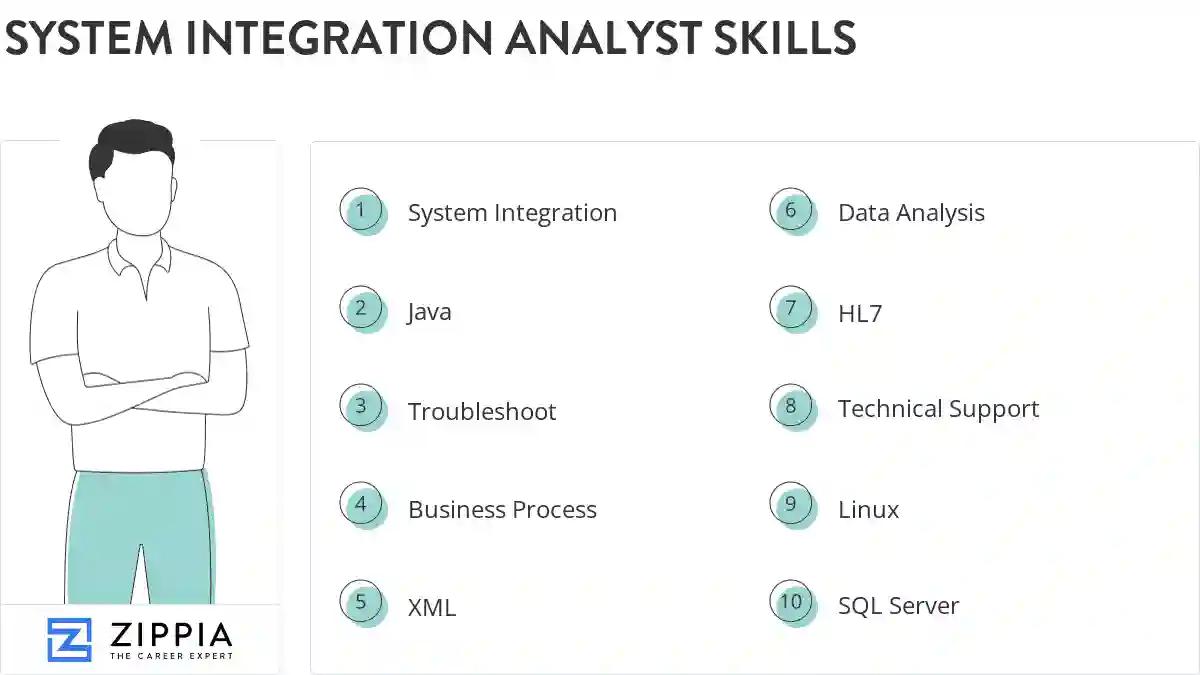
The most important skills for a system integration analyst resume and required skills for a system integration analyst to have include:
- System Integration
- Java
- Troubleshoot
- Business Process
- XML
- Data Analysis
- HL7
- Technical Support
- Linux
- SQL Server
- ERP
- Management System
- Technical Specifications
- EDI
- Test Procedures
- Windows Server
- Jira
- HTML
- Visio
- User Acceptance
- FTP
- Web Application
- SharePoint
- Test Cases
- Unix
- SDLC
- Regression
- QA
- Functional Specifications
- Test Scripts
- Configuration Management
- Debugging
- DOD
- VMware
- Scrum
- UAT
- Test Scenarios
- Workstations
- PC
- C Net
- Enterprise Applications
- SOA
- Design Sessions
- HR
- POS
- Technical Troubleshooting
- DNS
- PeopleSoft
Updated January 8, 2025
