Explore jobs
Find specific jobs
Explore careers
Explore professions
Best companies
Explore companies
Job outlook for systems analyst/developers in the United States
Systems analyst/developer job growth summary. After extensive research, interviews, and analysis, Zippia's data science team found that:
The projected systems analyst/developer job growth rate is 9% from 2018-2028.
About 56,000 new jobs for systems analyst/developers are projected over the next decade.
Systems analyst/developer salaries have increased 8% for systems analyst/developers in the last 5 years.
There are over 190,399 systems analyst/developers currently employed in the United States.
There are 175,586 active systems analyst/developer job openings in the US.
The average systems analyst/developer salary is $102,079.
Are systems analyst/developer jobs in demand?
Systems analyst/developer job and salary trends over time
Systems analyst/developer jobs over time
Systems analyst/developer job growth rate over time
| Year | # of jobs | % of population |
|---|---|---|
| 2021 | 190,399 | 0.06% |
| 2020 | 354,328 | 0.11% |
| 2019 | 169,219 | 0.05% |
| 2018 | 291,345 | 0.09% |
| 2017 | 283,760 | 0.09% |
Average systems analyst/developer salary over time
Systems analyst/developer salary by year
| Year | Avg. salary | Hourly rate | % Change |
|---|---|---|---|
| 2026 | $102,079 | $49.08 | +3.4% |
| 2025 | $98,715 | $47.46 | +2.3% |
| 2024 | $96,480 | $46.38 | +0.5% |
| 2023 | $95,969 | $46.14 | +1.2% |
| 2022 | $94,828 | $45.59 | +1.7% |
Systems analyst/developer jobs by state
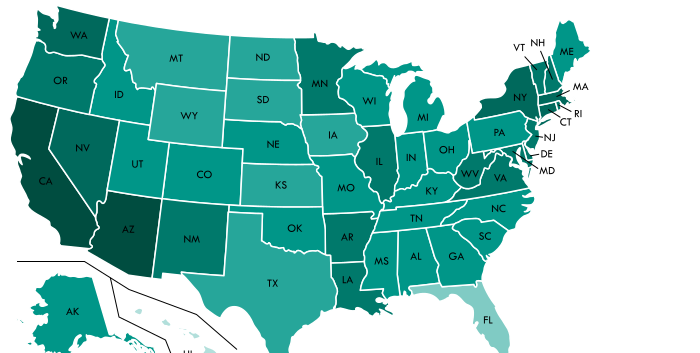
Most common states for systems analyst/developers
| Rank | State | Population | # of jobs | Employment/ 1000ppl |
|---|---|---|---|---|
| 1 | District of Columbia | 693,972 | 482 | 69% |
| 2 | Vermont | 623,657 | 225 | 36% |
| 3 | North Dakota | 755,393 | 264 | 35% |
| 4 | Rhode Island | 1,059,639 | 361 | 34% |
| 5 | Wyoming | 579,315 | 195 | 34% |
| 6 | Nebraska | 1,920,076 | 643 | 33% |
| 7 | Minnesota | 5,576,606 | 1,778 | 32% |
| 8 | New Hampshire | 1,342,795 | 416 | 31% |
| 9 | Alaska | 739,795 | 232 | 31% |
| 10 | New Mexico | 2,088,070 | 627 | 30% |
| 11 | South Dakota | 869,666 | 260 | 30% |
| 12 | Delaware | 961,939 | 282 | 29% |
| 13 | Washington | 7,405,743 | 2,080 | 28% |
| 14 | Oregon | 4,142,776 | 1,145 | 28% |
| 15 | Arizona | 7,016,270 | 1,805 | 26% |
| 16 | Alabama | 4,874,747 | 1,253 | 26% |
| 17 | Kansas | 2,913,123 | 766 | 26% |
| 18 | Montana | 1,050,493 | 270 | 26% |
| 19 | Georgia | 10,429,379 | 2,573 | 25% |
| 20 | Maine | 1,335,907 | 317 | 24% |
Most common cities for systems analyst/developers
| Rank | City | # of jobs | Employment/ 1000ppl | Avg. salary |
|---|---|---|---|---|
| 1 | Columbus | 1 | 2% | $88,425 |
| 2 | Terre Haute | 1 | 2% | $87,425 |
| 3 | Des Moines | 1 | 0% | $76,628 |
| 4 | Seattle | 1 | 0% | $108,940 |
Systems Analyst/Developer job outlook: Expert opinions
Our panel of systems analyst/developer experts
Widener University
Belmont University
Siena College
Mount St Mary's University
Indiana University - Purdue University Indianapolis
Carleton College
Mount Saint Mary's University
Florida International University
Carthage College
California State University - Bakersfield
What general advice would you give to a Systems Analyst/Developer?
Rebecca MacGowan: My general advice is to work backwards and start your career by thinking about what you want to achieve long term. When you think about your career in ten or twenty years, what position are you in? Once you have an idea of the type of position you would like to be in during the middle and/or late stage of your career, go on LinkedIn and look up individuals who currently hold that position and see what their career trajectory was. What positions provided them the stepping stones to achieve the career you currently aspire to? By working backwards, you can ensure that your initial position is setting you up for your long-term goals. Additionally, what you are likely to find when you look at the career paths of different folks is that there are often many paths leading to your ideal future position. Hopefully, this broadens your perspective regarding what position you need right now and how different positions can help set you up for your desired future career. Often, unless we are exceptionally fortunate, our first career after undergraduate isn’t going to be our ideal position, but with proper planning, it can be the first step towards our ideal position.
Prof. Mohammad Elahee Ph.D.
Perlroth Professor of Int’l. BusinessWhat Systems Analyst/Developer skills would you recommend for someone trying to advance their career?
Prof. Mohammad Elahee Ph.D.: A combination of both hard and soft skills will be needed to survive in this ‘dog eat dog world’. Hard skills that will be in high demand are familiarity with new AI- and machine-driven technologies and quantitative reasoning. Soft skills that employers will be looking for include emotional intelligence, communication and interpersonal skills and a “can do attitude”. Paradoxical though it may sound, AI would actually create more demand for people with emotional and social intelligence.
What general advice would you give to a Systems Analyst/Developer?
Dr. Laura Gonzalez Ph.D.: Technology, and in particular Artificial Intelligence, are becoming ubiquitous in all professions. New positions are being created and those who know how to use Artificial Intelligence will not be replaced by AI. This requires minimum programming knowledge, and it is useful to have some data analytics knowledge as well.
What general advice would you give to a Systems Analyst/Developer?
Jennifer Barr PhD: All of the skills noted in my response to Q1. However, as business professionals advance in their respective careers, they must have a keen understanding about the impact of technology on every aspect of an organization. It is also essential to stay abreast of emerging technologies and understand their implications for business practice.
Professional development should be an ongoing priority. Attend conferences and seminars, complete certificate programs, etc. Build your personal brand and value at every level.
Hone leadership skills for middle management positions including collaboration, thinking and acting systemically, resiliency and learning agility. Never forget the importance of humanity when interacting with subordinates. Lead by example always.
Recognizing the role of data capture, analytics and technology in advancing organizations, creating competitive advantage and delivering exceptional user experiences is paramount.
Hire well. Employees are considered the most valuable asset of every organization. Abilities, knowledge and experience matter but the soft skills in terms of how someone works and interacts with others should be top priorities.
What general advice would you give to a Systems Analyst/Developer?
David Hart: So the field of Business Analyst can encompass interacting with different department managers on a daily bases. Quite often they will be required to interpret large amounts of data from the various departments each day to look at trends either in sales or procurement. Working with IT is a must so that data mining of the correct data to help the company achieve their business goals is critical.
What Systems Analyst/Developer skills would you recommend for someone trying to advance their career?
David Hart: Most businesses may hire you on like a consultant. The employees rarely welcome consultants in their business so that early friction is something that most new Business Analysts find distasteful, however if taken in that context, it is also the most challenging part of the field. When you discover processes that will enhance the productivity of the company and help the employees see more profit sharing you can end up being the hero. Most employees spend most of their work career never feeling fulfilled. This profession will definitely give you that rewarding feeling.
Dany Doueiri
ProfessorWhat general advice would you give to a Systems Analyst/Developer?
Dany Doueiri: Don't try to start your own business right after you graduate. Keep your dreams, passions, and aspirations alive but get experience from the field through companies, organizations, and institutions. Gain wisdom from those who have more experience than you and those who make mistakes, including your own shortcomings. Then, you can consider branching out. Finally, learning never stops at the end of your college journey. Be humble and keep on learning for life.
What Systems Analyst/Developer skills would you recommend for someone trying to advance their career?
Adam Roth: I recommend that students start by identifying a specific skill in demand within your field, such as data analysis or social media marketing, and focus on developing expertise in that area. Research salary ranges and living costs in particular areas where you’re interested in working to ensure your compensation aligns with the local market. Always negotiate a salary and consider other aspects of the offer, such as funds for continuing education, technology and more. Continuing to network and establish demand for your services is essential; attend industry events, join professional associations, and engage with professionals in your field. Never miss an opportunity to reach out to and check in with your professional contacts. Pursue additional learning opportunities and education, such as certifications or advanced degrees, to provide a competitive advantage and increase your earning potential over time.
What general advice would you give to a Systems Analyst/Developer?
Bradley Andrew Ph.D.: So-called soft skills are still in demand by employers, based on recent surveys, because a smaller percentage of graduates possess them. These include:
Showing up and on time;
Having a strong work ethic;
Critical thinking skills
Social skills, including the ability to get along well with people, motivate and encourage them, and leadership skills. Also be able to schmooze with clients over dinner or drinks, or just in your office. A personal touch and connection is something software can’t provide.
Creativity—Apple products, for example, appeal to many people because of their combination of form and function.
The ability to work AI in order to increase one’s productivity will become more important over the next 5 years.
What will help Systems Analyst/Developers increase their earning potential?
Bradley Andrew Ph.D.: Once you have your first job, ask about or determine the 20% of your supervisor’s job that they hate and start doing that for them. They will love you for it and it will quickly get you recognition. You’ll also be well on your way to learning your boss’s job. Continue doing this as you progress in your career (Kudos to Theo Epstein, former GM for the Red Sox, for this recommendation)
No matter the task you’re given, do it to the absolute best of your abilities. In the professional world, you may often be given menial tasks or tasks that you don’t believe are part of your job description. Doing those tasks to the absolute best of your ability leads to increased trust, recognition and responsibility and will put you “above class.” If asked, the coffee you bring should be the best your boss has ever had. You never know who’s watching.
Don’t expect credit and don’t ask for credit when things go right; give the credit to others.
Tongyang Yang Ph.D.
Assistant Professor of Economics and Business AnalyticsWidener University
Business/Commerce
What general advice would you give to a Systems Analyst/Developer?
Tongyang Yang Ph.D.: There are many reasons that people like about being a business analyst, including reasons listed as follows: 1. Analytical Skills and Data Exploration: BAs often analyze data to understand trends and identify areas for improvement. Seeing a successful implementation and its positive impact can be very rewarding. 2. Problem-solving. BAs get to identify inefficiencies and propose solutions that can improve how a business operates. 3. Continuous learning. Business analysts may work on a range of projects and the field of business analysis may be constantly evolving, which required BAs to actively cultivate skills in new businesses. For example, the coming of the AI era requires BAs to master AI fundamentals and data fluency. 4. While some thrive on the problem-solving and communication aspects of a BA role, others may find them less appealing. Carefully consider your personality and preferences to see if this aligns with your career goals.
What general advice would you give to a Systems Analyst/Developer?
Dr. Tisha Brown-Gaines: Over the next five years, the expanding landscape of Big Data facilitated via Information Systems will continue to play a major role in the structure of how Smart Systems are created and maintained. As a result, having skills that will allow for effectively accessing, modifying, analyzing, storing and securing data is key. The integration of these skills are strengths that will support fields under the umbrella of computer science and data science that expand into machine learning, natural language processing and the Internet of Things (IoT) concepts.
What Systems Analyst/Developer skills would you recommend for someone trying to advance their career?
Dr. Tisha Brown-Gaines: Colleges and universities try very hard to prepare students for life after graduation. Most students have the required skill sets for their field of study. However, the journey after attaining a degree still can be tricky. Selecting the right field for you is paramount. Information Systems (IS) is a great major. The interdisciplinary aspect of Information Systems (IS) allows graduates to select from numerous opportunities in the field. However, this can be quite overwhelming when students have options to apply to countless jobs. My advice would be to reflect on several assignments, projects or internship experiences during your undergraduate career that captured your interest, made you smile while completing the assignment or even one which began as a random goal and became personal. Start by identifying tasks that made you inquire more about a topic outside of the minimum requirements or a task that was challenging but helped to improve a skill set. Reflecting on these experiences will allow you to effectively navigate what areas to consider and what jobs to apply to in a sea of endless opportunities. Additionally, having the ability to reflect on past accomplishments can motivate and challenge graduates to achieve additional goals as they continue building their careers.
What general advice would you give to a Systems Analyst/Developer?
Sunita Goel PhD: Great. Will send you the responses soon. Please let me know the latest deadline by which you need them.
What Systems Analyst/Developer skills would you recommend for someone trying to advance their career?
Sunita Goel PhD: Great. Will send you the responses soon. Please let me know the latest deadline by which you need them.
What will help Systems Analyst/Developers increase their earning potential?
Sunita Goel PhD: Great. Will send you the responses soon. Please let me know the latest deadline by which you need them.
What general advice would you give to a Systems Analyst/Developer?
Sagar Raina D.Sc.: The transition from the academic world to the industry is a significant milestone and may be overwhelming for the beginners. The first and foremost advice I would give is to be “patient”, be “positive” and be “open to learning”. The field of Information Systems consists of the three important components – people, processes, and technology. The graduates beginning their careers should be able to understand and learn about the “people” working in the organization, the “processes” of the organization and the “technology” used by the organization. To accomplish this, work hard, be open to ask questions to the senior colleagues and keep yourself informed about the new trends in Information Systems sector.
What will help Systems Analyst/Developers increase their earning potential?
Sagar Raina D.Sc.: Apart from the traditional knowledge expected in the field such coding, computer networking, database design and development, systems analyses, web technologies and development, data analytics; the use of generative Artificial Intelligence (AI) and the knowledge about cybersecurity will be considered as the important and prevalent skills sought among the new graduates in the field.
What general advice would you give to a Systems Analyst/Developer?
Oliver Keys Jr: The power of mentorships and networking early in your career will be beneficial in the long run. Also, understanding that professional skills can be half the battle. Showing up on time, dressing appropriately, and communicating effectively can be challenging for some students. Internships and externships are great for students to get technical and professional experience.
What general advice would you give to a Systems Analyst/Developer?
David Olawale PhD, PMP: - Work for a company with a good leadership development program that will expose you to different areas including engineering and business sides of the operations so that you can develop your capacity and be relevant to that organization and other organizations. Your priority is to build your capacity. Work on different projects and document the value you are adding to your team and organization. These are what you need to be able to command a higher salary in that organization or any other organization when you move.
What will help Systems Analyst/Developers increase their earning potential?
David Olawale PhD, PMP: - The ability to learn fast (seek and learn new things)
- Teamwork and effective communication
- customer-centric and systems-based thinking for design and problem-solving
What will help Systems Analyst/Developers increase their earning potential?
Professor Michael Hemesath President Emeritus: Despite recent criticisms of higher education and questions about the value of a college degree, education is still the primary determinant of one's lifetime earning potential. The evidence is overwhelming that getting a bachelor's degree is almost a required ticket to the middle and upper-middle class. Not only do college grads have higher starting salaries, they tend to have a steeper earning profile throughout their career (bigger raises and more promotions) and they face fewer employment disruptions (less time unemployed). In addition, college grads tend to marry or partner with other college grads which makes for higher household incomes and more financial stability. Beyond a bachelor's degree, additional education should be researched more carefully. Ask colleagues and mentors about what kind of additional education pays off in your career field before investing the time and money to get a graduate degree. Some graduate degrees have a high ROI, while others might even have negative returns, especially if one steps off the career path to return to school.
Dr. Michelle Holloway
Professor and Doheny Program DirectorMount Saint Mary's University
International Business
What will help Systems Analyst/Developers increase their earning potential?
Dr. Michelle Holloway: Figure out what you are good at, then consider what you would enjoy doing professionally. Your strengths will tell you what job function to do (e.g., sales, accounting, procurement). Your interests will tell you what industry to work in (e.g., tech, entertainment, retail).
What Systems Analyst/Developer skills would you recommend for someone trying to advance their career?
Linnéa Chapman: Given the recent advances in artificial intelligence (AI), and the possibility for automation to replace human workers in some contexts, I anticipate that two types of skills will become increasingly important. The first are technology-related skills, which include the ability to learn new systems and use them in a sophisticated manner. For example, employees who successfully leverage AI-enabled tools to carry out businesses processes may be seen as valuable assets (rather than workers who AI could replace). Additionally, AI-enabled tools can produce work that is inaccurate or flawed. Firms are therefore likely to value employees who are able to detect or prevent such pitfalls. The second type of skills are soft skills, such as being able to effectively communicate and build successful working relationships. For example, an employee who can not only use advanced technologies, but explain their functionality in clear and simple language might play an important role in helping executives understand their systems and make well-informed decisions. Similarly, employees who can clearly communicate their ideas and successfully influence others' perspectives are likely to be seen as emerging leaders, who could be promoted into management or executive-level roles.
What Systems Analyst/Developer skills would you recommend for someone trying to advance their career?
Prof. Kim Jovanovich P.E.: Attached please see the responses to your interview questions. I hope this sheds some light on the questions you asked!
What Systems Analyst/Developer skills would you recommend for someone trying to advance their career?
Mr. Joseph Tenuta MBA: Any major can benefit from the ability to analyze, read, and interpret data. From a software standpoint, learn Excel. For everyone, learn how to write a business email and email etiquette. It also pays to be attentive, be on time, and respectful. It helps to be a nice person too.
What will help Systems Analyst/Developers increase their earning potential?
Mr. Joseph Tenuta MBA: Salary potential is proportional to effort. If you work hard, the salary will come. It may not come as soon as you expect it or want it but it will come. That is why they say it pays to be patient.
Dr. John Tarjan
Chair, Management/MarketingCalifornia State University - Bakersfield
Business Administration, Management And Operations
What general advice would you give to a Systems Analyst/Developer?
Dr. John Tarjan: Before interviewing and/or starting a new job, do your homework. Learn everything you can about the company—its market, competitive strategy, culture and history. If possible, talk with people who work there or others who know the company well to get an idea what it takes to be successful there. Be respectful of the culture and traditions. Dress, speak and act as appropriate and expected. While every organization should reexamine itself occasionally, one should first demonstrate a longstanding commitment to the organization before expecting to be listened to about potential changes. Show up when expected, treat other employees, customers and suppliers with respect. While the forgoing may seem unnecessary to some to even mention, unfortunately, many, if not most employers would disagree.