Explore jobs
Find specific jobs
Explore careers
Explore professions
Best companies
Explore companies
Job outlook for systems analyst programmers in the United States
Systems analyst programmer job growth summary. After extensive research, interviews, and analysis, Zippia's data science team found that:
The projected systems analyst programmer job growth rate is 9% from 2018-2028.
About 56,000 new jobs for systems analyst programmers are projected over the next decade.
Systems analyst programmer salaries have increased 8% for systems analyst programmers in the last 5 years.
There are over 179,981 systems analyst programmers currently employed in the United States.
There are 119,179 active systems analyst programmer job openings in the US.
The average systems analyst programmer salary is $81,135.
Are systems analyst programmer jobs in demand?
Systems analyst programmer job and salary trends over time
Systems analyst programmer jobs over time
Systems analyst programmer job growth rate over time
| Year | # of jobs | % of population |
|---|---|---|
| 2021 | 179,981 | 0.05% |
| 2020 | 237,468 | 0.07% |
| 2019 | 164,930 | 0.05% |
| 2018 | 318,285 | 0.10% |
| 2017 | 324,983 | 0.10% |
Average systems analyst programmer salary over time
Systems analyst programmer salary by year
| Year | Avg. salary | Hourly rate | % Change |
|---|---|---|---|
| 2026 | $81,135 | $39.01 | +3.4% |
| 2025 | $78,462 | $37.72 | +2.3% |
| 2024 | $76,685 | $36.87 | +0.5% |
| 2023 | $76,279 | $36.67 | +1.2% |
| 2022 | $75,372 | $36.24 | +1.7% |
Systems analyst programmer jobs by state
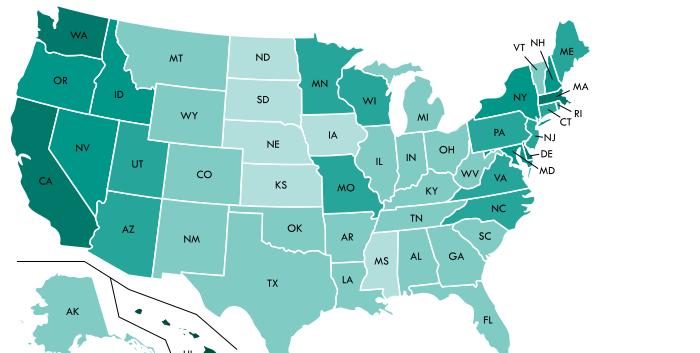
Most common states for systems analyst programmers
| Rank | State | Population | # of jobs | Employment/ 1000ppl |
|---|---|---|---|---|
| 1 | District of Columbia | 693,972 | 508 | 73% |
| 2 | Virginia | 8,470,020 | 2,176 | 26% |
| 3 | Alaska | 739,795 | 190 | 26% |
| 4 | Delaware | 961,939 | 225 | 23% |
| 5 | North Dakota | 755,393 | 175 | 23% |
| 6 | Vermont | 623,657 | 145 | 23% |
| 7 | Maryland | 6,052,177 | 1,360 | 22% |
| 8 | New Hampshire | 1,342,795 | 301 | 22% |
| 9 | Rhode Island | 1,059,639 | 219 | 21% |
| 10 | Oregon | 4,142,776 | 820 | 20% |
| 11 | South Dakota | 869,666 | 173 | 20% |
| 12 | Wyoming | 579,315 | 113 | 20% |
| 13 | Massachusetts | 6,859,819 | 1,322 | 19% |
| 14 | Minnesota | 5,576,606 | 1,047 | 19% |
| 15 | Washington | 7,405,743 | 1,322 | 18% |
| 16 | New Mexico | 2,088,070 | 378 | 18% |
| 17 | Nebraska | 1,920,076 | 355 | 18% |
| 18 | North Carolina | 10,273,419 | 1,710 | 17% |
| 19 | Arizona | 7,016,270 | 1,215 | 17% |
| 20 | Montana | 1,050,493 | 181 | 17% |
Most common cities for systems analyst programmers
| Rank | City | # of jobs | Employment/ 1000ppl | Avg. salary |
|---|---|---|---|---|
| 1 | Miami | 1 | 0% | $70,028 |
| 2 | New Orleans | 1 | 0% | $69,212 |
| 3 | Phoenix | 1 | 0% | $80,692 |
Systems Analyst Programmer job outlook: Expert opinions
Our panel of systems analyst programmer experts
Kent State University
Widener University
Siena College
University of Maine
Davidson College
California State University - Bakersfield
Harding University
University of Houston - Downtown
Mercer University
The University of the South
What Systems Analyst Programmer skills would you recommend for someone trying to advance their career?
Sepehr Mohammadian: 1. This is a pretty broad question. CS degree graduates can engage in different tasks and responsibilities based on the nature of their profession. Examples include 1) software engineering, in which the individual's efforts are toward leading or contributing to software development projects, 2) IT management, where the individual mainly oversees technology strategies and their implementation, 3) cybersecurity, where the individual's responsibilities are associated with the protection of systems and data from cyber threats, and 4) data and AI engineering, where the individual works on machine learning applications and analyze and derive insights from large datasets.
What general advice would you give to a Systems Analyst Programmer?
Dr. Swagata Banerjee PhD: Research salary benchmarks: Before negotiating your salary, research industry standards and typical salary ranges for your role and level of experience. Highlight your value: During interviews and salary negotiations, emphasize your skills, qualifications, and any relevant experience that sets you apart from other candidates. Negotiate strategically: Approach salary negotiations with confidence, but also be willing to compromise. Consider other factors such as benefits, professional development opportunities, and work-life balance. Consider long-term growth: While salary is important, also consider the potential for career advancement, learning opportunities, and overall job satisfaction when evaluating job offers. Continue to increase your value: Invest in continuous learning, seek out opportunities for skill development, and regularly reassess your market value as you gain experience and expertise.
What Systems Analyst Programmer skills would you recommend for someone trying to advance their career?
Dr. Swagata Banerjee PhD: Digital literacy: As technology continues to evolve, proficiency in digital tools and platforms will become increasingly essential. Adaptability: The ability to quickly learn new skills and adapt to changing circumstances will be crucial in a rapidly evolving industry landscape. Data literacy: Understanding and analyzing data will become more important for making informed decisions and optimizing strategies. Interdisciplinary skills: The ability to work across different disciplines and collaborate effectively with diverse teams will be highly valued. Emotional intelligence: Soft skills such as empathy, communication, and teamwork will continue to be in demand as workplaces become more interconnected and dynamic.
What general advice would you give to a Systems Analyst Programmer?
Rebecca MacGowan: My general advice is to work backwards and start your career by thinking about what you want to achieve long term. When you think about your career in ten or twenty years, what position are you in? Once you have an idea of the type of position you would like to be in during the middle and/or late stage of your career, go on LinkedIn and look up individuals who currently hold that position and see what their career trajectory was. What positions provided them the stepping stones to achieve the career you currently aspire to? By working backwards, you can ensure that your initial position is setting you up for your long-term goals. Additionally, what you are likely to find when you look at the career paths of different folks is that there are often many paths leading to your ideal future position. Hopefully, this broadens your perspective regarding what position you need right now and how different positions can help set you up for your desired future career. Often, unless we are exceptionally fortunate, our first career after undergraduate isn’t going to be our ideal position, but with proper planning, it can be the first step towards our ideal position.
What will help Systems Analyst Programmers increase their earning potential?
Rebecca MacGowan: Maximizing salary potential at any stage of your career is related to how you as a candidate can create value (tangible and intangible) in the organization as well as establishing to the organization the idea of scarcity as it pertains to your profile as a job candidate. Start by assessing what your value add as a candidate is to the company. What hard and soft skills do you have related to your specific field, or the position you are interested in, that you should be compensated for? Establishing this helps you to secure your baseline compensation. Then, in order to further maximize your pay and benefits, it is important to communicate with recruiters and hiring managers how your particular mix of skills is unique and would be difficult to find in another candidate. This creates the scarcity regarding your candidate profile and incentivizes the company to compensate you at a higher level in order to recruit you into the organization. Not only do you have valuable skills, but finding a similar candidate would take significant time and effort, ultimately costing the organization more, so they would be better off allocating that money to giving you a better offer.
Prof. Mohammad Elahee Ph.D.
Perlroth Professor of Int’l. BusinessWhat general advice would you give to a Systems Analyst Programmer?
Prof. Mohammad Elahee Ph.D.: The main advice I would give to a new graduate is to be prepared for continuous learning for the rest of his working life. AI and other technological breakthroughs are changing the job market landscape. The skillset that would help one get a job would not keep him/her there for long. To remain marketable, one has to regularly acquire new skills, develop and maintain a strong professional network and scan the market regularly to gauge impending changes.
Dany Doueiri
ProfessorWhat will help Systems Analyst Programmers increase their earning potential?
Dany Doueiri: Ability to adapt to new realities, creativity, ethics, innovation, and resilience to face new realities.
What will help Systems Analyst Programmers increase their earning potential?
Bradley Andrew Ph.D.: Once you have your first job, ask about or determine the 20% of your supervisor’s job that they hate and start doing that for them. They will love you for it and it will quickly get you recognition. You’ll also be well on your way to learning your boss’s job. Continue doing this as you progress in your career (Kudos to Theo Epstein, former GM for the Red Sox, for this recommendation)
No matter the task you’re given, do it to the absolute best of your abilities. In the professional world, you may often be given menial tasks or tasks that you don’t believe are part of your job description. Doing those tasks to the absolute best of your ability leads to increased trust, recognition and responsibility and will put you “above class.” If asked, the coffee you bring should be the best your boss has ever had. You never know who’s watching.
Don’t expect credit and don’t ask for credit when things go right; give the credit to others.
What Systems Analyst Programmer skills would you recommend for someone trying to advance their career?
Dr. Vaneet Kaur: There are two sets of skills I will highly encourage graduates to proactively start building. Firstly, business graduates need to develop higher-order skills and capabilities like knowledge-based dynamic capabilities. These will help them to (a) constantly collect knowledge about emerging opportunities (and threats) in the industry, (b) mobilize themselves and their resources to bring identified opportunities into fruition, and (c) constantly renew their skills to effectively respond to the changes in the environment. Developing such knowledge-based dynamic capabilities will automatically prepare them for the different waves of skill set requirements that will keep arising in the job market. Secondly, it is no secret that we are living in the times of artificial intelligence and automation. So, in this day and age, it is extremely important that graduates learn to ride the wave of automation rather than being discouraged by it. Business graduates are set to contribute to the world with their business acumen and expertise, what they can do to complement it is to develop low-code, no-code skills. Such skills will help graduates to automate routine processes so that their time and energies can be strategically channelized towards those activities and processes that can add significant value to their organizations.
Tongyang Yang Ph.D.
Assistant Professor of Economics and Business AnalyticsWidener University
Business/Commerce
What general advice would you give to a Systems Analyst Programmer?
Tongyang Yang Ph.D.: There are many reasons that people like about being a business analyst, including reasons listed as follows: 1. Analytical Skills and Data Exploration: BAs often analyze data to understand trends and identify areas for improvement. Seeing a successful implementation and its positive impact can be very rewarding. 2. Problem-solving. BAs get to identify inefficiencies and propose solutions that can improve how a business operates. 3. Continuous learning. Business analysts may work on a range of projects and the field of business analysis may be constantly evolving, which required BAs to actively cultivate skills in new businesses. For example, the coming of the AI era requires BAs to master AI fundamentals and data fluency. 4. While some thrive on the problem-solving and communication aspects of a BA role, others may find them less appealing. Carefully consider your personality and preferences to see if this aligns with your career goals.
What general advice would you give to a Systems Analyst Programmer?
Sunita Goel PhD: Great. Will send you the responses soon. Please let me know the latest deadline by which you need them.
What general advice would you give to a Systems Analyst Programmer?
Dr. Ryan LaRochelle Ph.D.: Be flexible. Today's job market is not the same as the one that your parents or grandparents entered into. It's unlikely that you'll be with the same company for your entire working career, so look at every experience as a potential opportunity to learn and explore. Also, the work environment you're joining is more important than the job title and position description. Do some research about what it's like to work at the place that is looking to hire you, and don't be afraid to reach out to current employees to get some candid feedback. Your job title and job description is much easier to change or renegotiate over time, but it's really hard to completely transform a toxic organizational culture and environment.
What Systems Analyst Programmer skills would you recommend for someone trying to advance their career?
Dr. Ryan LaRochelle Ph.D.: Don't be afraid to negotiate. The labor market is incredibly tight at the moment, so employees have more leverage than they've had in decades. Your starting salary and benefits package will be the baseline for any negotiation moving forward, so use the leverage you have now to get the best package you can get. Also, think carefully about how different compensation and benefit packages interact with other factors in the state or region where you're looking to work.
What general advice would you give to a Systems Analyst Programmer?
Oliver Keys Jr: The power of mentorships and networking early in your career will be beneficial in the long run. Also, understanding that professional skills can be half the battle. Showing up on time, dressing appropriately, and communicating effectively can be challenging for some students. Internships and externships are great for students to get technical and professional experience.
What Systems Analyst Programmer skills would you recommend for someone trying to advance their career?
Prof. Kim Jovanovich P.E.: Attached please see the responses to your interview questions. I hope this sheds some light on the questions you asked!
Katie Horowitz
Associate Professor of Gender & Sexuality StudiesDavidson College
Ethnic, Cultural Minority, Gender, And Group Studies
What Systems Analyst Programmer skills would you recommend for someone trying to advance their career?
Katie Horowitz: Some research shows that women and members of marginalized racial groups are less likely to negotiate their salaries than their white male counterparts. When you get a job offer, don’t forgo the opportunity to advocate for a higher salary.
Dr. John Tarjan
Chair, Management/MarketingCalifornia State University - Bakersfield
Business Administration, Management And Operations
What general advice would you give to a Systems Analyst Programmer?
Dr. John Tarjan: Before interviewing and/or starting a new job, do your homework. Learn everything you can about the company—its market, competitive strategy, culture and history. If possible, talk with people who work there or others who know the company well to get an idea what it takes to be successful there. Be respectful of the culture and traditions. Dress, speak and act as appropriate and expected. While every organization should reexamine itself occasionally, one should first demonstrate a longstanding commitment to the organization before expecting to be listened to about potential changes. Show up when expected, treat other employees, customers and suppliers with respect. While the forgoing may seem unnecessary to some to even mention, unfortunately, many, if not most employers would disagree.
What general advice would you give to a Systems Analyst Programmer?
Joseph Taylor: Effective Business Analysts are generally people who enjoy problem solving, and working through ambiguous situation. Business Analysts need to be able to figure things out with little direction, and that can be frustrating for individuals who like to follow pre-determined steps.
What will help Systems Analyst Programmers increase their earning potential?
Joseph Taylor: The role of a Business Analyst can vary greatly from company to company, and even from department to department, so it is very important to look at the details of a particular position that you are applying for. One common factor from all Business Analyst is that they are generally expected to make sense of data, and to be effective communicators that can apply insights to real-world problems.
What general advice would you give to a Systems Analyst Programmer?
Dr. Joe Faith: Skills involving how to properly use AI and AI-enabled tools will be big. We've already seen huge changes since November of 2022. I only think the life cycle for these products will continue to get shorter. It's not AI that you need to worry about displacing you from your job. It's a smart human that knows how to use AI. I think that, for IS professionals specifically, you need to focus not only on hard skills, but soft skills as well. Many individuals can either communicate well or program well but not many can do both. There is a niche there that needs to be filled.
What will help Systems Analyst Programmers increase their earning potential?
Dr. Joe Faith: I think the best general advice would be to not be scared to take a risk on yourself. There are a lot of jobs out there that people are oftentimes afraid to apply for. This can be for several factors but one of the main ones I hear is that they don't feel like they are qualified enough. I can't tell you how many times I've had students that got a job they were slightly underqualified for because they were smart, had drive, and were a great culture fit for the firm in question. Along with that, I would say that certifications can help land your first gig. After a while, in many cases, experience will be more important. But, a cert can be just the thing to get you 'over the top' and land that first job after college.
What Systems Analyst Programmer skills would you recommend for someone trying to advance their career?
Brett Hobby M.Ed.: Based on research by the National Association of Colleges and Employers (NACE, naceweb.org), there are 'core' skills that employers expect to see in their hires and these skills don't change that much year over year. Typically, the top skill is communication. Typically, the other top skills are teamwork, critical thinking, and professionalism. Although lower down on the list, technology is always listed as an important competency by employers. With the advancements of Artificial Intelligence (AI), and in talking to employers at our Career Fairs, they also think students' technology skills should include familiarity with systems such as ChatGPT and Microsoft CoPilot. I've heard from companies that they are usually developing their own versions of these platforms so a student having working knowledge of this technology is advantageous.
What general advice would you give to a Systems Analyst Programmer?
Benjamin Greulich Ph.D.: I have attached my responses to those three questions. Let me know if you are looking for something a little bit different and I would be happy to reanswer/update anything!
What general advice would you give to a Systems Analyst Programmer?
Bahae Samhan: Data Analysis, Business Intelligence Analysis, Social Media Data Analysis, Database Management Systems, Data Structures and Algorithms, Cyber Security, Cloud Computing. While AI is advancing quickly, but MIS graduates are expected to utilize AI applications rather than developing it.