
Automatically apply for jobs with Zippia
Upload your resume to get started.
Systems engineer/architect skills for your resume and career
15 systems engineer/architect skills for your resume and career
1. C++
C++ is a general-purpose programming language that is used to create high-performing applications. It was invented as an extension to the C language. C++ lets the programmer have a high level of domination over memory and system resources. C++ is an object-oriented language that helps you implement real-time issues based on different data functions
- NET and Java Platforms C++ and Java languages SOAP Messaging.
- Implemented various systems-level programming using C++, Lua, DirectX, SQL Server, and TCP/IP.
2. C #
- Used WPF, WCF, and VB.Net and C # extensively.
3. Database
A database is a collection of data and information which makes it easy to view, access, and manage. Databases save a lot of time and can store huge amounts of data. Databases make sorting data easier and stores it in certain fields which narrows the searching criteria. A database usually contains tables, graphs, and columns to display data.
- Created and presented training and database provisioning documentation used for the introduction of new operator services features.
- Design included customer & portfolio database, financial forecasting/modeling, document management and corporate website/portal.
4. Cloud
Cloud is a server that is accessed over the internet. There are different programs and software that also run on these servers. These clouds can be accessed from anywhere in the world as they are not present in your computer storage, but have their online servers. Cloud consists of data centers all across the world.
- Lead Cloud Architecture Development effort that worked toward integrating a Cisco UCS with IBM Hardware into a complete IaaS foundation.
- Worked with DevOps team to leverage CHEF for hybrid cloud automation (later moved to Puppet).
5. AWS
- Developed business model for engineering companies to migrate storage and high compute intensive tasks to AWS.
- Deployed on Amazon AWS EC2, S3 and RDS, running on Postgresql DBMS, Stripe and Apache
6. Azure
- Deployed and monitored Azure-based rights management services; coordinated participation in Azure SCOM Monitoring Pilot project.
- Experienced with deployments, Maintenance and troubleshooting applications on Microsoft Cloud infrastructure Azure.
Choose from 10+ customizable systems engineer/architect resume templates
Build a professional systems engineer/architect resume in minutes. Our AI resume writing assistant will guide you through every step of the process, and you can choose from 10+ resume templates to create your systems engineer/architect resume.7. Infrastructure
Infrastructure includes the organizational and physical structures needed to run an area or a society smoothly. It is a group of basic facilities required for any society or firm to run sustainably and efficiently. The infrastructural system is a high investing area and helps majorly in flourishing the economy and prosperity of a country. It is an underlying system needed for ensuring the safety and comfort of the public and to run a country smoothly. All the tasks needed to be performed for a flourishing economy and a happy and healthy public are included in infrastructure.
- Served as Microsoft ecosystem service architect and project management, responsible for providing technical infrastructure solutions and services.
- Designed and implemented Network, System, and Storage infrastructure solutions for Transaction processing application.
8. Python
Python is a widely-known programming language. It is an object-oriented and all-purpose, coding language that can be used for software development as well as web development.
- Tested services using python based unit test scripts.
- Implemented using Python enforces configuration management using a web application, BitBucket and Atomics' CRM.
9. Java
Java is a widely-known programming language that was invented in 1995 and is owned by Oracle. It is a server-side language that was created to let app developers "write once, run anywhere". It is easy and simple to learn and use and is powerful, fast, and secure. This object-oriented programming language lets the code be reused that automatically lowers the development cost. Java is specially used for android apps, web and application servers, games, database connections, etc. This programming language is closely related to C++ making it easier for the users to switch between the two.
- Developed Java based tools for the evaluation and remediation of web sites to identify and resolve issues relating to accessibility.
- Evaluated Java based WebSphere Extreme Scale caching for persisting data across the broker topology.
10. Amazon Web Services
- Work within the Cloud Engineer group to design and build Test, Development, and Production environments in Amazon Web Services.
- Leveraged Google Maps API and Fused Location Provider for location and Amazon Web Services for cloud data storage.
11. Project Management
- Transitioned development team's informal agile practice to Scrum; guided development manager transition from traditional project management to Scrum.
- Executed all project management activities for all releases to ensure timely and quality delivery of releases.
12. DOD
Definition of Done (DoD) is a set of deliverables that are needed to devise software. These deliverables are valuable to the system and can be exemplified by writing code, coding comments, unit testing, integration testing, design documents, release notes, and so on.
- Implemented new software production and deployment methodologies that resulted in optimizing build and deployment while ensuring stringent DOD vulnerability management.
- Facilitated and delivered project deliverable results to high level members of the Federal Government and DoD.
13. JavaScript
- Develop the RIA platform for a robust Event Management System using JavaScript, ExtJs, Spring MVC, JMS and JMX.
- Contracted to develop a Customer Portal for Support Services using Spring MVC, MySQL, jQuery and OO JavaScript.
14. Web Services
A web service is software that is available on the internet and uses a specific messaging system. A web service is a kind of service that is not bound to any specific programming language or operating system. Web services help every device to communicate over the world wide web.
- Configured, upgraded and supported web services on Internet Information Services 4 and 6.
- Developed highly robust web services (C#, XML, SOAP, ADO.NET, SQL Server) for financial transactions.
15. Service Oriented Architecture
- Developed JCIDS-based service oriented architectures (SOAs) for the Air Force Satellite Control Network (AFSCN) for the SMC.
5 Systems Engineer/Architect resume examples
Build a professional systems engineer/architect resume in minutes. Browse through our resume examples to identify the best way to word your resume. Then choose from 5+ resume templates to create your systems engineer/architect resume.

What skills help Systems Engineers/Architects find jobs?
Tell us what job you are looking for, we’ll show you what skills employers want.
What skills stand out on systems engineer/architect resumes?
Austin McCoy
Director of Javelina Engineering Student Success Center, Texas A&M University - Kingsville
-Internship/co-op experience -Research experience
-Good leadership skills and involvement on campus and in the community and activities where the individual works as part of a team.
-Well written resume can tell a lot about the technical writing skill; a resume needs to be clean and comfortable to read; recruiters can find what they are looking for easily.
-Less is sometimes more because students sometimes will put more information on a resume than is pertinent to the position applying for.
What hard/technical skills are most important for systems engineer/architects?
David Garaventa
Director, Computer Information Systems and Cybersecurity Programs, Assistant Professor, CIS, Albertus Magnus College
Going deeper into the subject, technical skills around project management, cloud infrastructure, security, and end-user support bridge across all industries. Having knowledge and skills in these areas will serve IT professionals well, no matter what field or industry they end up in. Again, it is challenging to recommend specific technical skills because the field of IT is so broad.
What soft skills should all systems engineer/architects possess?
Brian Kelly
Associate Dean for Development and Faculty Affairs, Area Chair / Director, Architecture Program, University of Maryland
What systems engineer/architect skills would you recommend for someone trying to advance their career?
Dr. Ariful Azad Ph.D.
Director of Graduate Studies for the Dept. of Intelligent Systems Engineering, Assistant Professor of Intelligent Systems Engineering, Indiana University Bloomington
What type of skills will young systems engineer/architects need?
Michael Armstrong
CEO, NCARB
We also encourage graduates, and all who are considering the licensed practice as a career, to explore our newly-launched Destination Architect site, an interactive guide with video tutorials and useful tips.
List of systems engineer/architect skills to add to your resume
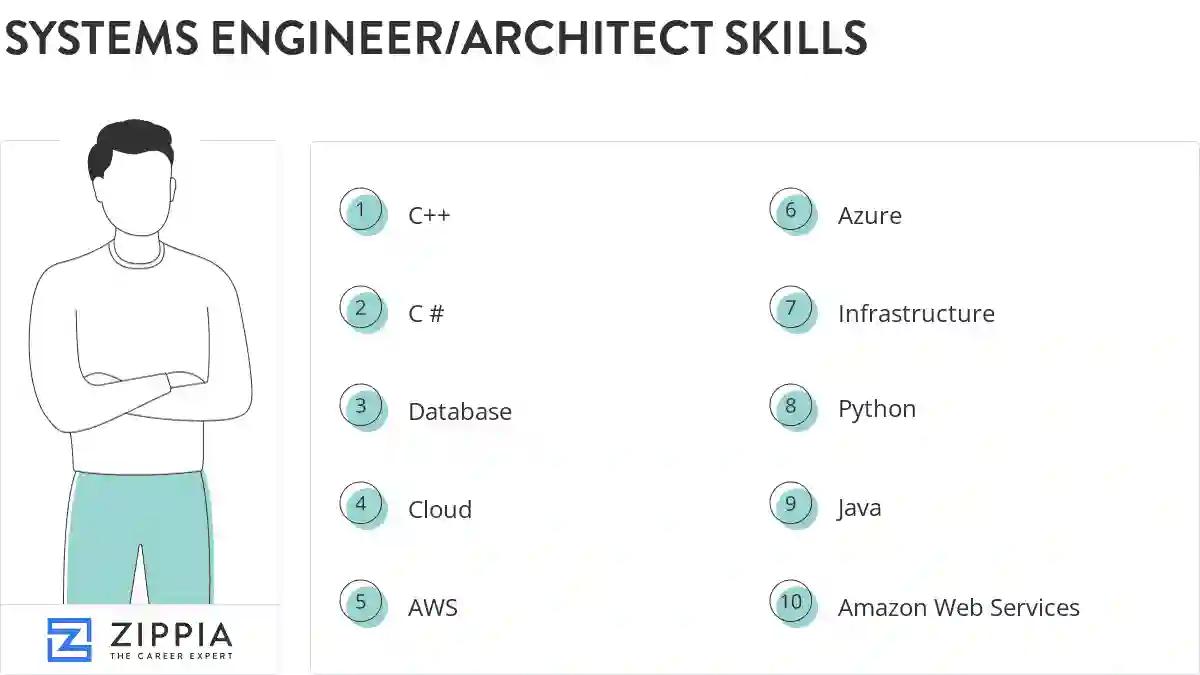
The most important skills for a systems engineer/architect resume and required skills for a systems engineer/architect to have include:
- C++
- C #
- Database
- Cloud
- AWS
- Azure
- Infrastructure
- Python
- Java
- Amazon Web Services
- Project Management
- DOD
- JavaScript
- Web Services
- Service Oriented Architecture
- UML
- Prototyping
- Linux
- SOA
- Emerging Technologies
- System Architecture
- OS
- Unix
- VMware
- Cloud Computing
- Virtualization
- Enterprise Architecture
- API
- Disaster Recovery
- SAN
- Troubleshoot
- Configuration Management
- UI
- EMC
- PowerShell
- Provisioning
- Pre Sales
- RFP
- NetApp
- Jenkins
- Switches
- SME
- Tcp Ip
- Fire Protection
- Management System
- Ruby
- QA
- Debugging
Updated January 8, 2025
