
Automatically apply for jobs with Zippia
Upload your resume to get started.
Systems lead programmer skills for your resume and career
15 systems lead programmer skills for your resume and career
1. Mainframe
A mainframe is a high-performance digital computer used by large organizations for mission-critical applications, high transaction volumes, and reliable performance, designed for intensive high-speed computing for large-scale computing purposes that require greater availability and security which a smaller machine cannot offer.
- Developed mainframe software environment and configuration definitions while transparently resolved all connections issues and successfully converted 600 users on schedule.
- Initiated a comprehensive Mainframe Performance Study and implemented best practice solutions.
2. MQ
- Installed, implemented and performed duties of administrator of MQ Series Version 2.1.
- Created several Word documents that are used currently for requesting MQ definitions for Mainframe Systems and Information Security personnel.
3. Disaster Recovery
The ability or procedure by which an organization regains its access and control over its IT framework after an unwanted disaster such as natural calamity or a cyberattack.
- Coordinated and implemented preliminary IBM 3494 Automated Tape Library used as Disaster Recovery libraries for Business Contingency.
- Established and implemented Backup and Recovery strategies, including Disaster recovery tests.
4. DB2
The DB2, known as the Relational Database Management System, is a type of procedure developed by IBM to run and operate software applications such as Windows, Unix, and the Linux System. This type of system is designed mainly for IBM but was innovated to run in various operating systems. The main feature of the DB2 is to handle and manage a big chunk of data while allowing the users to enter the database engine without any problem.
- Conducted periodic presentations on DB2 performance topics.
- Authored portions of the internal Data Manager manuals for IBM for low level I/O of VSAM, CICS, & DB2.
5. CICS
- Lead systems programmer and project manager for CICS TS 1.3 to 2.3 upgrade.
- Worked with programmers to put their CICS applications into production.
6. Technical Support
Technical support or tech support are the services provided by any hardware or software company to users. They help in solving the technical difficulties the customers face with their products or services. Moreover, the tech support employees maintain, manage, and repair the IT faults. They are also responsible for resolving the network problems, installing and configuring hardware and software.
- Provided the primary technical support to the applications programming community in all facets of operating systems issues and facilities
- Provide technical support for financial institutions and merchants.
Choose from 10+ customizable systems lead programmer resume templates
Build a professional systems lead programmer resume in minutes. Our AI resume writing assistant will guide you through every step of the process, and you can choose from 10+ resume templates to create your systems lead programmer resume.7. Software Products
- Installed and maintained third party software products at four data processing centers.
- Developed, customized, and evaluated software products.
8. Java
Java is a widely-known programming language that was invented in 1995 and is owned by Oracle. It is a server-side language that was created to let app developers "write once, run anywhere". It is easy and simple to learn and use and is powerful, fast, and secure. This object-oriented programming language lets the code be reused that automatically lowers the development cost. Java is specially used for android apps, web and application servers, games, database connections, etc. This programming language is closely related to C++ making it easier for the users to switch between the two.
- Implemented tape encryption, as team member responsible for ACF2 rules and USS and Java configuration resulting in secure off-site backups.
- Coded and supported a JAVA plugin to extract existing information residing in PDS libraries using IBM's JAVA SDK.
9. TCP/IP
- Designed and implemented data replication schemes using TCP/IP, UUCP, Term and e-mail.
- Learned UNIX and TCP/IP as mini-systems became part of our job.
10. OEM
OEM stands for Original Equipment Manufacturer and is a term for a company that produces and markets the parts of equipment for another company after having received the go-ahead to do so. The company can also produce devices from the combination of parts from different companies while in partnership with these companies. This is common in the computer hardware industry and is popular in the automobile and computer industries.
- Team Lead for 5 z/OS System Programmers, providing z/OS System and OEM Software installations/upgrades on the AT&T Account.
- Resulted in savings of 1 million+ dollars on OEM product contracts.
11. Z/OS
- Led a group of 5 Z/OS systems programmers who maintained 2 Z/OS main frames.
- Lead systems programmer on upgrades from OS/390 2.6 to 2.10, and on OS/390 2.10 to z/OS 1./3.
12. Application Development
- Led application development of the Quality Control system for West Virginia's welfare system.
- Project analysis, application development of data conversion programs in support of Y2K modifications for the Florida Medicaid system
13. Linux
Linux is a Unix-like operating system. Just like Windows, Mac OS, and IOS, Linux is an operating system used by millions across the globe. Android itself is powered by the Linux operating system. Linux manages all the hardware resources that are associated with your computer. The software is famous because of the protection it grants from viruses, malware, and crashes. The Linux operating system is entirely free and is an open-source software meaning it can be altered by those equipped with the knowledge to code.
- Designed and implemented a redundant load balanced web cluster utilizing 6 Linux nodes.
- Lead engineer responsible for 97 VMware ESX hosts with 800+ Windows [ ] and Linux guests.
14. SAS
SAS stands for Statistical Analysis System which is a Statistical Software designed by SAS institute. This software enables users to perform advanced analytics and queries related to data analytics and predictive analysis. It can retrieve data from different sources and perform statistical analysis on it.
- Manage team responsible for creating turnkey presentation quality reports of statistical data using SAS and Microsoft Office/Visual Basic programming.
- Designed and created SAS on-line system allowing analysts easy access to survey data and improved self-sufficiency.
15. LPAR
- Participated in major workload splits creating new LPAR's while providing DASD and tape support for the process.
- Achieved improved efficiency and cost reduction goals through efforts and expertise provided in multiple LPAR eliminations and data center consolidations.
5 Systems Lead Programmer resume examples
Build a professional systems lead programmer resume in minutes. Browse through our resume examples to identify the best way to word your resume. Then choose from 5+ resume templates to create your systems lead programmer resume.

What skills help Systems Lead Programmers find jobs?
Tell us what job you are looking for, we’ll show you what skills employers want.
List of systems lead programmer skills to add to your resume
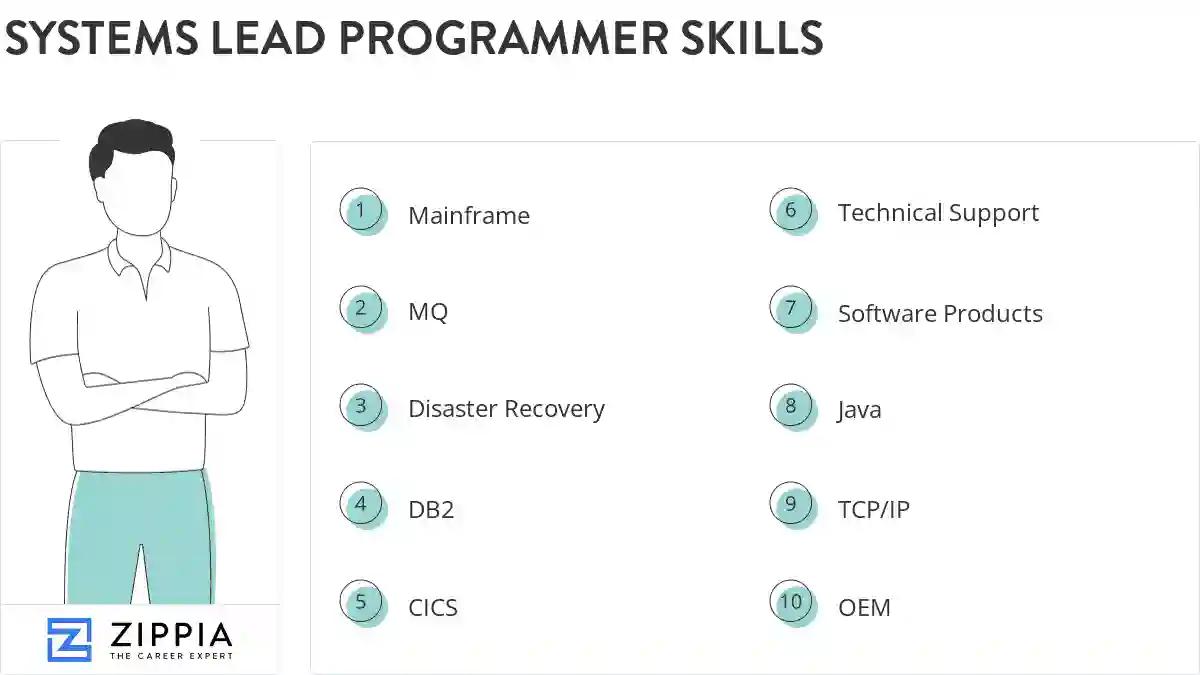
The most important skills for a systems lead programmer resume and required skills for a systems lead programmer to have include:
- Mainframe
- MQ
- Disaster Recovery
- DB2
- CICS
- Technical Support
- Software Products
- Java
- TCP/IP
- OEM
- Z/OS
- Application Development
- Linux
- SAS
- LPAR
- Servers
- Unix
- Debugging
- JavaScript
- Vtam
- Problem Resolution
- Data Centers
- Windows
- Capacity Planning
- CSS
- SMP/E
- TSO
- ISPF
- Management System
- PL/SQL
- SMF
- Problem Determination
- Omegamon
- VM
- HTML
- Connect Direct
- REXX
- PC
- JCL
- PHP
- Dasd
- Payroll
- IMS
- Perl
- RACF
Updated January 8, 2025
