Explore jobs
Find specific jobs
Explore careers
Explore professions
Best companies
Explore companies
Job outlook for teachers of the deaf/hard of hearing in the United States
Are teacher of the deaf/hard of hearing jobs in demand?
Teacher of the deaf/hard of hearing job and salary trends over time
Teacher of the deaf/hard of hearing jobs over time
Teacher of the deaf/hard of hearing job growth rate over time
| Year | # of jobs | % of population |
|---|---|---|
| 2021 | 1,441 | 0.00% |
| 2020 | 1,475 | 0.00% |
| 2019 | 1,513 | 0.00% |
| 2018 | 1,462 | 0.00% |
| 2017 | 1,460 | 0.00% |
Average teacher of the deaf/hard of hearing salary over time
Teacher of the deaf/hard of hearing salary by year
| Year | Avg. salary | Hourly rate | % Change |
|---|---|---|---|
| 2026 | $62,997 | $30.29 | +0.3% |
| 2025 | $62,831 | $30.21 | +1.8% |
| 2024 | $61,719 | $29.67 | +1.3% |
| 2023 | $60,898 | $29.28 | +2.7% |
| 2022 | $59,276 | $28.50 | +2.2% |
Teacher of the deaf/hard of hearing jobs by state
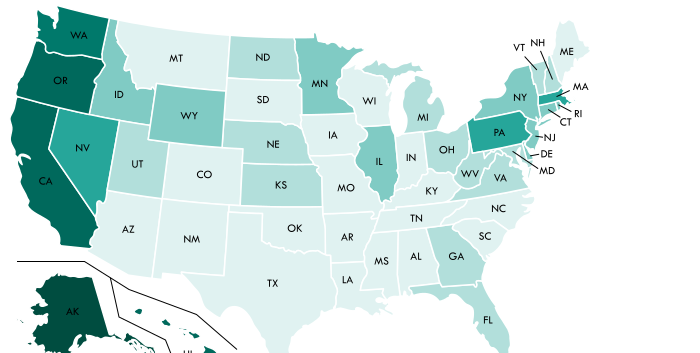
Most common states for teachers of the deaf/hard of hearing
| Rank | State | Population | # of jobs | Employment/ 1000ppl |
|---|---|---|---|---|
| 1 | New Hampshire | 1,342,795 | 308 | 23% |
| 2 | District of Columbia | 693,972 | 145 | 21% |
| 3 | Delaware | 961,939 | 188 | 20% |
| 4 | Vermont | 623,657 | 126 | 20% |
| 5 | Montana | 1,050,493 | 199 | 19% |
| 6 | Maryland | 6,052,177 | 1,007 | 17% |
| 7 | Colorado | 5,607,154 | 964 | 17% |
| 8 | Connecticut | 3,588,184 | 622 | 17% |
| 9 | Arizona | 7,016,270 | 1,106 | 16% |
| 10 | Wyoming | 579,315 | 94 | 16% |
| 11 | Nevada | 2,998,039 | 452 | 15% |
| 12 | New Mexico | 2,088,070 | 323 | 15% |
| 13 | Illinois | 12,802,023 | 1,824 | 14% |
| 14 | New Jersey | 9,005,644 | 1,255 | 14% |
| 15 | Minnesota | 5,576,606 | 797 | 14% |
| 16 | Massachusetts | 6,859,819 | 859 | 13% |
| 17 | Nebraska | 1,920,076 | 253 | 13% |
| 18 | Kansas | 2,913,123 | 345 | 12% |
| 19 | Idaho | 1,716,943 | 211 | 12% |
| 20 | Alaska | 739,795 | 80 | 11% |
Most common cities for teachers of the deaf/hard of hearing
| Rank | City | # of jobs | Employment/ 1000ppl | Avg. salary |
|---|---|---|---|---|
| 1 | Flint | 7 | 7% | $61,602 |
| 2 | Bridgeton | 1 | 4% | $73,379 |
| 3 | Fredericksburg | 1 | 4% | $63,291 |
| 4 | Kennesaw | 1 | 3% | $62,403 |
| 5 | Marietta | 1 | 2% | $62,401 |
| 6 | Colorado Springs | 1 | 0% | $54,791 |
Teacher Of The Deaf/Hard Of Hearing job outlook: Expert opinions
Our panel of teacher of the deaf/hard of hearing experts
California State University - Fullerton
University of Minnesota - Twin Cities
University of Utah

Texas A & M University, Kingsville
Augustana University
Tiffany Row Ph.D.
Program Coordinator, MMSN and ESNCalifornia State University - Fullerton
Special Education And Teaching
What Teacher Of The Deaf/Hard Of Hearing skills would you recommend for someone trying to advance their career?
Tiffany Row Ph.D.: There has been an increasing focus on social emotional learning in schools, and these skills are just as important for teachers to grow within themselves so they can best support and guide students in learning to regulate their emotions and navigate social relationships. And of course it's always crucial for teachers to have strong skills in literacy instruction.
What will help Teachers Of The Deaf/Hard Of Hearing increase their earning potential?
Amy Kunkel Ph.D.: To maximize your salary potential, first ask to see the hiring district’s salary schedule. Most districts operate on a “step and lane” system in which you receive higher pay for each year of service (step) and receive substantial raises for additional degrees earned (lane). For example, some districts will raise your salary for every 15 graduate credits you have earned, maximizing at a terminal degree. Teachers with a master’s degree + additional credits will earn substantially more than those without a master’s degree.
What will help Teachers Of The Deaf/Hard Of Hearing increase their earning potential?
Breda O’Keeffe Ph.D.: Before even starting your career in special education, look for programs and scholarships that provide financial support for your education and teaching license/credential. Because special education teachers are in high demand, many states, districts, and institutes of higher education provide financial incentives and supports for preservice teachers. Another option is to look for programs that provide loan forgiveness for working in high need areas (e.g., special education), schools (e.g., Title I schools), or districts. Graduating with low or no debt can help maximize your take-home pay as a teacher. Also, be aware that each state has its own teacher licensing/credentialing systems and that licenses/credentials do not always transfer directly when going from one state to another. If you know what state you will be teaching in, make sure your license/credential will be easily recognized in that state (or you may face additional educational requirements and costs). In addition, be aware that teacher salaries vary widely across states, across cities within states, and across different settings (e.g., private, public, preschool, K-12, etc.). In seeking preparation to become a special education teacher, you have many options that will ultimately affect your salary potential. Alternative routes to licensure which do not include the typical supports of a traditional teacher education program may be tempting, because they tend to be shorter and less expensive. Unfortunately, special education teachers prepared through these routes leave the field sooner and at higher rates than teachers provided with higher quality training at an institute of higher education (e.g., colleges and universities). Look for accredited programs that provide hands-on instruction and multiple supervised field experiences in the settings you will be teaching in, with high quality supervision and feedback (e.g., from a faculty member with teaching experience in your area), support for preparing for licensing/credentialing requirements, and instruction in evidence-based practices in academics, classroom management, intensive behavior supports, assessment, and special education law and policy. You will be more competitive when you start and more likely to persist, which will make the costs of your education worthwhile! When you are seeking a job, district salary schedules are posted on their respective websites. If salary is of utmost interest to you, start looking for high paying districts. Typically, charter and private schools do not have posted salary schedules, but if you are applying to those institutions, you should feel comfortable asking them to match the neighboring district pay. Some districts also offer additional compensation through incentive programs, “buying out” preparation periods, or other school-related duties. Don’t jump into committees and “extra duties” right away. Look for incentive programs specifically for high needs areas, such as special education. For example, in Utah, special education teachers can access the Teacher Salary Supplement Program (TSSP). This fund serves to reward and retain qualified educators in positions that have been identified as having staffing shortages. The state has also provided additional paid workdays outside of contract days to special education teachers to help prepare files and paperwork at the start or end of the school year. In addition, you can increase your pay by seeking further education such as a master’s degree or endorsements.
Dr. Patricia Huskin Ph.D.
Associate Professor, Special Education Undergraduate & Graduate Program CoordinatorTexas A & M University, Kingsville
Department of Teacher & Bilingual Education
What skills stand out on Teacher Of The Deaf/Hard Of Hearing resumes?
Dr. Patricia Huskin Ph.D.: Since the demand for qualified special education teachers exceeds supply in all 50 states across the US, I think candidates with advanced degrees on their resumes stand out. A graduate degree in Special Education prepares educators for advanced expertise in culturally and linguistically responsive special education services to students with both high-incidence and low-incidence disabilities. They are skilled in theory and pedagogy, assessment, and classroom management. They are prepared to become instructional leaders on their campuses.
What hard/technical skills are most important for Teachers Of The Deaf/Hard Of Hearing?
Dr. Patricia Huskin Ph.D.: The technical or "Hard Skills" are the core of effective and successful special educators. These skills are:
-Critical Knowledge of theory and practice in special education instructional strategies, accommodations, modifications, and differentiation strategies.
-Assessment knowledge and data collection skills; ability to use assessment data to inform instructional decision making for continuous student improvement and success.
-Critical knowledge of behavior principles and classroom management skills for a safe and positive learning climate.
-Critical knowledge of special education law and advocacy. A special education teacher must adhere to special education law, assure the rights of their students are upheld, and advocate for their students on a daily basis.
Dr. Michelle Powers
Assistant Professor of Special EducationAugustana University
School of Education
How do you envision technology impacting Teachers Of The Deaf/Hard Of Hearing in the next 5 years?
Dr. Michelle Powers: The importance of a skilled professional in the classroom continues to be the most critical factor in influencing student educational achievement. Being proficient in using technology, as a school tool, has never been more essential than today, but its value will never be outweighed by the teacher who wields the tool. Educators are challenged to remain current, as technology continues to evolve, which can be overwhelming, especially to the new teaching professional. Using your mentors and staying focused on the purpose of technology in the classroom will help to streamline the selection and integration of the most influential technology practices in the school. It is an exciting time to be an educator, and technology is a big part of that excitement. Still, ultimately, the real excitement is in seeing students engaged, excited, and learning.