Explore jobs
Find specific jobs
Explore careers
Explore professions
Best companies
Explore companies
Job outlook for technical support analyst leads in the United States
Technical support analyst lead job growth summary. After extensive research, interviews, and analysis, Zippia's data science team found that:
The projected technical support analyst lead job growth rate is 10% from 2018-2028.
About 83,100 new jobs for technical support analyst leads are projected over the next decade.
Technical support analyst lead salaries have increased 9% for technical support analyst leads in the last 5 years.
There are over 154,960 technical support analyst leads currently employed in the United States.
There are 159,204 active technical support analyst lead job openings in the US.
The average technical support analyst lead salary is $108,371.
Are technical support analyst lead jobs in demand?
Technical support analyst lead job and salary trends over time
Technical support analyst lead jobs over time
Technical support analyst lead job growth rate over time
| Year | # of jobs | % of population |
|---|---|---|
| 2021 | 154,960 | 0.05% |
| 2020 | 171,572 | 0.05% |
| 2019 | 134,175 | 0.04% |
| 2018 | 104,888 | 0.03% |
| 2017 | 102,246 | 0.03% |
Average technical support analyst lead salary over time
Technical support analyst lead salary by year
| Year | Avg. salary | Hourly rate | % Change |
|---|---|---|---|
| 2026 | $108,371 | $52.10 | +3.4% |
| 2025 | $104,800 | $50.38 | +2.3% |
| 2024 | $102,428 | $49.24 | +1.5% |
| 2023 | $100,881 | $48.50 | +1.7% |
| 2022 | $99,233 | $47.71 | +1.6% |
Technical support analyst lead jobs by state
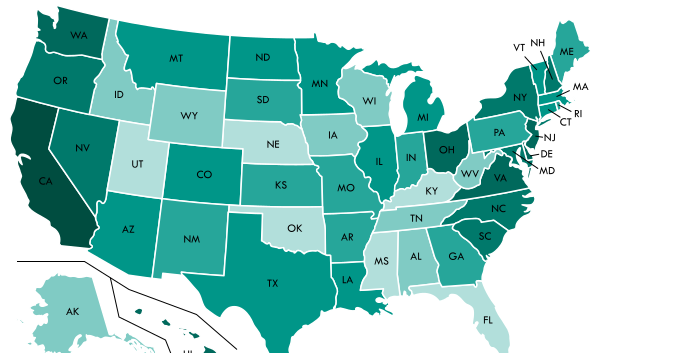
Most common states for technical support analyst leads
| Rank | State | Population | # of jobs | Employment/ 1000ppl |
|---|---|---|---|---|
| 1 | District of Columbia | 693,972 | 371 | 53% |
| 2 | New Hampshire | 1,342,795 | 666 | 50% |
| 3 | Vermont | 623,657 | 286 | 46% |
| 4 | North Dakota | 755,393 | 285 | 38% |
| 5 | Nebraska | 1,920,076 | 713 | 37% |
| 6 | South Dakota | 869,666 | 321 | 37% |
| 7 | Wyoming | 579,315 | 199 | 34% |
| 8 | Montana | 1,050,493 | 332 | 32% |
| 9 | Alaska | 739,795 | 240 | 32% |
| 10 | Rhode Island | 1,059,639 | 320 | 30% |
| 11 | Utah | 3,101,833 | 896 | 29% |
| 12 | Arkansas | 3,004,279 | 880 | 29% |
| 13 | Missouri | 6,113,532 | 1,737 | 28% |
| 14 | New Mexico | 2,088,070 | 567 | 27% |
| 15 | Idaho | 1,716,943 | 445 | 26% |
| 16 | Kentucky | 4,454,189 | 1,094 | 25% |
| 17 | Nevada | 2,998,039 | 732 | 24% |
| 18 | Hawaii | 1,427,538 | 341 | 24% |
| 19 | Illinois | 12,802,023 | 2,693 | 21% |
| 20 | Kansas | 2,913,123 | 619 | 21% |
Technical Support Analyst Lead job outlook: Expert opinions
Our panel of technical support analyst lead experts
Massachusetts Maritime Academy
Tuskegee University

SUNY Potsdam

California State University - Long Beach
Dominican University
NCWIT
Loyola University Chicago
What Technical Support Analyst Lead skills would you recommend for someone trying to advance their career?
Mark Whalen P.E.: Many system engineers enjoy working across all technologies at a higher organizational level, and interacting with all types of technologists to manage and implement complex technical systems.
Many system engineers can feel challenged by their lack of depth of understanding of particular technologies compared to technical specialists.
Laura Kier
Network Design and Administration InstructorWhat general advice would you give to a Technical Support Analyst Lead?
Laura Kier: Students graduating from the Computer Network Design and Administration program will enter the job market with a solid foundation in networking technologies. Above that they should also be able to develop and demonstrate excellent communication and interpersonal skills. Networking has a strong emphasis on teamwork and being able to communicate well with customers, co-workers and teammates is vital. Attaining certifications in Cisco, Linux, Windows, and security will also help the student stand out within the industry (classes in the program help to learn the knowledge needed to attain certifications). Students should participate in any local or online communities and groups to enhance skills and knowledge and find networking opportunities.
What Technical Support Analyst Lead skills would you recommend for someone trying to advance their career?
Laura Kier: Computer Networking is a dynamic field with a wide variety of opportunities in many different industries. Some skills that will be more important in general are skills in software defined networking and automation. Skills in the DevOps field will be necessary, as well as skills leveraging AI tools. Cybersecurity is always important and using AI tools to enhance security and monitoring is necessary.
What will help Technical Support Analyst Leads increase their earning potential?
Laura Kier: Learn to present your skills well from the interview and into your career. Those communication skills count! Industry certifications like CCNA matter. They help you demonstrate a willingness to grow and learn beyond what was required for your degree. Be willing to take on new challenges with your new job and keep learning new skills. It is really important for graduates to understand that talented IT professionals can move up quickly in a company, but they often must start at the bottom to showcase their technical and soft skills. Because of that, they should not shy away from entry level jobs if there is potential for growth.
Dalya Fadlalla
Adjunct FacultyTuskegee University
Computer/Information Technology Administration And Management
What general advice would you give to a Technical Support Analyst Lead?
Dalya Fadlalla: People who work as A_AN JOB_TITLE may enjoy their work because they know what is expected from them, as it is clear on JOB_TITLE. It also, helps them be unstressed due to the clear responsibility. They can have a great opportunity to learn new skills, which has a significant impact on their organization.
Some people may find the work is more stressful, challenging, and need long hours
As a Computer Information Systems graduate entering the job market, they can explore what people like and dislike about being a Computer Information Systems professional.
Many people like working in this field, as Technology advances very fast there is always something new to learn and discover. Others may think it is hard to keep up with new technologies.
Many people appreciate that their work has a significant impact on the world. For example, if they are developing new software.
Therefore, this will depend on the person, and how he sees working in this field. By understanding the advantages and disadvantages of the field, you can make you can decide if this is the right path for you.
What's a good job out of college for Technical Support Analyst Leads?
Christopher Lanz: The industry is screaming for qualified techies. In Burlington, for example, firms are unable to fnd who they need. Firms actually compete for our graduates. Any job in the industry, therefore, tends to be high-paying and secure.
What are the biggest trends we'll see in the Technical Support Analyst Lead job market given the pandemic?
Dr. Lesley Farmer: Many employees have trouble pivoting to online work so in the short term, tech support and instructional design jobs are in high demand. Data privacy and security are also hot topics and need ed tech expertise. Tech maintenance, including cloud services and networks, continue to be needed, rather like car maintenance. Thinking forward, software development is another area of need, particularly with more online-based education. If grads have data analytics expertise, they can find jobs on data management and learning analytics.
Disabilities continue to be an issue, particularly in terms of equity, so jobs dealing with assistive technology and other ed tech supports are possible. Finally, grads should broaden their concept of educational settings; informal education is more important than ever: in business/HR, libraries and museums, recreational and youth-serving clubs, mass media, government and non-profit agencies. All of these entities are involved in training, outreach, PR, and public awareness/education. Be creative and persistent.
What general advice would you give to a Technical Support Analyst Lead?
Dr. Lesley Farmer: Get to know the site before interviewing, and remember that even interviews are an opportunity to practice communication skills-and to see if there's a good match between you and the site. Once hired, learn about the organizational culture and develop trustful relationships. Make one memorable contribution the first month, but focus on becoming an expert before changing others. In addition, join a local and national professional association to keep current and network.
What Technical Support Analyst Lead skills would you recommend for someone trying to advance their career?
Dr. Lesley Farmer: Internships are probably the best option, even if unpaid. Some institutions provide career placement services, and grads could contact their instructors about possible options. Companies, professional associations, and non-profits also advertise internships.
What are the biggest trends we'll see in the Technical Support Analyst Lead job market given the pandemic?
Kate Marek Ph.D.: Probably an acceleration of existing trends - remote working, skill-set based job openings (rather than degree-specific), along with an ongoing need for necessary skills such as writing, problem-solving, collaboration, and project management.
What Technical Support Analyst Lead skills would you recommend for someone trying to advance their career?
Kate Marek Ph.D.: If possible, find a paid internship in your area of interest, which will help expand your professional network and build your skillset. Use this time to keep scanning job ads to identify skill sets in demand; look for online mini-courses to make those skill sets.
What general advice would you give to a Technical Support Analyst Lead?
Kate Marek Ph.D.: Choose an organization in tune with one's values. Look for a job in growth areas, such as data asset management, data analysis, etc.
Are there any particularly good places in the United States for Technical Support Analyst Leads to find work opportunities?
Adriane Bradberry: Technology increasingly permeates every aspect of society and provides the foundation for most modern innovation. Young graduates with computing skills will be able to apply to some of the most fastest-growing and highest-paying jobs over the next decade-jobs that are available in nearly every industry, including art, finance, healthcare, and entertainment. Students can establish and develop necessary skills by exploring computing programming apps, taking Computer Science or IT courses (online or at a local community college, if these classes are not offered at school), taking math classes, and joining after-school computing clubs. Graduates who develop these skills will contribute to meaningful work-developing innovative solutions that save lives, solve health problems, improve the environment, and keep us connected.
What type of skills will young Technical Support Analyst Leads need?
Peter Dordal Ph.D.: I'm leaving off software developers, and answering about our Information Technology graduates.
IT students entering the business world will need to know how to get the maximum leverage out of business systems. In many cases, this will mean writing their own specialized queries to extract the precise business intelligence needed; general-purpose "canned" queries just won't cut it. They will need a broad understanding of what software can accomplish for the enterprise and how to deploy new software effectively; this applies to software used in the office as well as to software used in manufacturing and shipping. And they will need to understand how to lease storage and computing resources from the cloud to meet not only predictable, long-term demands but also sudden short-term business projects.
Students working in database administration and management will need to be able to manage much larger volumes of data than a few years ago. They will need to be familiar with the great variety of new databases in order to pick the best tool for the job.
Students working in network management will need to be able to ensure that everyone has the bandwidth and server access they need, as those demands expand to include extensive video, low-latency real-time connectivity, and the regular transfer of huge amounts of data.
Students in cybersecurity will need to be fully acquainted with all the recommended best practices. However, they will also have to be able to anticipate and guard against potential new vulnerabilities. "By the book" protection is no longer sufficient.