Explore jobs
Find specific jobs
Explore careers
Explore professions
Best companies
Explore companies
Job outlook for technical training coordinators in the United States
Technical training coordinator job growth summary. After extensive research, interviews, and analysis, Zippia's data science team found that:
The projected technical training coordinator job growth rate is 8% from 2018-2028.
About 28,900 new jobs for technical training coordinators are projected over the next decade.
Technical training coordinator salaries have increased 6% for technical training coordinators in the last 5 years.
There are over 31,952 technical training coordinators currently employed in the United States.
There are 117,714 active technical training coordinator job openings in the US.
The average technical training coordinator salary is $60,285.
Are technical training coordinator jobs in demand?
Technical training coordinator job and salary trends over time
Technical training coordinator jobs over time
Technical training coordinator job growth rate over time
| Year | # of jobs | % of population |
|---|---|---|
| 2021 | 31,952 | 0.01% |
| 2020 | 30,242 | 0.01% |
| 2019 | 29,710 | 0.01% |
| 2018 | 27,707 | 0.01% |
| 2017 | 26,657 | 0.01% |
Average technical training coordinator salary over time
Technical training coordinator salary by year
| Year | Avg. salary | Hourly rate | % Change |
|---|---|---|---|
| 2025 | $60,285 | $28.98 | +2.4% |
| 2024 | $58,852 | $28.29 | +0.6% |
| 2023 | $58,525 | $28.14 | +0.8% |
| 2022 | $58,035 | $27.90 | +2.3% |
| 2021 | $56,747 | $27.28 | +1.4% |
Technical training coordinator jobs by state
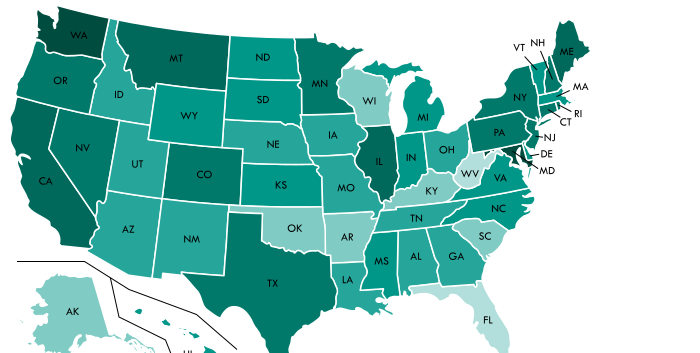
Most common states for technical training coordinators
| Rank | State | Population | # of jobs | Employment/ 1000ppl |
|---|---|---|---|---|
| 1 | Delaware | 961,939 | 363 | 38% |
| 2 | North Dakota | 755,393 | 259 | 34% |
| 3 | Maine | 1,335,907 | 414 | 31% |
| 4 | South Dakota | 869,666 | 236 | 27% |
| 5 | New Hampshire | 1,342,795 | 354 | 26% |
| 6 | New Mexico | 2,088,070 | 531 | 25% |
| 7 | West Virginia | 1,815,857 | 454 | 25% |
| 8 | Wyoming | 579,315 | 145 | 25% |
| 9 | Alabama | 4,874,747 | 1,189 | 24% |
| 10 | Montana | 1,050,493 | 249 | 24% |
| 11 | Rhode Island | 1,059,639 | 229 | 22% |
| 12 | Colorado | 5,607,154 | 1,121 | 20% |
| 13 | Oklahoma | 3,930,864 | 792 | 20% |
| 14 | Alaska | 739,795 | 145 | 20% |
| 15 | Minnesota | 5,576,606 | 1,049 | 19% |
| 16 | Georgia | 10,429,379 | 1,837 | 18% |
| 17 | Maryland | 6,052,177 | 1,093 | 18% |
| 18 | Kansas | 2,913,123 | 519 | 18% |
| 19 | Nebraska | 1,920,076 | 338 | 18% |
| 20 | District of Columbia | 693,972 | 127 | 18% |
Most common cities for technical training coordinators
| Rank | City | # of jobs | Employment/ 1000ppl | Avg. salary |
|---|---|---|---|---|
| 1 | Spring | 1 | 2% | $68,202 |
| 2 | San Jose | 1 | 0% | $77,329 |
Technical Training Coordinator job outlook: Expert opinions
Our panel of technical training coordinator experts
University of Alaska Fairbanks
University of Denver
Colorado State University

Rocky Mountain College

Edgewood College

Monmouth University
Montclair State University
University of Central Missouri
University of Kentucky
Rocky Mountain College
Central Connecticut State University

University of Puget Sound
What Technical Training Coordinator skills would you recommend for someone trying to advance their career?
Jaunelle Celaire: Leadership - the world needs more of these; the ability to lead, craft and grow. Digital literacy - this world is definitely turning digital and virtual is the new trend. Emotional intelligence - there is a vast number of personalities in our world today; individuals grow and it is our job to stay emotionally connected, so we can operate more effectively.
What will help Technical Training Coordinators increase their earning potential?
Jaunelle Celaire: Learn from everything. Remember every moment is a learning opportunity from everyone around you, no matter their title. Pay attention when things go well and clue in and pay extra attention when they do not; watch how people react to it. Build relationships and network with the people who face problems by being their solution.
Will there be an enduring impact of the coronavirus pandemic on Technical Training Coordinators?
Maria Salazar Ph.D.: The coronavirus will have an enduring impact on higher education graduates. In the field of education, graduates have experienced first hand the deep and lasting inequalities that the coronavirus has had on youth and families from Communities of Color. The have seen educational gaps widen into education chasms. They have witnessed the struggles, successes, and resiliency of families as they navigate the impact of the virus. Graduates leave education programs with their eyes wide open to the systemic racism and other isms that impact youth and their families, from education, to healthcare, and beyond.
In teacher education programs, our graduates have had a front row seat to inequality. They have witnessed children and adolescents disengage from schooling and life. They have struggled to support their students' mental and physical health. They ache to be with their students in classrooms, yet fear the repercussions of close contact due to the virus. Yet, they persist, and they keep believing they can make a difference.
What technical skills for a Technical Training Coordinator stand out to employers?
Maria Salazar Ph.D.: Technical skills that stand out to employers in the education sector during and after the time of COVID include interpersonal skills, ability to navigate change and challenges, and commitment to educational equity. Interacting with colleagues, students, and families online is challenging. This requires a set of interpersonal skills that involve a tolerance for uncertainty, risk-taking, creativity, and innovation. The ability to navigate change and challenges is essential during uncertain times. In schools, the landscape is alway changing, and more so in a global pandemic.
It is important to foster a growth-mindset in oneself, and also in one's school community. Employers are also looking for a commitment to educational equity. With emerging consciousness of racial inequality and the need for systems that promote racial justice, employers want to hire people who are culturally competent and can move beyond statements of the value of diversity, to the enactment of educational environments that promote equity for those who are marginalized. This skill set includes: cross-cultural communication, culturally responsive teaching, and strength-based practices.
Dr. Ann Sebald
Assistant Professor, Co-DirectorColorado State University
Center for Educator Preparation
Will there be an enduring impact of the coronavirus pandemic on Technical Training Coordinators?
Dr. Ann Sebald: Not sure what is meant by 'enduring'. However, if you are asking if there will be a long/longer term impact of the pandemic on recent graduates entering the teaching profession, I would say yes. As the state continues to work through the fiscal impact of the pandemic, schools will need to identify their priorities. As it relates to in-person learning, educators have done an amazing job at continuous adjustments during the past year. Teacher candidates have learned along-side veteran educators how best to adapt the learning environment for all students and their needs. What we've learned over this past year is being applied in schools around the globe moving forward.
Dr. Stevie Schmitz
Director of EducationRocky Mountain College
Leadership and Distance Education Program
Will there be an enduring impact of the coronavirus pandemic on Technical Training Coordinators?
Dr. Stevie Schmitz: I believe that there will be an enduring impact on the entire education system due to the pandemic. Students may experience gaps in their education due to remote learning which will have to be addressed by educational leaders and their faculty members as well as parents. Social emotional stress is bound to be a factor as students return to school. Leaders need to support students and staff with this transition. Educational technology will occupy a new role in public education and we need to embrace and support it. Financial impact will also be a reality for newly graduated educational leaders. Money spent or needing to be spent on safety measures will continue as more students return to school. All of these situations (and others not yet imagined) will impact new leaders.
Dr. Tom Holub Ph.D.
Director of Curriculum & InstructionEdgewood College
Department of Curriculum and Instruction
What technical skills for a Technical Training Coordinator stand out to employers?
Dr. Tom Holub Ph.D.: This field is very qualitative in nature, but there are significant issues relative to our technologies as well. As Rehabilitation Psychologists and Special Education (RPSE) personnnel, reliance upon systems of data support and communication are critical. Having the ability to navigate qualitative research technologies will help an RPSE candidate show a competetive edge over other candidates.
What are the biggest trends we'll see in the Technical Training Coordinator job market given the pandemic?
Antonio Estudillo Ph.D.: A range of considerations come to mind, all of which are interconnected and speak to sustainability in the field of education. Generally speaking, there is a teacher shortage where specific endorsements are concerned (e.g., STEM, Special Education, ESL/working with Multi-Lingual Leaners as well as historically underrepresented students). Of immediate interest is the recruitment and retention of our teaching force that cannot simply pivot how they approach teaching pedagogy, but actually how prospective teacher-educators can change their practices to be more learner-centered, equity-minded, and intentional moving forward (i.e., namely, concentration in quality of technology applications and usage; online learning/blended learning/hybrid intruction).
Specific to the pandemic, this is perhaps most pressing when considering how to better differentiate within and across learning environments/spaces to offer a personalized student experience-facilitating and cultivating meaningful engagement, especially having incoming teachers bring with them an increased/enhanced sense of self and awareness-knowledge of the backgrounds and representation of children of color (Black, Indigenous, and People of Color) and in particular Latinx and Black/African-American students. In addition too, per job market and the current pandemic, there is still a tremendous need to increase and diversify the ethnic-racial representation of the teaching force.
What's a good job out of college for Technical Training Coordinators?
Antonio Estudillo Ph.D.: One where an individual out of college has the opportunity to gain access to critical mentorship, professional learning (e.g., professional development), a greater sense of autonomy, and the presence of a community (e.g., sense of belonging as a professional). These combined considerations may be aspirational, but in the context of schools, a recognition for school leadership also matters. Therefore, those seeking a position should aim to consider the present and ongoing investments that are in motion/developing within an institution and how these investments may become increasingly comprehensive, forward-thinking, and accessible over time and after one is hired.
What are the biggest trends we'll see in the Technical Training Coordinator job market given the pandemic?
Dr. Nicole Barnes: Although the abrupt changes that occurred to K-12 schooling in the Spring of 2020 have given way to more detailed reopening plans and a vaccine is now available, the use of hybrid and remote learning remains with the ongoing influence of COVID-19. Therefore, it seems essential that teacher educators, researchers, and K-12 school districts rethink what good teaching looks like for K-12 education's changed landscape. Teachers more then ever will need to be prepared to teach in virtual environments and garner the same academic, social, and emotional student outcomes that they would face to face.
Lea Porta
InstructorUniversity of Central Missouri
Early Childhood Education Department
What experience really stands out on Technical Training Coordinator resumes?
Lea Porta: I think if they have Google certification, that might be a bonus. Any work or volunteering in their field of study, as well as substituting.
Dr. Kun Huang Ph.D.
Assistant Professor of Instructional Systems DesignUniversity of Kentucky
Department of Curriculum & Instruction
Will there be an enduring impact of the coronavirus pandemic on Technical Training Coordinators?
Dr. Kun Huang Ph.D.: While the pandemic will affect graduates of all disciplines in varying degrees, the impact on graduates in educational technology may be a little different due to the fact that many organizations rely more on technology to support their training and communication operations. Educational institutions also need more expertise in this area. According to insidehighered, while many universities instituted a hiring freeze in 2020, many have been hiring graduates in fields related to educational technology.
Precious McKenzie Ph.D.
Associate Professor of EnglishRocky Mountain College
Division Chair for Humanities & Fine Arts
What skills stand out on Technical Training Coordinator resumes?
Precious McKenzie Ph.D.: Employers in the United States and in Europe look for tech skills (database skills, Excel, Adobe and such), but they also acknowledge that they can train employees on how to use technology. What employers cannot teach are skills such as critical thinking and communication, including writing and public speaking. I firmly believe that if a college student majors or minors in English, this will set them apart from the competition in the job market. I have talked with scientists, engineers, and business people who bemoan the fact that professionals in their fields have difficulty with writing, researching, and public speaking. My advice: pick up a minor in English. It will serve you well. In the interest of full disclosure, I am an English professor.
Mary Collins
Professor, Creative Writing/Nonfiction, Program Coordinator, Writing Minors, Career/Internship AdvisorCentral Connecticut State University
English Department
What are the biggest trends we'll see in the Technical Training Coordinator job market given the pandemic?
Mary Collins: Those in the performing arts have been decimated by the pandemic, having lost jobs at a rate unseen in nearly any other category. Those in the writing/editing fields have had more luck because their skills translate better to virtual work. Indeed, many big companies must build a much better platform online and in virtual meetings etc. They rely heavily on good writers/editors to help them pull that off. Instead of in-person meetings, maybe they have a newsletter now, for example, to sustain a sense of community among employees.
The writing market for places like Buzzfeed, Bitch, Vice, and other media is glutted with young writers out of work who think they can freelance good pieces. The end result is overwhelmed editors going through huge slush piles to find the good work and then offering less money for it. The best answer: find a company or organization and to hire you on as a steady employee or consistent contractor. Again, these types of organizations are looking for workers.
Sue Dahlin
Associate Director of Career and Employer EngagementUniversity of Puget Sound
Career and Employment Services
Are there any particularly good places in the United States for Technical Training Coordinators to find work opportunities?
Sue Dahlin: As History majors can go a lot of different directions with their degree, that's harder to pinpoint, but I can say this: when job markets tighten, it really helps for a candidate to be flexible about as much as possible, including where (geographically and by type of organization) they'll consider working. Starting in locations where you have a good network can be a good strategy. Always look at that first role out of school as a learning opportunity and a chance to build new skills. You don't have to be tied to it forever.