Explore jobs
Find specific jobs
Explore careers
Explore professions
Best companies
Explore companies
What is a telecommunication operator and how to become one

Telecommunications operators play an important role in satisfying the rising demands of individuals and businesses. They were very vital when multi-line telephone networks were first adopted. In comparison, although some businesses have moved over time to digital processes, consumers enjoy a hands-on approach more. A telecommunications operator is required to handle incoming calls, gather necessary information, write quickly and precisely, route calls, and monitor conversations when necessary.
There are really no formal qualifications to become a telecommunications operator. Most employers, however, would prefer someone who has experience in the field. Many large companies and emergency services often provide on-the-job training. Bear in mind that his/her position demands outstanding oral communication skills and someone who must be able to work under pressure.
Avg. Salary $39,381
Avg. Salary $59,228
Growth rate 4%
Growth rate 0.3%
American Indian and Alaska Native 1.20%
Asian 3.80%
Black or African American 14.96%
Hispanic or Latino 15.94%
Unknown 3.59%
White 60.52%
Genderfemale 65.90%
male 34.10%
Age - 57American Indian and Alaska Native 3.00%
Asian 7.00%
Black or African American 14.00%
Hispanic or Latino 19.00%
White 57.00%
Genderfemale 47.00%
male 53.00%
Age - 57Stress level is high
7.1 - high
Complexity level is challenging
7 - challenging
Work life balance is excellent
6.4 - fair
Telecommunication operator career paths
Key steps to become a telecommunication operator
Explore telecommunication operator education requirements
Start to develop specific telecommunication operator skills
Skills Percentages Patients 19.41% Customer Service 8.97% Emergency Situations 6.22% Telephone Calls 5.73% Non-Emergency Calls 5.13% Complete relevant telecommunication operator training and internships
Accountants spend an average of Less than 1 month on post-employment, on-the-job training. New telecommunication operators learn the skills and techniques required for their job and employer during this time. The chart below shows how long it takes to gain competency as a telecommunication operator based on U.S. Bureau of Labor Statistics data and data from real telecommunication operator resumes.Gain additional telecommunication operator certifications
More About CertificationsTelecommunication operator certifications can show employers you have a baseline of knowledge expected for the position. Certifications can also make you a more competitive candidate. Even if employers don't require a specific telecommunication operator certification, having one may help you stand out relative to other applicants.
The most common certifications for telecommunication operators include Telecommunications (TCM) and Nationally Certified Medical Office Assistant (NCMOA).
Research telecommunication operator duties and responsibilities
- Manage patients calls effectively and efficiently in a complex, fast-pace and challenging call center environment.
- Report real-time facts and statistics to immediate patrol supervisors throughout the shift.
- Answer inbound calls from citizens in need of police, fire, ems.
- Answer PBX, used computerized system for physician's answering service, hospital phones and paging.
Prepare your telecommunication operator resume
When your background is strong enough, you can start writing your telecommunication operator resume.
You can use Zippia's AI resume builder to make the resume writing process easier while also making sure that you include key information that hiring managers expect to see on a telecommunication operator resume. You'll find resume tips and examples of skills, responsibilities, and summaries, all provided by Zippi, your career sidekick.
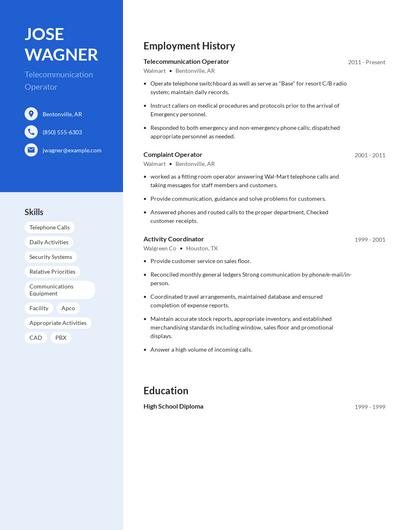
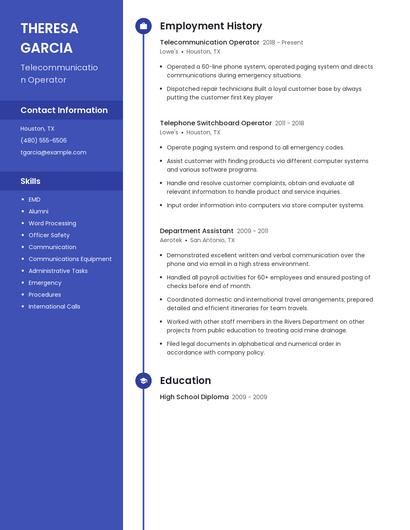
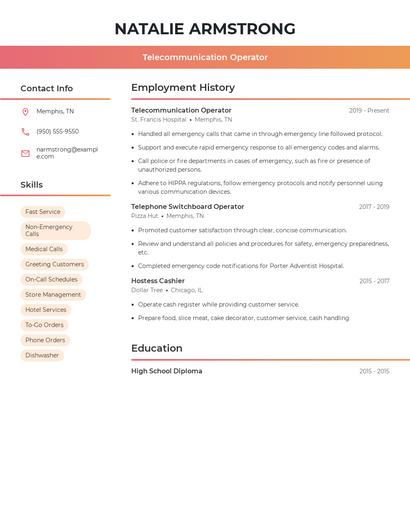
Choose from 10+ customizable telecommunication operator resume templates
Build a professional telecommunication operator resume in minutes. Browse through our resume examples to identify the best way to word your resume. Then choose from 10+ resume templates to create your telecommunication operator resume.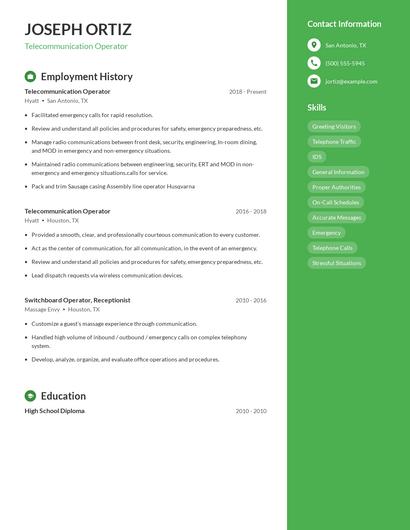

Apply for telecommunication operator jobs
Now it's time to start searching for a telecommunication operator job. Consider the tips below for a successful job search:
- Browse job boards for relevant postings
- Consult your professional network
- Reach out to companies you're interested in working for directly
- Watch out for job scams
How did you land your first telecommunication operator job

Are you a telecommunication operator?
Share your story for a free salary report.
Average telecommunication operator salary
The average telecommunication operator salary in the United States is $39,381 per year or $19 per hour. Telecommunication operator salaries range between $30,000 and $50,000 per year.
What am I worth?

How do telecommunication operators rate their job?
Telecommunication operator reviews

Pay is not a liveable wage.
Being able to help people in need create clear and accurate communication
Isolation I guess which I anyway understand needed to effectively perform duties and responsibilities.
Really likes people and shows it through courtesy and co-operation,willing to observe company rules and goes an extra mile.
Not to upset my clients and the company reputation.
Updated January 8, 2025
