Explore jobs
Find specific jobs
Explore careers
Explore professions
Best companies
Explore companies
What is a telecommunicator and how to become one
The emergency number 911 was first instituted in 1968. Ever since then, whenever people have an emergency, all they have to do is dial 911, and they will be connected with the help they need. The person responsible for answering those calls and directing emergency services where they are needed is a telecommunicator, also sometimes called a dispatcher.
Above all, the telecommunicator needs to be a good communicator. They have to get the facts of a situation, often from callers in distress and who are unable to speak clearly. They then have to relay that information to emergency responders such as EMTs or firefighters, direct them to the right address, and record call details.
Most telecommunicators do not have bachelor's degrees. Instead, they need to have other important skills that are usually not learned in a classroom. Besides excellent communication skills, telecommunicators need to have a cool head when under pressure and even know basic first aid to instruct people over the phone while they wait for help. A good telecommunicator can save many lives.
Avg. Salary $39,327
Avg. Salary $59,228
Growth rate 4%
Growth rate 0.3%
American Indian and Alaska Native 0.72%
Asian 0.90%
Black or African American 9.14%
Hispanic or Latino 11.11%
Unknown 6.00%
White 72.13%
Genderfemale 71.03%
male 28.97%
Age - 38American Indian and Alaska Native 3.00%
Asian 7.00%
Black or African American 14.00%
Hispanic or Latino 19.00%
White 57.00%
Genderfemale 47.00%
male 53.00%
Age - 38Stress level is very high
7.1 - high
Complexity level is intermediate
7 - challenging
Work life balance is excellent
6.4 - fair
Telecommunicator career paths
Key steps to become a telecommunicator
Explore telecommunicator education requirements
Start to develop specific telecommunicator skills
Skills Percentages Computer Aided Dispatch 13.99% CAD 7.04% EMS 6.06% NCIC 5.58% Patrol 4.44% Complete relevant telecommunicator training and internships
Accountants spend an average of 3-6 months on post-employment, on-the-job training. New telecommunicators learn the skills and techniques required for their job and employer during this time. The chart below shows how long it takes to gain competency as a telecommunicator based on U.S. Bureau of Labor Statistics data and data from real telecommunicator resumes.Gain additional telecommunicator certifications
More About CertificationsTelecommunicator certifications can show employers you have a baseline of knowledge expected for the position. Certifications can also make you a more competitive candidate. Even if employers don't require a specific telecommunicator certification, having one may help you stand out relative to other applicants.
The most common certifications for telecommunicators include Telecommunications (TCM) and Emergency Medical Dispatcher Certification (EMD).
Research telecommunicator duties and responsibilities
- Help organize telecommunication PSAP and back-up PSAP weekly.
- Use NCIC and FCIC and provide accurate information for search.
- Provide CPR instructions over the phone until emergency personnel arrive at location.
- Monitor radio communications at the same time and update cad throughout emergency.
Prepare your telecommunicator resume
When your background is strong enough, you can start writing your telecommunicator resume.
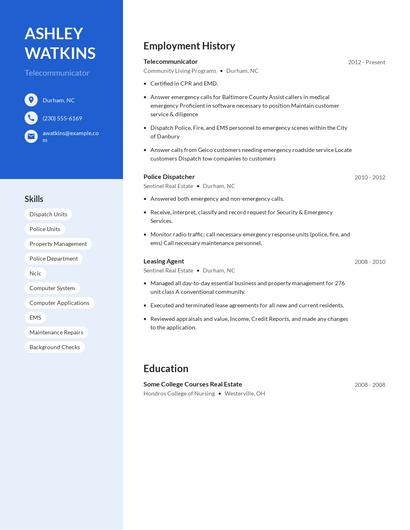
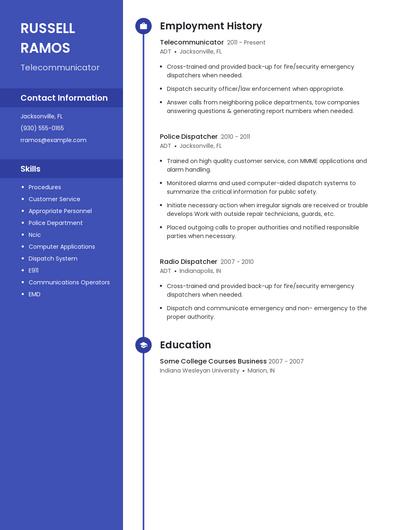
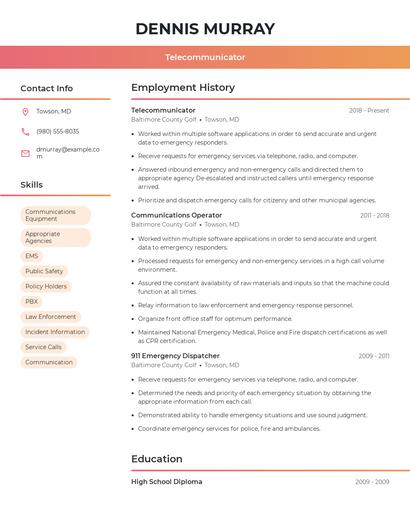
You can use Zippia's AI resume builder to make the resume writing process easier while also making sure that you include key information that hiring managers expect to see on a telecommunicator resume. You'll find resume tips and examples of skills, responsibilities, and summaries, all provided by Zippi, your career sidekick.
Choose from 10+ customizable telecommunicator resume templates
Build a professional telecommunicator resume in minutes. Browse through our resume examples to identify the best way to word your resume. Then choose from 10+ resume templates to create your telecommunicator resume.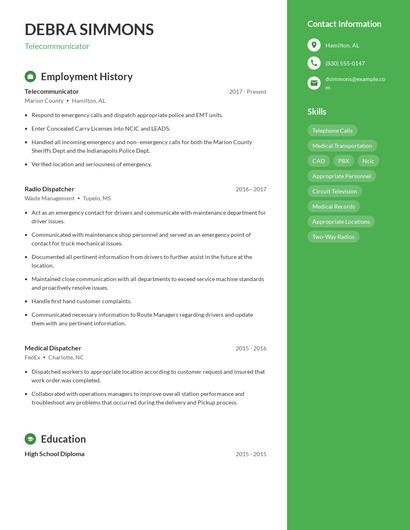

Apply for telecommunicator jobs
Now it's time to start searching for a telecommunicator job. Consider the tips below for a successful job search:
- Browse job boards for relevant postings
- Consult your professional network
- Reach out to companies you're interested in working for directly
- Watch out for job scams
How did you land your first telecommunicator job

Are you a telecommunicator?
Share your story for a free salary report.
Average telecommunicator salary
The average telecommunicator salary in the United States is $39,327 per year or $19 per hour. Telecommunicator salaries range between $28,000 and $53,000 per year.
What am I worth?

How do telecommunicators rate their job?
Telecommunicator reviews

Working from home makes life much easier to manage.
Pay is not a liveable wage.
Quick paced, professional environment Troubleshooting. Assisting peers with any issues they might have.
Updated January 8, 2025
