
Automatically apply for jobs with Zippia
Upload your resume to get started.
Telecommunicator supervisor skills for your resume and career
15 telecommunicator supervisor skills for your resume and career
1. Telecommunication
- Promoted and fostered a close working relationship with network engineers at other directorates through joint cooperation on Telecommunication projects.
- Managed telecommunication and network system migrations and installations requiring both major and minor changes in voice and data infrastructure.
2. PBX
PBX represents Private Branch Exchange, which is a private phone network utilized inside an organization or association. The clients of the PBX telephone framework can call internally (inside their organization) and remotely (with the rest of the world), utilizing diverse correspondence stations like Voice over IP or ISDN.
- Developed PBX operators' departmental performance standard and prepared annual reviews and performance appraisals.
- Analyzed billing information and compiled PBX statistical data to evaluate and improve network efficiency.
3. Non-Emergency Calls
Non-emergency calls are calls that do not require immediate attention or intervention. They are simply a request for police, fire or rescue service that does not present a life or death situation. In this case, the local non-emergency number should be used if immediate dispatch of the police is not required.
- Dispatched police, fire, and medical personnel on emergency and non-emergency calls.
- Monitor direct emergency alarms, answer non-emergency calls for assistance.
4. VoIP
- Deployed a fully functional VoIP and video teleconference solution to 100+ users of the command during exercises.
- Assisted management with reviewing, meeting with and selecting the best VoIP vendor.
5. LAN
A Local Area Network (LAN) is a collection of devices that are connected in the same building, office, or network to facilitate the transmission of information among devices. The area of LAN depends upon the number of devices connected which vary according to the size of a building or an office. It includes cables, computers, switches, routers, access points, and other networking components.
- Assisted the Local Area Network (LAN) Manager ensuring timely system backup and system sparing to ensure minimum down time.
- Evaluate local area network (LAN) or wide area network (WAN) performance data to ensure speed.
6. Communications Equipment
Communication equipment is an installation or a facility that consists of the physical plants and equipment solely to disseminate information. Communication equipment includes mobile and/or portable radios, based and/or fixed station radios, and repeaters.
- Conducted inventory of communications equipment monthly and upon completion of each communication assignment, to ensure all equipment was on hand.
- Identified and initiated effort to reclaim $500,000 of communications equipment and supervised salvage operation of recyclable assets.
7. Communications Systems
A communications system otherwise called a communication system is a collection of communications equipment integrated into a coherent system and allows people to keep in touch with each other over a geographical system.
- Planned, installed and maintained various communications systems and data circuits in support of a military intelligence unit.
- Manage program for project deployments and testing, along with day-to-day operations of voice/network/wireless telecommunications systems.
8. CAD
- Prioritized calls and logged all information, utilizing CAD and Oklahoma Law Enforcement Telecommunications System (OLETS).
- Supervised the installation and implementation of CAD into the McIntosh County Sheriff Dispatch center.
9. Performance Evaluations
Performance evaluation is a formal and productive process to measure an employee's work and results based on their job responsibilities over a defined period of time and to properly measure an employee's contribution to the workforce and employers and achieve a high level of quality and quantity of work produced. The evaluation also helps employees provide information about deficiencies in job performance and the company's expectations for the future.
- Administered monthly and weekly professional developmental and performance evaluations/ training sessions to help motivate soldiers to complete any mission.
- Compose employee performance evaluations and determine merit increases.
10. IVR
An Interactive Voice Response is a customer service system that operates telephonically by automating calls to your business. This technology monitors the synthesis of touch-tone and voice inputs. A user can access a database of information via phone.
- Stabilized an aging IVR system that resulted in completely eliminating weekly system problems.
- Performed all switch programming including local IVR menus, call routing, customized treatments and timing elements.
11. Law Enforcement Agencies
- Used NCIC for all inputs as requested by law enforcement agencies.
- Combined effort with fellow communication officers, supervisors, and various law enforcement agencies to ensure correct emergency response.
12. IP
An IP - Internet Protocol is a unique number assigned to all devices connected to information technology, such as printers, routers, modems, etc. Each device or domain that connects to the Internet is assigned an IP address, and as packets are directed to the IP address attached to them, the data goes where it is needed. IP addresses are the identifier used to send information between devices on a network. They contain location information and make devices accessible for communication.
- Assisted field techs for Carousel Industries with IP phone installs, cut over's, service calls and surveys.
- Project oversight for the creation of an RFP/RFQ for a court wide Voice Over IP replacement phone system.
13. ACD
ACD is a term that refers to an Associate Creative Director. ACD duties include preparing and producing content for advertising and marketing companies, assisting creative directors in campaigns, and supervising staff on design projects. The qualifications to be an Associate Creative Director (ACD) is a degree in marketing or advertising. A portfolio of your past work in the advertising industry will give you an advantage. You need to have strong leadership and interpersonal skills for employers to consider you.
- Program and complete Contact Center request for Automatic Call Distribution (ACD) services, time of day changes, etc.
- Monitored the implementation and usage of additional equipment such as: Video Conferencing, ACD, Call-Accounting and Voice Mail.
14. Phone System
- Implemented various telephone system incentive programs.
- Maintain and control all phone equipment, provided training for all employees on how to use the phone system.
15. Telephone Systems
A telephone system is a technology that enables wired or wireless telecommunication services. It is used for enabling electronic transmission of voice or data between distant parties. Landlines, mobile phones, smartphones, voice calling apps and software, all are examples of modern telephone systems.
- Provided set-up and troubleshooting support of telephone systems.
- Managed migration of legacy telephone systems in multiple locations to Cisco IP Telephony platform.

What skills help Telecommunicator Supervisors find jobs?
Tell us what job you are looking for, we’ll show you what skills employers want.
List of telecommunicator supervisor skills to add to your resume
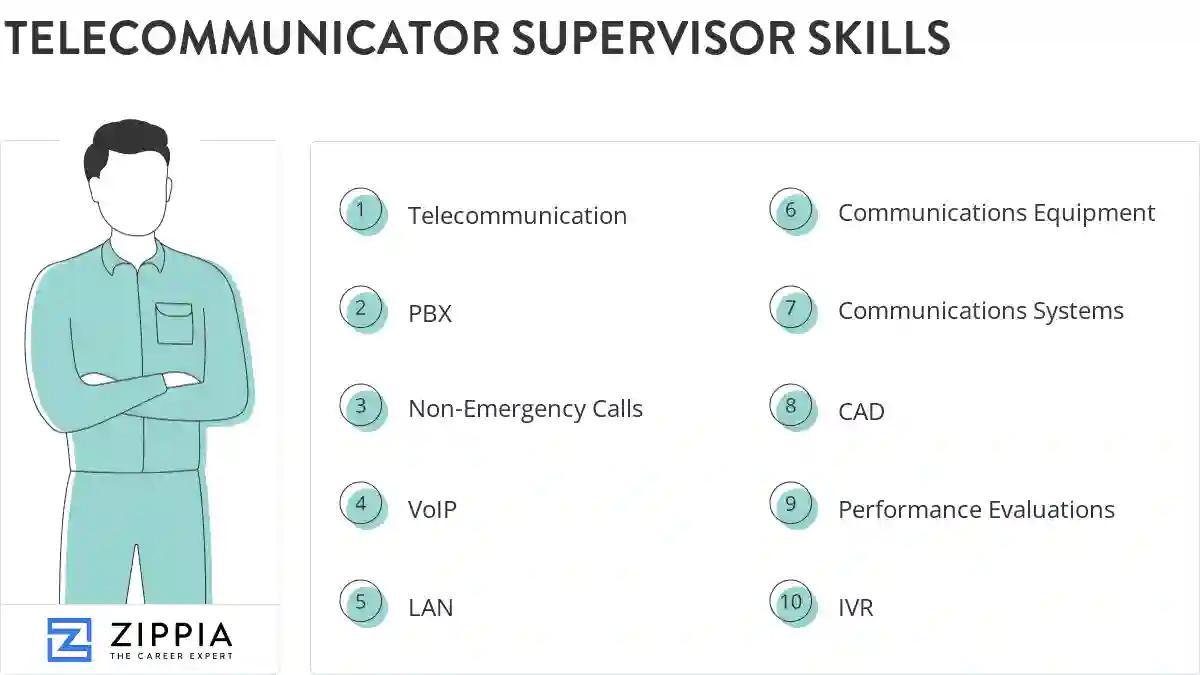
The most important skills for a telecommunicator supervisor resume and required skills for a telecommunicator supervisor to have include:
- Telecommunication
- PBX
- Non-Emergency Calls
- VoIP
- LAN
- Communications Equipment
- Communications Systems
- CAD
- Performance Evaluations
- IVR
- Law Enforcement Agencies
- IP
- ACD
- Phone System
- Telephone Systems
- Test Equipment
- T-1
- Data Communications
- EMS
- Radio Systems
- UHF
- Emergency Communications
- Cell Phones
- Paging Systems
- Disciplinary Actions
- Computer System
- Telephone Calls
- Data Network
- ISDN
- Technical Assistance
- Satellite Communications
- T1
- COMSEC
- Network Operations
- RF
- VHF
- PC
- Computer Aided Dispatch
- Fiber Optic
- Nortel
- Professional Development
- Network Systems
- Sprint
- Customer Support
- AS400
- Statistical Reports
- Switchboard Operators
Updated January 8, 2025
