
Automatically apply for jobs with Zippia
Upload your resume to get started.
Therapeutic recreation leader skills for your resume and career
11 therapeutic recreation leader skills for your resume and career
1. Role Model
A role model is a person with desirable qualities who inspires other people to emulate their example.
- Participated and demonstrated a positive role model for campers.
- Provided spiritual development lessons and served as role model/mentor.
2. Incident Reports
An Incident Report, in a medical facility such as hospitals and nursing homes, is a type of paperwork filled out immediately after and in the case of an incident of some sort, with the goal of describing the incident and its consequences, as well as the measurements taken after or during the incident, as well as any other information relevant to said incident. Such an incident might be a patient acting out or a patient being injured.
- Complete accident/incident reports related to injuries or behavior problems and health concerns
- Enforced policies and procedures promptly and properly reported accident and incident reports.
3. MDS
Minimum Data Set or MDS refers to a standardized assessment tool used in Medicare and Medicaid-certified nursing facilities. It assists social services specialists with developing, organizing, and conducting programs to resolve and prevent problems relevant to substance abuse, human relations, or dependent care.
- Utilized clinical assessment, MDS documentation, and collaboration with interdisciplinary team and families.
- Manage activity and progress reports including statistical data required by regulators, initial assessments, MDS and IDC documentation.
4. Therapeutic Recreation Programs
- Planned, coordinated, implemented, and evaluated seasonal therapeutic recreation programs for individuals with disabilities.
- Assisted with the implementation, adaptation, and evaluation of assigned therapeutic recreation programs.
5. Vital Signs
Vital signs are a set of values indicating different body systems' performance. They are measurements of the body's most basic functions. The four major vital signs used in medicine to assess a patient are body temperature, pulse rate, respiration rate, and blood pressure.
- Transport patients to and from appointments, clinics, laboratories, and/or treatments, as and when appropriate Check vital signs.
- admit and discharge patients, maintain close contact, monitor vital signs; heart rate and blood pressure.
6. Mental Health Professionals
- Consult with doctors and other mental health professionals, Our team includes social workers and therapists.
- Consult with doctors and other mental health professionals, often as part of a team that includes social workers and therapists.
7. Patient Behavior
Patient behavior is frequently described as disturbing behavior as they have an altered mental stage. They might live in a conceived state of fear and anxiety and have modification of lifestyle if suffering from a chronic illness.
- Observed, communicated, and documented pertinent patient behavior.
- Observe patient behaviors, record their conditions and lead them in therapeutic and recreational activities.
8. Developmental Disabilities
- Assist with planning and implementing recreation and leisure activities for program participants with physical and developmental disabilities.
- Supervised children ages 6-12 with intellectual and developmental disabilities.
9. Physical Disabilities
- coordinated various creative activities for children ages 5-12, including children with learning and physical disabilities)
- Developed and created social programs for adolescents experiencing behavioral and physical disabilities.
10. Intellectual Disabilities
- Designed and implemented program plan for an adult with intellectual disabilities.
- Provided respite care and recreational activities for a 27 year old woman with intellectual disabilities.
11. Skill Development
Skills development is the process of understanding the gaps in your skills, then sharpening them. Developing your skills is important because your skills can determine your potential to accomplish plans with success. Without the right skills, you could spend time working on a project ineffectively or start with the wrong approach. If you take the time to hone your skills, you can find a great job, earn more money, and improve your life.
- Provided skill development, leisure education, and recreation programs for individuals with disabilities.
- Assisted in the orientation and skill development of staff.

What skills help Therapeutic Recreation Leaders find jobs?
Tell us what job you are looking for, we’ll show you what skills employers want.
What skills stand out on therapeutic recreation leader resumes?
Marieke Van Puymbroeck Ph.D.
Professor, Graduate Coordinator, Clemson University
What therapeutic recreation leader skills would you recommend for someone trying to advance their career?
Dr. Jamie Hoffman CTRS
Chair, Professor, California State University - Sacramento
What type of skills will young therapeutic recreation leaders need?
Dr. Jon McChesney
Department Chair & Graduate Coordinator, Eastern Kentucky University
What technical skills for a therapeutic recreation leader stand out to employers?
Dr. Stacey Kendig
Director and Associate Professor, Shepherd University
What soft skills should all therapeutic recreation leaders possess?
Jessica Tangen Daniels Ph.D.
Associate Provost - Innovation and Partnerships, Program Director/Professor, Ed.D. Leadership in Higher Education, Bethel University
Employers may be seeking skills like imaginative bridging, humbly and curiously connecting dots. Or the skills of facilitation and curation, with so many different perspectives and lived experiences, and an overabundance of information, an educational leader, must manage people, perspectives, and content like never before.
Employers are looking for skills that relate to not only the day-to-day tactical aspects of educational leadership but also imaginative problem-solving for a thriving future.
List of therapeutic recreation leader skills to add to your resume
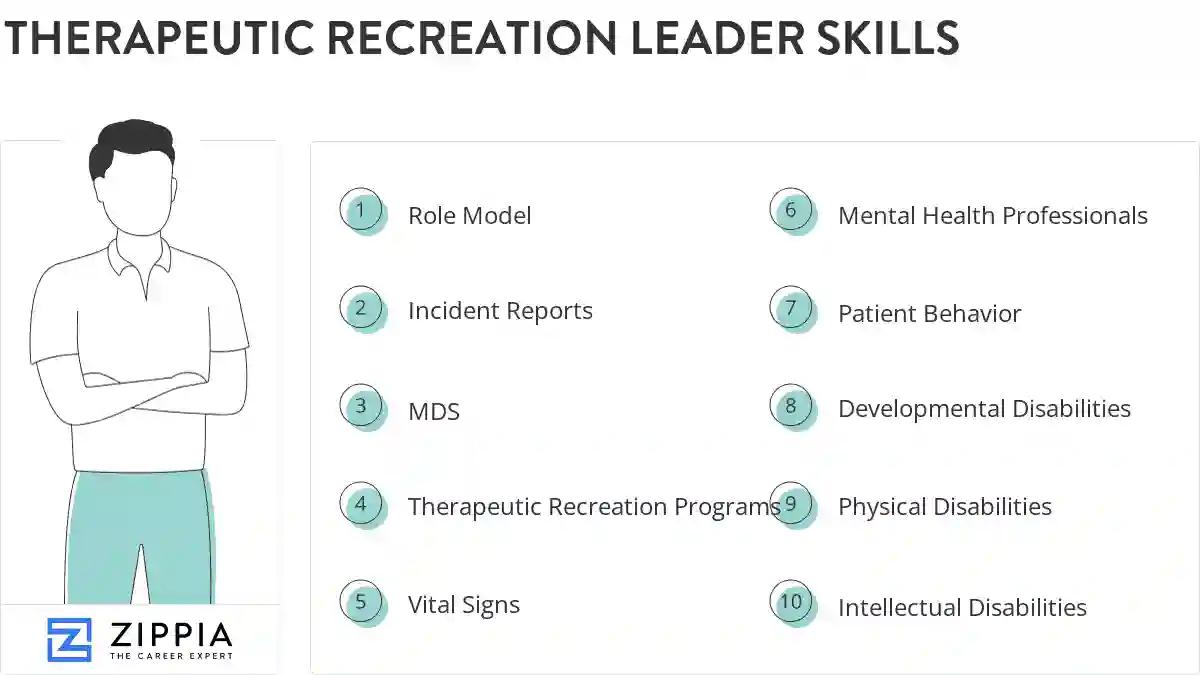
The most important skills for a therapeutic recreation leader resume and required skills for a therapeutic recreation leader to have include:
- Role Model
- Incident Reports
- MDS
- Therapeutic Recreation Programs
- Vital Signs
- Mental Health Professionals
- Patient Behavior
- Developmental Disabilities
- Physical Disabilities
- Intellectual Disabilities
- Skill Development
Updated January 8, 2025
