
Automatically apply for jobs with Zippia
Upload your resume to get started.
Title curator skills for your resume and career
10 title curator skills for your resume and career
1. Address Inquiries
- Address inquiries from client, buyer, agents, internal staff and Asset Management Company professionally and in a timely manner.
- Address inquiries from servicer, foreclosure attorney and client in order to close on the property within the assigned deadlines.
2. HOA
HOA stands for "Home Owner's Association." This association is comprised of community members to ensure all community guidelines and codes are followed. These rules are often created by the association to give the community a uniform and clean look. Rules can include everything from placement of trash cans to lawn care maintenance, and members often join an HOA as soon as a home is purchased in a community with such an association.
- Corresponded with banks, lenders, underwriters, attorneys, HOA's, tax offices, clerk of court, etc.
- Ordered payoffs on mortgages, judgments, HOA status letters and liens attached to the subject property.
3. Real Estate
Real estate is land that has buildings on it. This kind of property consists of permanent improvements either natural or man-made, which include, houses, fences, bridges, water trees, and minerals. There are 4 types of real estate namely; residential real estate, commercial real estate, industrial real estate, and vacant land.
- Order updates from the underwriter and determine clearance necessary for the Real Estate closing.
4. Foreclosure
Foreclosure is a term that refers to the legal process used by mortgage holders to take over mortgage real estate from borrowers who are unable to pay their mortgages. Foreclosure allows the lenders to collect the amount owed on the defaulted loan by taking possession of the asset which is used as collateral for the loan or by forcing it to sell.
- Review of foreclosure deeds for correctness including vesting, recording information, and notary acknowledgment.
- Evaluated foreclosure process on defaulted mortgages to ensure compliance with all legal and regulatory requirements.
5. Title Commitments
- Reviewed foreclosure proceedings for accuracy and completeness and prepared title commitments in preparation for sale of property by lending institutions.
- Monitored turnaround production time on title commitments and with month-end production efficiency report for review by title company management.
6. Marketable Title
- Performed title curative work for the REO/Foreclosure department, providing marketable title for bank owned properties.
- Minnesota/Completed Vesting and Marketable Title for Basin Electric Power Cooperative throughout North Dakota.
7. Title Issues
- Created division orders and corresponded with attorneys to cure specific title issues.
- Investigated and creatively facilitated the closure and/or clearance of title issues/exceptions to title for agent of several major title underwriters.
8. Lenders
A lender is a financial institution, an individual, a private or public group, that offers funds to a business or person with the condition and expectation that these funds must be repaid. Repayment will also include the payment of interest or fees. Lenders have detailed guidelines to verify the ability to repay a loan and creditworthiness. They established the interest rate, repayment schedule, terms, and other key aspects of the money being borrowed.
- Communicate with Lenders, Agents and Attorney's.
- Identify all necessary annotations in accordance to lenders guidelines.
9. REO
- Developed policy and procedures for REO department
- Managed workouts of non-performing loans and REO assets; * Performed due diligence on assets backed by commercial real estate.
10. Title Searches
- Provided all necessary information to vendors to initiate title searches and verified order confirmations.
- Eliminated costs by performing title searches independently.

What skills help Title Curators find jobs?
Tell us what job you are looking for, we’ll show you what skills employers want.
List of title curator skills to add to your resume
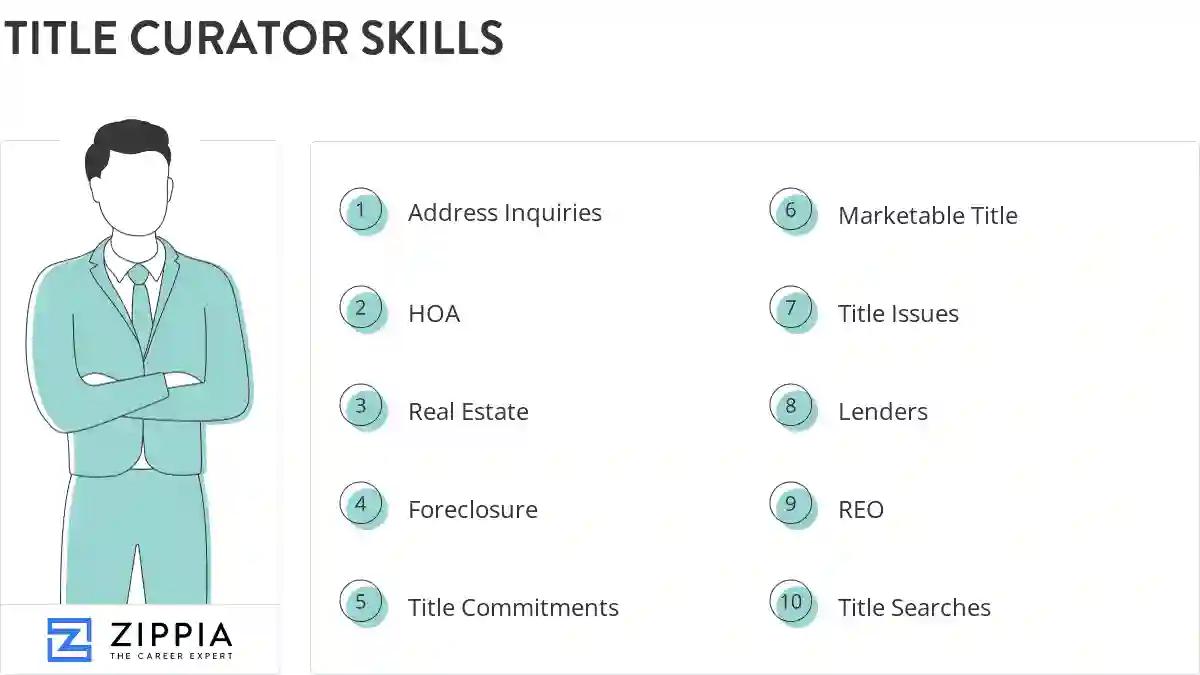
The most important skills for a title curator resume and required skills for a title curator to have include:
- Address Inquiries
- HOA
- Real Estate
- Foreclosure
- Title Commitments
- Marketable Title
- Title Issues
- Lenders
- REO
- Title Searches
Updated January 8, 2025
