
Automatically apply for jobs with Zippia
Upload your resume to get started.
Title officer skills for your resume and career
15 title officer skills for your resume and career
1. Endorsements
- Typed insurance policies and endorsements.
- Review Title commitments, endorsements & related documents.
2. Title Commitments
- Reviewed and cleared title commitments per underwriter requirements.
- Prepare title commitments, guarantees, proforma and final title insurance policies in accordance with the instructions of each respective transaction.
3. Customer Service
Customer service is the process of offering assistance to all the current and potential customers -- answering questions, fixing problems, and providing excellent service. The main goal of customer service is to build a strong relationship with the customers so that they keep coming back for more business.
- Delivered high levels of efficiency, customer service and stakeholder relationship management providing proficient support to title processing.
- Completed customer service requests for Commercial and Agricultural brokers.
4. Title Searches
- Provided survey inspections, title searches and managed land development projects including: Trump Tower and the Citi-Center in White Plains.
- Set up vendors all over the State of Arizona to provide title evidence for out of network title searches.
5. Real Estate Transactions
- Research the history of properties to identify potential risks with real estate transactions and write insurance for these transfers in ownership.
- Prepared closing package, HUD-1 Settlement Statement for all real estate transactions and acted as a settlement agent for closings.
6. Legal Descriptions
The legal description is a short document of about two to three paragraphs that describes a real estate or landed property for legal purposes. It's a document that legally identifies a given property by its dimensions, boundaries, features, lot numbers, total acreage, and location for the purpose of deed conveyance, real estate transactions, or other legal matters. A legal description is necessary before any property can be sold or bought.
- Coordinated the Processed and facilitated Indemnity Letter request using Title Plant searches, surveys, legal descriptions and surveys.
- Work collectively with Escrow to resolve legal descriptions, easements, vesting, tax liens etc.
Choose from 10+ customizable title officer resume templates
Build a professional title officer resume in minutes. Our AI resume writing assistant will guide you through every step of the process, and you can choose from 10+ resume templates to create your title officer resume.7. External Policies
- Researched and wrote title policies in accordance with internal and external policies and regulations.
- used industry related experience to provide clear title in accordance with internal and external policies, procedures, and regulations.
8. Real Property
Real property refers to the land, buildings, and every other physical thing on sight within a marked area of land. It also refers to everything physically and permanently attached to a given parcel of land including the soil. It goes further into the legal documents like the right to ownership, right to sell, lease, and use the land including all the physical assets on it. The term is also related to real estate and can be used interchangeably.
- Performed searches on real property, individuals and companies from public record and title plant to create an insurable property report.
- Performed educational courses within the client data base on all topics involved in the real property and land use process.
9. Client Relationships
- Maintain and build client relationships to acquire additional business.
- Developed client relationships for future business.
10. Probate
- Reviewed cases, journal entries and court documents involving probate, divorce, bankruptcy, judgment liens and foreclosures.
- Research probate records to find heirs for possible missing interest, divorces, and errors.
11. Conveyance
- Prepared and reviewed instruments of conveyance and related documents to ensure accuracy and authenticity.
- Review and approve data on title and settlement documents including title curative information, conveyance documents and HUD-1 settlement statements.
12. Notary
- Prepared Pre-HUDS and closing HUDS for final approval prior to closing the Mortgage as a Notary assigned to the file.
- Create reports for underwriters and remit monies owing, Became Title Officer and Notary
13. Foreclosure
Foreclosure is a term that refers to the legal process used by mortgage holders to take over mortgage real estate from borrowers who are unable to pay their mortgages. Foreclosure allows the lenders to collect the amount owed on the defaulted loan by taking possession of the asset which is used as collateral for the loan or by forcing it to sell.
- Obtain foreclosure documents from attorney offices.
- Prepare ownership reports in order to proceed with foreclosure - worked all states within the United States.
14. Title Reports
- Read title reports and prepare title insurance commitments for clients, including attorneys and lenders; prepare title insurance policies.
- Examined titles and created title reports and finally title policies on all types of commercial and residential properties in California.
15. HOA
HOA stands for "Home Owner's Association." This association is comprised of community members to ensure all community guidelines and codes are followed. These rules are often created by the association to give the community a uniform and clean look. Rules can include everything from placement of trash cans to lawn care maintenance, and members often join an HOA as soon as a home is purchased in a community with such an association.
- Organized database of HOA fees per subdivision.
- Obtained closing protection letters, surveys and HOA estoppels.
5 Title Officer resume examples
Build a professional title officer resume in minutes. Browse through our resume examples to identify the best way to word your resume. Then choose from 5+ resume templates to create your title officer resume.

What skills help Title Officers find jobs?
Tell us what job you are looking for, we’ll show you what skills employers want.
List of title officer skills to add to your resume
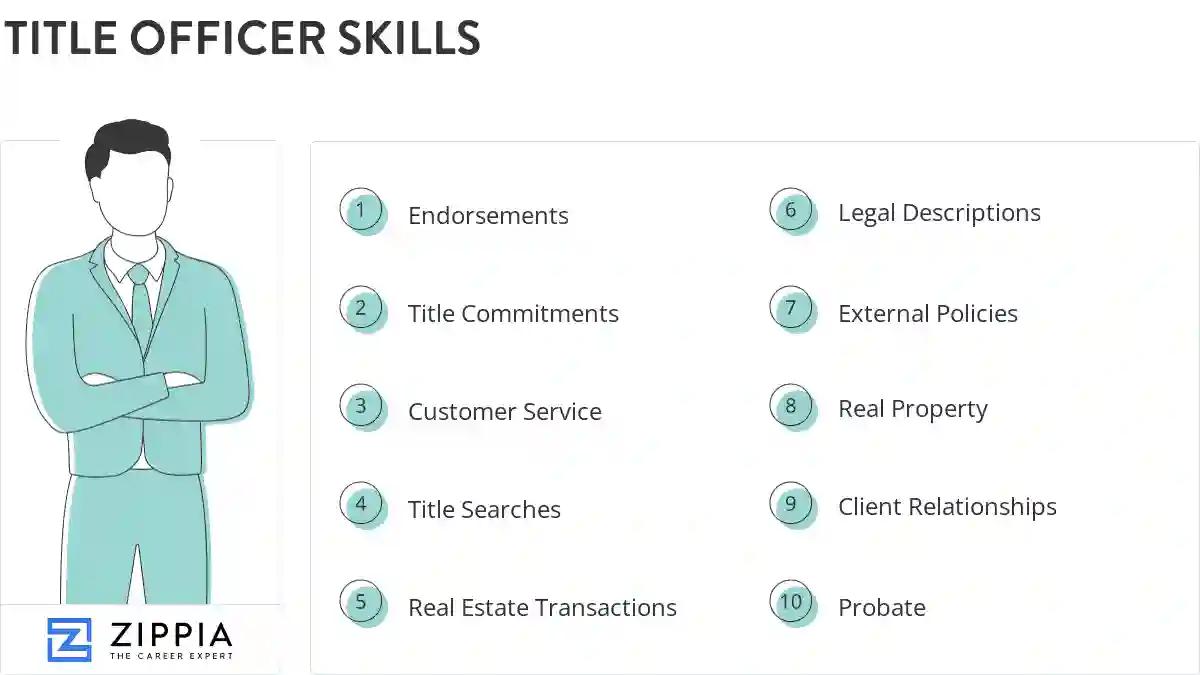
The most important skills for a title officer resume and required skills for a title officer to have include:
- Endorsements
- Title Commitments
- Customer Service
- Title Searches
- Real Estate Transactions
- Legal Descriptions
- External Policies
- Real Property
- Client Relationships
- Probate
- Conveyance
- Notary
- Foreclosure
- Title Reports
- HOA
- Residential Properties
- Title Insurance Policies
- Title Orders
- Softpro
- REO
- Title Policies
- Settlement Statements
- Real Estate Closings
- Title Issues
- Tax Assessments
- HUD-1
- Real Estate Professionals
- Underwriting Decisions
- Title Defects
- Mortgage Lenders
- Property Searches
- Legal Issues
- Property Title
- Leaseholds
- Commercial Property
- FHA
Updated January 8, 2025
