
Automatically apply for jobs with Zippia
Upload your resume to get started.
Tool engineer skills for your resume and career

15 tool engineer skills for your resume and career
1. Python
Python is a widely-known programming language. It is an object-oriented and all-purpose, coding language that can be used for software development as well as web development.
- Designed and implemented a Python server and abstraction layer to delegate tasks to a 3rd-party data simulation tool.
- Developed a Python framework for testing QEMU emulated firmware.
2. Java
Java is a widely-known programming language that was invented in 1995 and is owned by Oracle. It is a server-side language that was created to let app developers "write once, run anywhere". It is easy and simple to learn and use and is powerful, fast, and secure. This object-oriented programming language lets the code be reused that automatically lowers the development cost. Java is specially used for android apps, web and application servers, games, database connections, etc. This programming language is closely related to C++ making it easier for the users to switch between the two.
- Developed the XML Transformation Service using leading-edge Java EE and Web 2.0 technologies.
- Developed a Java based client/server framework used to configure Telecommunications services.
3. CAD
- Analyze customer CAD data and product design for manufacturing feasibility and provide recommendations.
- Tool and Die Components Started Departments - Set Up and Operated: CNC Machining Centers CNC Wire EDM CAD / CAM Programming
4. Linux
Linux is a Unix-like operating system. Just like Windows, Mac OS, and IOS, Linux is an operating system used by millions across the globe. Android itself is powered by the Linux operating system. Linux manages all the hardware resources that are associated with your computer. The software is famous because of the protection it grants from viruses, malware, and crashes. The Linux operating system is entirely free and is an open-source software meaning it can be altered by those equipped with the knowledge to code.
- Conducted periodic patching of Windows and Linux boxes from the BSA console.
- Deployed patrol agents and KM's to Windows, Linux, Solaris and AIX OS platform boxes.
5. Jenkins
Jenkins is an open source automation server that is free to use. It aids continuous deployment and execution by automating the aspects of product creation related to building, analyzing, and deploying. It is a system based on the server that runs in servlet containers like Apache Tomcat. Jenkins is a Java-based fully accessible automation platform with plugins designed for Continuous Integration.
- Conducted configuration and the integration of SCM and Project management tools such as Perforce, Jenkins, Maven and Code Collaborator.
- Conduct configuration and the integration of SCM tools such as Perforce, Jenkins and Gits.
6. Ruby
Ruby is a high-level programming language, versatile in its uses and tools. It might be used to design either programs and software which can be applied and used on a number of devices, other programs, and platforms. The fact that it is a high-level programming language means that it is easier to use than low-level languages, in that it automises parts of the program building process and uses natural language for some of its elements.
- Manage deployment automation using Chef, Ruby and Perl.
Choose from 10+ customizable tool engineer resume templates
Build a professional tool engineer resume in minutes. Our AI resume writing assistant will guide you through every step of the process, and you can choose from 10+ resume templates to create your tool engineer resume.7. Unix
UNIX is a computer operating system that was first created in the 1960s and has been constantly updated since then. The operating system refers to the set of programs that enable a machine to function. It is a multi-user, multi-tasking device that works on computers, laptops, and servers. UNIX systems also have a graphical user interface (GUI), similar to Microsoft Windows, that makes it simple to use.
- Defined and documented build process for new UNIX servers used for monitoring and database functions.
- Installed setup and configured UNIX servers.
8. Solidworks
- Tool design for aircraft accessories and structures to meet Component Maintenance Manual (CMM) requirements using SolidWorks.
- Procure and design special tooling for the production of locomotives using SolidWorks, UG NX, and SolidEdge.
9. Continuous Improvement
Continuous improvement is an ongoing process of improvement of products, services, and processes with the help of innovative ideas. It is an organized approach that helps an organization to find its weaknesses and improve them.
- Review and interact with customer and supplier on continuous improvement planning, engineering concerns and workplace ergonomics in the manufacturing environment.
- Provide technical support for manufacturing operations and jointly develop solutions to problems for continuous improvement.
10. Project Management
- Project Management of converting local DDTs systems to a centralized defect tracking system in production development process.
- Supply Project Management with tooling requirements and quotes for customer approval.
11. Jigs
- Designed Automated major assembly jigs, sub assembly jigs, holding fixtures, assembly drill jigs, scaffolding & worker platforms.
- Designed and managed the implementation of production tooling (fixtures, jigs, gauges, cutting tools, etc.)
12. GD
GD refers to Grade Delay and is often mentioned on report cards or academic records when the instructor of a particular subject decides to hold the grade of a student. This is usually done if the instructor wants the student to improve their grade by retaking the exam or doing something for extra credit that will ultimately enhance their overall grade. Eventually, when the grade is assigned, the GD is then replaced with the original grade.
- Performed GD & T and tolerance analysis for vendor parts preventing future issues part of First Article Inspection Process.
- Reviewed medical component drawings with respect to GD & T requirements.
13. CNC
CNC stands for Computer Numerical Control. It is a subtractive manufacturing technique that usually uses computerized controls and machine tools to strip layers of material from a stock piece.
- Developed and maintained CNC programs for vertical and horizontal machining centers.
- Designed and programmed CNC machinery for secondary operations.
14. Windows
Windows is a chain of operating systems that controls a computer and is developed by Microsoft. Every version of Windows consists of GUI (graphical user interface), with a desktop that allows the user to open their files.
- Supported the implementation of Requisite Pro, ClearCase LT, ClearQuest, TestManager, Robot on a Windows XP based infrastructure.
- Lead and supported the migration of admin rights for Windows and Mac workstations.
15. Debugging
- Assisted Chief Engineer with Tool Designing, debugging and customer quotations.
- Lead evaluation, installation, debugging and final acceptance testing on specified Capital equipment.
5 Tool Engineer resume examples
Build a professional tool engineer resume in minutes. Browse through our resume examples to identify the best way to word your resume. Then choose from 5+ resume templates to create your tool engineer resume.

What skills help Tool Engineers find jobs?
Tell us what job you are looking for, we’ll show you what skills employers want.
What skills stand out on tool engineer resumes?
Charles Jenckes
Assistant Professor, University of North Carolina at Charlotte
1.Where the candidate went to school and what was studied
2.GPA
3.Any successful internships
4.Projects completed by the student
What soft skills should all tool engineers possess?
Bryant Harrison
Instructor, Murray State University
What hard/technical skills are most important for tool engineers?
Bryant Harrison
Instructor, Murray State University
What tool engineer skills would you recommend for someone trying to advance their career?
Dr. Sridhar Santhanam Ph.D.
Professor and Chair, Villanova University
What type of skills will young tool engineers need?
Andy Gerrick
Associate Professor and Chair, Embry-Riddle, Prescott
List of tool engineer skills to add to your resume
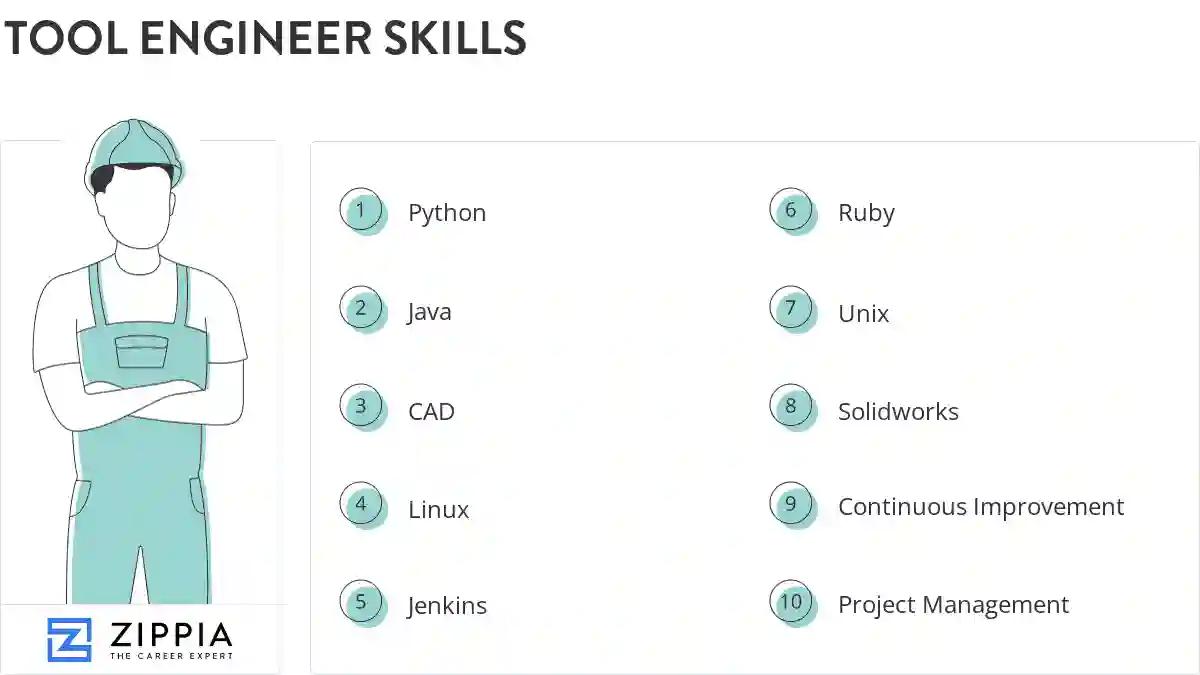
The most important skills for a tool engineer resume and required skills for a tool engineer to have include:
- Python
- Java
- CAD
- Linux
- Jenkins
- Ruby
- Unix
- Solidworks
- Continuous Improvement
- Project Management
- Jigs
- GD
- CNC
- Windows
- Debugging
- Sigma
- FEA
- Lean Manufacturing
- UI
- SQL
- Product Design
- QA
- Process Improvement
- Design Reviews
- Perl
- Product Quality
- SPC
- Mold Design
- Aided Design
- Assembly Fixtures
- DFM
- Technical Support
- ISO
- Engineering Changes
- Catia V5
- Product Development
- Design Tools
- Corrective Action
- Cost Reduction
- Quality Standards
- Confluence
- Lean Six Sigma
- Cad Cam
- PPAP
- Shop Floor
- Macro
- Prototyping
- Engineering Support
Updated January 8, 2025
