
Automatically apply for jobs with Zippia
Upload your resume to get started.
Train engineer skills for your resume and career
15 train engineer skills for your resume and career
1. Pi Planning
- Facilitated PI planning readiness, Vision, backlogs and facilities.
- Facilitated PI Planning readiness via fostering the preparation of vision and backlogs and via pre-and post-planning meetings.
2. Release Train
- Lead 9 scrum teams that define the Card Processing Release Train, a total of 65 team members.
- Facilitated scrum of scrums and other release train and company-wide ceremonies.
3. Scrum
Scrum is a lean structure for communicating, designing, and promoting complex products, with a focus on programming development. It has been applied to a variety of areas, including manufacturing, testing, new technology, and marketing techniques. Scrum is a simple framework that helps people, organizations, and teams generate value by providing many solutions to complicated problems.
- Incorporated Scrum Events Backlog refinement, Sprint Planning, Stand up meeting, Sprint Review and Sprint Retrospective.
- Assisted PO Sync and Scrum of Scrums.
4. RTE
- Program Manager, PTE and RTE for CenturyLink's Sales Compensation Applications.
5. PI
PI is the execution of all research's components such as preparation, conduction, and administration.
- Preformed lab test for various soils such as proctors, PI, sieve analysis, etc.
- Aggregated Team PI Objectives into Program PI Objectives and publish them for visibility and transparency.
6. Continuous Improvement
Continuous improvement is an ongoing process of improvement of products, services, and processes with the help of innovative ideas. It is an organized approach that helps an organization to find its weaknesses and improve them.
- Studied for continuous improvement of process lines.
Choose from 10+ customizable train engineer resume templates
Build a professional train engineer resume in minutes. Our AI resume writing assistant will guide you through every step of the process, and you can choose from 10+ resume templates to create your train engineer resume.7. Project Management
- Performed project estimation and project management, including all daily maintenance repairs and preventative maintenance operations.
- Receive high ratings on customer service, quality and project management from stake holders and manufacturing customers.
8. EIT
- Completed EIT Core Program at Rockwell Automation specializing in Advanced Software.
- Gained experience as an EIT.
9. Civil Engineering
Civil Engineering is a term referring to the branch of the engineering industry which deals with the design, creation, and keep up of public spaces such as roads, dams, parks, railways, pipelines, and various other infrastructures. It is one of the oldest branches of this field, having been born with the first larger cities and civilizations; thus "civil" engineering. It is an industry generally used to solve the problems of the public, such as a lack of sheltering or low cleanliness.
- Developed fundamental Civil Engineering skills including surveying, drafting and construction oversight while employed summers and vacation periods during college years.
- Provided educational recommendations, interpretation, and assistance on civil engineering problems.
10. Autocad
- Performed voltage drop calculations and power system analysis using AutoCAD.
- Designed electrical layouts in commercial & residential buildings using AutoCAD.
11. Civil 3D
Civil 3D is computer software that allows architects and engineers to plan and design structural engineering projects. An architectural design crafted through civil 3D software is also supported by Computer-Aided Designs (CAD) and Building Information Modelling (BIM). The software makes it easy for architects and engineers to correct any potential flaws and make changes in the structural design of a building quickly and efficiently.
- Frequent use of Civil 3D and Autodesk Stormwater Design Extensions.
- Performed horizontal and vertical track alignment along with associated grading design using AutoCADCivil 3D.
12. Lifecycle Management
- Delivered classroom instruction of Pro/ENGINEER and CATIA V5 related curriculum nationwide and internationally with a specific focus on product lifecycle management.
13. CAD
- Produce civil and structural drawings using computer aided drafting system (CAD).
- Completed the revision and modernization of company-wide CAD standards.
14. PowerPoint
- Created training documentation and PowerPoint lesson plans with extensive lecturing and hands-on operation of equipment.
- Created training and support documentation for users and management using Adobe Captivate and PowerPoint.
15. Technical Training
Technical Training refers to the act of teaching individuals the technical skills needed for various positions. This training may be on a form of software (though this doesn't include any coding technology), how to repair a piece of machinery, or how to operate a piece of machinery.
- Designed, developed and taught technical training programs to sales staff and customers.
- Developed and taught technical training courses on LSI Logic's FlexStream ASIC development flow.
5 Train Engineer resume examples
Build a professional train engineer resume in minutes. Browse through our resume examples to identify the best way to word your resume. Then choose from 5+ resume templates to create your train engineer resume.

What skills help Train Engineers find jobs?
Tell us what job you are looking for, we’ll show you what skills employers want.
What skills stand out on train engineer resumes?
Charles Jenckes
Assistant Professor, University of North Carolina at Charlotte
1.Where the candidate went to school and what was studied
2.GPA
3.Any successful internships
4.Projects completed by the student
What hard/technical skills are most important for train engineers?
Mike DeVore Ph.D.
Professor & Program Chair, Cincinnati State Technical & Community College
-Knowledge of manufacturing processes
-A good mathematics foundation
-Technical communication
-Problem solving
What soft skills should all train engineers possess?
Dr. Heidrun Schmitzer
Professor and Chair, Xavier University
What train engineer skills would you recommend for someone trying to advance their career?
Devin Roach PhD
Assistant Professor, Oregon State University
What type of skills will young train engineers need?
John Ring
Director Engineering Outreach, Elon University
List of train engineer skills to add to your resume
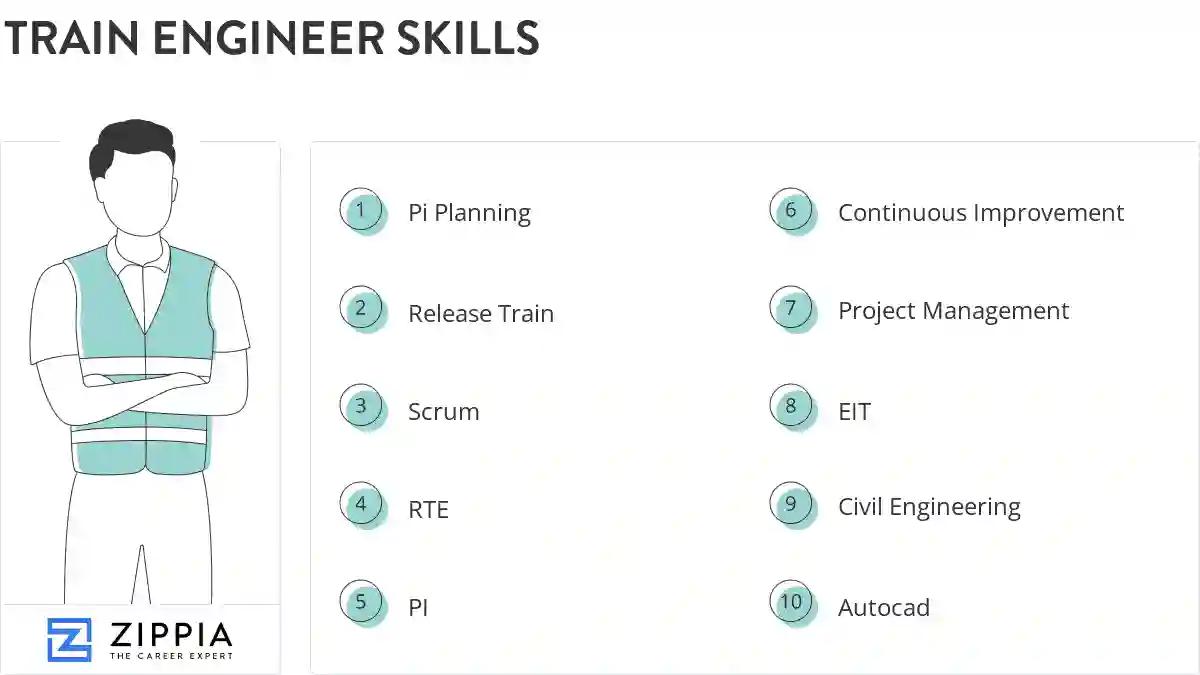
The most important skills for a train engineer resume and required skills for a train engineer to have include:
- Pi Planning
- Release Train
- Scrum
- RTE
- PI
- Continuous Improvement
- Project Management
- EIT
- Civil Engineering
- Autocad
- Civil 3D
- Lifecycle Management
- CAD
- PowerPoint
- Technical Training
- Sigma
- Asphalt
- Java
- Cost Estimates
- Windows
- Training Programs
- GIS
- System Design
- Engineering Design
- Linux
- SharePoint
- Geotechnical
- Training Materials
- Construction Projects
- GPS
- R
- Structural Design
- Engineering Support
- Unix
- ISO
- Service Oriented Architecture
- Training Courses
- Technical Reports
- Structural Analysis
- Engineering Drawings
- CNC
- Roadway Design
Updated January 8, 2025
