Explore jobs
Find specific jobs
Explore careers
Explore professions
Best companies
Explore companies
Job outlook for training and development coordinators in the United States
Training and development coordinator job growth summary. After extensive research, interviews, and analysis, Zippia's data science team found that:
The projected training and development coordinator job growth rate is 8% from 2018-2028.
About 28,900 new jobs for training and development coordinators are projected over the next decade.
Training and development coordinator salaries have increased 6% for training and development coordinators in the last 5 years.
There are over 14,503 training and development coordinators currently employed in the United States.
There are 98,225 active training and development coordinator job openings in the US.
The average training and development coordinator salary is $52,925.
Are training and development coordinator jobs in demand?
Training and development coordinator job and salary trends over time
Training and development coordinator jobs over time
Training and development coordinator job growth rate over time
| Year | # of jobs | % of population |
|---|---|---|
| 2021 | 14,503 | 0.00% |
| 2020 | 13,727 | 0.00% |
| 2019 | 13,486 | 0.00% |
| 2018 | 12,576 | 0.00% |
| 2017 | 12,100 | 0.00% |
Average training and development coordinator salary over time
Training and development coordinator salary by year
| Year | Avg. salary | Hourly rate | % Change |
|---|---|---|---|
| 2025 | $52,925 | $25.44 | +2.4% |
| 2024 | $51,667 | $24.84 | +0.6% |
| 2023 | $51,380 | $24.70 | +0.8% |
| 2022 | $50,950 | $24.49 | +2.3% |
| 2021 | $49,818 | $23.95 | +1.4% |
Training and development coordinator jobs by state
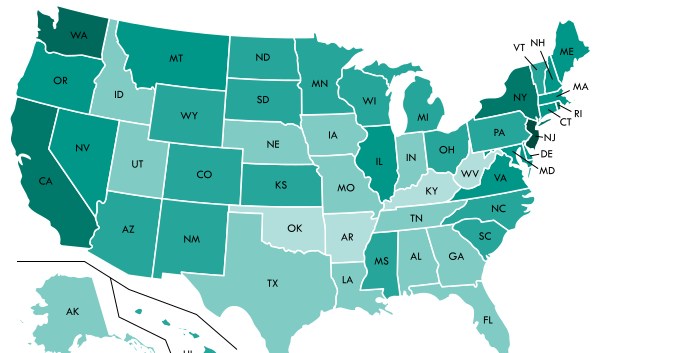
Most common states for training and development coordinators
| Rank | State | Population | # of jobs | Employment/ 1000ppl |
|---|---|---|---|---|
| 1 | New Hampshire | 1,342,795 | 622 | 46% |
| 2 | Maine | 1,335,907 | 517 | 39% |
| 3 | North Dakota | 755,393 | 270 | 36% |
| 4 | South Dakota | 869,666 | 272 | 31% |
| 5 | New Mexico | 2,088,070 | 606 | 29% |
| 6 | Alabama | 4,874,747 | 1,264 | 26% |
| 7 | West Virginia | 1,815,857 | 463 | 25% |
| 8 | Delaware | 961,939 | 238 | 25% |
| 9 | Montana | 1,050,493 | 247 | 24% |
| 10 | Alaska | 739,795 | 176 | 24% |
| 11 | District of Columbia | 693,972 | 164 | 24% |
| 12 | Rhode Island | 1,059,639 | 248 | 23% |
| 13 | Minnesota | 5,576,606 | 1,218 | 22% |
| 14 | Oklahoma | 3,930,864 | 834 | 21% |
| 15 | Maryland | 6,052,177 | 1,184 | 20% |
| 16 | Arkansas | 3,004,279 | 613 | 20% |
| 17 | Kansas | 2,913,123 | 576 | 20% |
| 18 | Nebraska | 1,920,076 | 368 | 19% |
| 19 | Iowa | 3,145,711 | 572 | 18% |
| 20 | Idaho | 1,716,943 | 316 | 18% |
Most common cities for training and development coordinators
| Rank | City | # of jobs | Employment/ 1000ppl | Avg. salary |
|---|---|---|---|---|
| 1 | Peachtree City | 1 | 3% | $41,076 |
| 2 | Boulder | 1 | 1% | $51,865 |
| 3 | Bryan | 1 | 1% | $47,314 |
| 4 | Cambridge | 1 | 1% | $56,061 |
| 5 | Framingham | 1 | 1% | $56,138 |
| 6 | Lafayette | 1 | 1% | $46,922 |
| 7 | Baltimore | 1 | 0% | $56,840 |
| 8 | Boston | 1 | 0% | $56,092 |
| 9 | Colorado Springs | 1 | 0% | $51,247 |
| 10 | Greensboro | 1 | 0% | $50,376 |
Training And Development Coordinator job outlook: Expert opinions
Our panel of training and development coordinator experts
Texas A&M University - Central Texas
University of Alaska Fairbanks
Connecticut College
University of Denver
Colorado State University

Rocky Mountain College
Heidelberg University
Alverno College

Monmouth University

Austin Community College
Marshall University
Montclair State University
Allen Redmon Ph.D.
Dean, College of Arts and SciencesTexas A&M University - Central Texas
Multi/Interdisciplinary Studies
What Training And Development Coordinator skills would you recommend for someone trying to advance their career?
Allen Redmon Ph.D.: One essential job trait that doesn’t get discussed enough is empathy, the ability to develop processes, statements, and objectives with the client, customer, or user in mind. Those employees or companies who start from a place of empathy will always outpace those who do not.
What general advice would you give to a Training And Development Coordinator?
Jaunelle Celaire: Never stop learning! This may consist of going back to school, earning new certifications in your field of study, attending conferences and seminars, and making sure that your time management is always at its finest level of excellence.
What Training And Development Coordinator skills would you recommend for someone trying to advance their career?
Jaunelle Celaire: Leadership - the world needs more of these; the ability to lead, craft and grow. Digital literacy - this world is definitely turning digital and virtual is the new trend. Emotional intelligence - there is a vast number of personalities in our world today; individuals grow and it is our job to stay emotionally connected, so we can operate more effectively.
What will help Training And Development Coordinators increase their earning potential?
Jaunelle Celaire: Learn from everything. Remember every moment is a learning opportunity from everyone around you, no matter their title. Pay attention when things go well and clue in and pay extra attention when they do not; watch how people react to it. Build relationships and network with the people who face problems by being their solution.
What are the biggest trends we'll see in the Training And Development Coordinator job market given the pandemic?
Julia Kushigian Ph.D.: The exciting trends for students graduating in Hispanic Studies and for those already in the job market are the potential benefits of a remote learning anticipated years ago through pedagogical tools designed by those in language, literature and culture. The interactive formulas, ability to engage participants and broaden the definition of language learning to include cultural studies of a variety of professional fields were already in the works and Covid was the impetus to move even faster. We know from a variety of studies, including a major report by the American Council of Teachers of Foreign Languages, for example, that 9 out of 10 U.S. employers rely on employees with language skills other than English. Spanish being in high demand is the most sought after language. Of course, beyond the more obvious benefits of being bilingual ("Why Bilinguals are Smarter" NYT 2012) are the less obvious of being adept at solving certain mental problems, thriving in ambiguity, flexibility with unknowns and the potential to stave off dementia later in life.
How have salaries changed over time for Training And Development Coordinators?
Julia Kushigian Ph.D.: As demand has increased, salaries have risen tremendously to try and keep pace. In fields like education, business, health care, government, social services, service related employment, law, etc., salaries have improved year over year to stay competitive.
Will there be an enduring impact of the coronavirus pandemic on Training And Development Coordinators?
Maria Salazar Ph.D.: The coronavirus will have an enduring impact on higher education graduates. In the field of education, graduates have experienced first hand the deep and lasting inequalities that the coronavirus has had on youth and families from Communities of Color. The have seen educational gaps widen into education chasms. They have witnessed the struggles, successes, and resiliency of families as they navigate the impact of the virus. Graduates leave education programs with their eyes wide open to the systemic racism and other isms that impact youth and their families, from education, to healthcare, and beyond.
In teacher education programs, our graduates have had a front row seat to inequality. They have witnessed children and adolescents disengage from schooling and life. They have struggled to support their students' mental and physical health. They ache to be with their students in classrooms, yet fear the repercussions of close contact due to the virus. Yet, they persist, and they keep believing they can make a difference.
What technical skills for a Training And Development Coordinator stand out to employers?
Maria Salazar Ph.D.: Technical skills that stand out to employers in the education sector during and after the time of COVID include interpersonal skills, ability to navigate change and challenges, and commitment to educational equity. Interacting with colleagues, students, and families online is challenging. This requires a set of interpersonal skills that involve a tolerance for uncertainty, risk-taking, creativity, and innovation. The ability to navigate change and challenges is essential during uncertain times. In schools, the landscape is alway changing, and more so in a global pandemic.
It is important to foster a growth-mindset in oneself, and also in one's school community. Employers are also looking for a commitment to educational equity. With emerging consciousness of racial inequality and the need for systems that promote racial justice, employers want to hire people who are culturally competent and can move beyond statements of the value of diversity, to the enactment of educational environments that promote equity for those who are marginalized. This skill set includes: cross-cultural communication, culturally responsive teaching, and strength-based practices.
Dr. Ann Sebald
Assistant Professor, Co-DirectorColorado State University
Center for Educator Preparation
Will there be an enduring impact of the coronavirus pandemic on Training And Development Coordinators?
Dr. Ann Sebald: Not sure what is meant by 'enduring'. However, if you are asking if there will be a long/longer term impact of the pandemic on recent graduates entering the teaching profession, I would say yes. As the state continues to work through the fiscal impact of the pandemic, schools will need to identify their priorities. As it relates to in-person learning, educators have done an amazing job at continuous adjustments during the past year. Teacher candidates have learned along-side veteran educators how best to adapt the learning environment for all students and their needs. What we've learned over this past year is being applied in schools around the globe moving forward.
What will help Training And Development Coordinators increase their earning potential?
Dr. Ann Sebald: Within the field of P-12 education, the question that should be asked is what will help people in our field improve student learning. Professional development opportunities, supported by what we have learned from recent and on-going research, is what will support teachers and leaders within the field of P-12 education. The goal remains the same, how can we best prepare future children and youth to be well prepared to address the challenges and opportunities they will face as they graduate and move out into the workforce and world.
Dr. Stevie Schmitz
Director of EducationRocky Mountain College
Leadership and Distance Education Program
Will there be an enduring impact of the coronavirus pandemic on Training And Development Coordinators?
Dr. Stevie Schmitz: I believe that there will be an enduring impact on the entire education system due to the pandemic. Students may experience gaps in their education due to remote learning which will have to be addressed by educational leaders and their faculty members as well as parents. Social emotional stress is bound to be a factor as students return to school. Leaders need to support students and staff with this transition. Educational technology will occupy a new role in public education and we need to embrace and support it. Financial impact will also be a reality for newly graduated educational leaders. Money spent or needing to be spent on safety measures will continue as more students return to school. All of these situations (and others not yet imagined) will impact new leaders.
What's a day at work look like for a Training And Development Coordinator?
Dr. Stevie Schmitz: It will be stressful and rewarding...complicated by the impact of the pandemic and yet still rewarding because of working with young people and helping them reach their full potential.
What will help Training And Development Coordinators increase their earning potential?
Dr. Stevie Schmitz: The demand for more leaders may increase earning potential, but it will be tempered by the additional expenses incurred and the stagnant revenue stream to meet those demands.
Paige Atterholt
Adjunct ProfessorHeidelberg University
Will there be an enduring impact of the coronavirus pandemic on Training And Development Coordinators?
Paige Atterholt: I think now, being in year 2 of the pandemic, I think if anything there will be more jobs for graduates. Just looking through the jobs online, there are many opportunities for graduates to get a job. I think the older community retired when things got bad, which opened the door for the younger generation.
What's a good job out of college for Training And Development Coordinators?
Paige Atterholt: A good job out of college is a job that you feel passionate about because I believe your happiness comes first. Being in the world of education, a good job in my eyes is a job that you enjoy going to every day, want to make an impact, and enjoy the time you have with your students.
What will help Training And Development Coordinators increase their earning potential?
Paige Atterholt: There are many ways a teacher can increase their earning potential. This can be done through continuing education, maybe looking at a Masters or more to move up on the pay scale. Teachers can advise student council, tutoring, or even look at coaching to earn more money. There's vast opportunities in the world of education! Schools always need teachers who are well-rounded.
What certifications/licenses/courses can have the biggest impact for Training And Development Coordinators?
Randa Suleiman Ph.D.: Are you asking about my job as a faculty? If yes, here is my answer: As a faculty, I worked diligently to model best practices teaching in a virtual environment. I believe in modeling my expectations. As education faculty, we have to walk the talk. I created effective learning environment for my teacher candidates that they can take ideas and strategies to implement in their own teaching.
What will help Training And Development Coordinators increase their earning potential?
Randa Suleiman Ph.D.: As more teachers are leaving the field, there is a teacher shortage. All teaching licenses are needed. Some of the areas with immediate needs are special education and bilingual
What are the biggest trends we'll see in the Training And Development Coordinator job market given the pandemic?
Antonio Estudillo Ph.D.: A range of considerations come to mind, all of which are interconnected and speak to sustainability in the field of education. Generally speaking, there is a teacher shortage where specific endorsements are concerned (e.g., STEM, Special Education, ESL/working with Multi-Lingual Leaners as well as historically underrepresented students). Of immediate interest is the recruitment and retention of our teaching force that cannot simply pivot how they approach teaching pedagogy, but actually how prospective teacher-educators can change their practices to be more learner-centered, equity-minded, and intentional moving forward (i.e., namely, concentration in quality of technology applications and usage; online learning/blended learning/hybrid intruction).
Specific to the pandemic, this is perhaps most pressing when considering how to better differentiate within and across learning environments/spaces to offer a personalized student experience-facilitating and cultivating meaningful engagement, especially having incoming teachers bring with them an increased/enhanced sense of self and awareness-knowledge of the backgrounds and representation of children of color (Black, Indigenous, and People of Color) and in particular Latinx and Black/African-American students. In addition too, per job market and the current pandemic, there is still a tremendous need to increase and diversify the ethnic-racial representation of the teaching force.
What technical skills for a Training And Development Coordinator stand out to employers?
Antonio Estudillo Ph.D.: I may not have an exact estimation, but I do foresee pre-service teacher educators who enter into the profession with technical skills that are integrative and flexible as being most favorable. Per our times in COVID-19 and beyond, the increased saliency in willingness to be both mindful and continuously learn newer skills even after one graduates will be critical to one's success. This may also include some awareness and practice in underscoring an interdisciplinary approach to teaching and learning/curriculum development and assessment.
Meaning, as far as one's experience in teaching pedagogy-skill development prior to entering the profession ought to be open to increased experiences in such areas as collaboration/encouraging professional learning (e.g., team-based approaches), independent project management, and continuous means of self-reflection (i.e., reflective artifacts or representation of works that signal an aim to increase competencies in all things related to the profession; spotlighting research and informed decision making; culturally sustaining practices).
What's a good job out of college for Training And Development Coordinators?
Antonio Estudillo Ph.D.: One where an individual out of college has the opportunity to gain access to critical mentorship, professional learning (e.g., professional development), a greater sense of autonomy, and the presence of a community (e.g., sense of belonging as a professional). These combined considerations may be aspirational, but in the context of schools, a recognition for school leadership also matters. Therefore, those seeking a position should aim to consider the present and ongoing investments that are in motion/developing within an institution and how these investments may become increasingly comprehensive, forward-thinking, and accessible over time and after one is hired.
Will there be an enduring impact of the coronavirus pandemic on Training And Development Coordinators?
Stuart Greenfield Ph.D.: According to the National Student Clearinghouse estimates for Fall 2018-Fall 2020, Nscresearchcenter, enrollment inf post-secondary institutions declined by 703.9K. Of this decline, 621.4K (88.3%) were attributed to Public 2-year institutions.
What soft skills should all Training And Development Coordinators possess?
Stuart Greenfield Ph.D.: Given the changing demographics that the country has experienced, the entire education continuum must change. According to the Brookings Institution, Brookings, the non-Hispanic White population in the under 18 cohort since 2000 has declined.
As you'll note from the occupations that are projected to increase the greatest, most require face-to-face contact, so that soft-skills will be necessary. I would also expect that critical thinking skills will be needed as more responsibility will be required of front-line workers.
What certifications/licenses/courses can have the biggest impact for Training And Development Coordinators?
Stuart Greenfield Ph.D.: According to the Bureau of Labor Statistics' Occupation Outlook, half the twenty fastest jobs, BLS, require only a high school diploma. The three fastest-growing jobs, Care Aides, Fast-food workers, and Cooks, only require a high school diploma.
The health care sector has been and will continue to be the fastest-growing sector in the economy. Many of these occupations require certifications. The health care sector's growth should provide community colleges an area for growth as they can provide health care training at an affordable cost.
The Philadelphia Fed has a tool, Philadelphiafed, that shows what training/skills are required for job seekers to improve their earnings.
Dr. E.Del Chrol
Chair of Humanities, Professor of ClassicsMarshall University
Humanities Department
What soft skills should all Training And Development Coordinators possess?
Dr. E.Del Chrol: Useful soft skills are definitely those that Classical languages produce: ability to look closely at a body of work and pay attention to cultural context, ability to articulate complex ideas through speech and writing, deep focus to understand the fiddly bits of syntax.
What are the biggest trends we'll see in the Training And Development Coordinator job market given the pandemic?
Dr. Nicole Barnes: Although the abrupt changes that occurred to K-12 schooling in the Spring of 2020 have given way to more detailed reopening plans and a vaccine is now available, the use of hybrid and remote learning remains with the ongoing influence of COVID-19. Therefore, it seems essential that teacher educators, researchers, and K-12 school districts rethink what good teaching looks like for K-12 education's changed landscape. Teachers more then ever will need to be prepared to teach in virtual environments and garner the same academic, social, and emotional student outcomes that they would face to face.
What's a good job out of college for Training And Development Coordinators?
Dr. Nicole Barnes: Our graduates are obviously looking for teaching, counseling, or administrative positions in K-12 schools. What I hope for them is that they are in an environment that supports their future learning, and puts kids (all kids) at the forefront of their decision making processes.