Explore jobs
Find specific jobs
Explore careers
Explore professions
Best companies
Explore companies
Job outlook for training assistants in the United States
Training assistant job growth summary. After extensive research, interviews, and analysis, Zippia's data science team found that:
The projected training assistant job growth rate is 8% from 2018-2028.
About 28,900 new jobs for training assistants are projected over the next decade.
Training assistant salaries have increased 6% for training assistants in the last 5 years.
There are over 5,403 training assistants currently employed in the United States.
There are 37,797 active training assistant job openings in the US.
The average training assistant salary is $40,334.
Are training assistant jobs in demand?
Training assistant job and salary trends over time
Training assistant jobs over time
Training assistant job growth rate over time
| Year | # of jobs | % of population |
|---|---|---|
| 2021 | 5,403 | 0.00% |
| 2020 | 5,113 | 0.00% |
| 2019 | 5,024 | 0.00% |
| 2018 | 4,685 | 0.00% |
| 2017 | 4,507 | 0.00% |
Average training assistant salary over time
Training assistant salary by year
| Year | Avg. salary | Hourly rate | % Change |
|---|---|---|---|
| 2025 | $40,334 | $19.39 | +2.4% |
| 2024 | $39,375 | $18.93 | +0.6% |
| 2023 | $39,156 | $18.83 | +0.8% |
| 2022 | $38,828 | $18.67 | +2.3% |
| 2021 | $37,966 | $18.25 | +1.4% |
Training assistant jobs by state
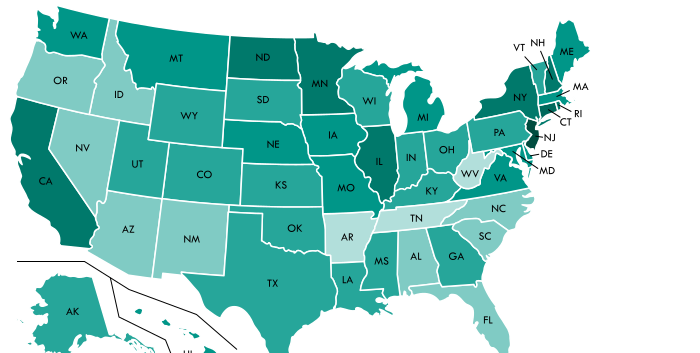
Most common states for training assistants
| Rank | State | Population | # of jobs | Employment/ 1000ppl |
|---|---|---|---|---|
| 1 | District of Columbia | 693,972 | 122 | 18% |
| 2 | Maine | 1,335,907 | 193 | 14% |
| 3 | New Hampshire | 1,342,795 | 175 | 13% |
| 4 | Delaware | 961,939 | 111 | 12% |
| 5 | Minnesota | 5,576,606 | 603 | 11% |
| 6 | Arkansas | 3,004,279 | 317 | 11% |
| 7 | West Virginia | 1,815,857 | 201 | 11% |
| 8 | Montana | 1,050,493 | 113 | 11% |
| 9 | Massachusetts | 6,859,819 | 679 | 10% |
| 10 | Alabama | 4,874,747 | 471 | 10% |
| 11 | Mississippi | 2,984,100 | 310 | 10% |
| 12 | Iowa | 3,145,711 | 302 | 10% |
| 13 | North Dakota | 755,393 | 77 | 10% |
| 14 | Kentucky | 4,454,189 | 414 | 9% |
| 15 | Kansas | 2,913,123 | 254 | 9% |
| 16 | New Mexico | 2,088,070 | 190 | 9% |
| 17 | Nebraska | 1,920,076 | 169 | 9% |
| 18 | Wyoming | 579,315 | 55 | 9% |
| 19 | Missouri | 6,113,532 | 512 | 8% |
| 20 | Rhode Island | 1,059,639 | 81 | 8% |
Most common cities for training assistants
| Rank | City | # of jobs | Employment/ 1000ppl | Avg. salary |
|---|---|---|---|---|
| 1 | Paducah | 3 | 12% | $35,790 |
| 2 | Fairfax | 2 | 8% | $42,737 |
| 3 | Bangor | 2 | 6% | $40,125 |
| 4 | Mankato | 2 | 5% | $49,377 |
| 5 | Bethesda | 2 | 3% | $41,233 |
| 6 | Broomfield | 2 | 3% | $37,447 |
| 7 | Fort Smith | 2 | 2% | $25,133 |
| 8 | Sioux City | 2 | 2% | $40,877 |
| 9 | Ames | 1 | 2% | $41,100 |
| 10 | Annandale | 1 | 2% | $42,803 |
| 11 | Atlanta | 3 | 1% | $35,558 |
| 12 | Birmingham | 3 | 1% | $32,509 |
| 13 | Riverside | 2 | 1% | $44,917 |
| 14 | Albany | 1 | 1% | $35,091 |
| 15 | Alexandria | 1 | 1% | $42,873 |
| 16 | Ann Arbor | 1 | 1% | $44,871 |
| 17 | Detroit | 3 | 0% | $45,202 |
| 18 | Miami | 2 | 0% | $31,918 |
Training Assistant job outlook: Expert opinions
Our panel of training assistant experts
University of Denver

Rocky Mountain College

Monmouth University
Marshall University
Montclair State University
Will there be an enduring impact of the coronavirus pandemic on Training Assistants?
Maria Salazar Ph.D.: The coronavirus will have an enduring impact on higher education graduates. In the field of education, graduates have experienced first hand the deep and lasting inequalities that the coronavirus has had on youth and families from Communities of Color. The have seen educational gaps widen into education chasms. They have witnessed the struggles, successes, and resiliency of families as they navigate the impact of the virus. Graduates leave education programs with their eyes wide open to the systemic racism and other isms that impact youth and their families, from education, to healthcare, and beyond.
In teacher education programs, our graduates have had a front row seat to inequality. They have witnessed children and adolescents disengage from schooling and life. They have struggled to support their students' mental and physical health. They ache to be with their students in classrooms, yet fear the repercussions of close contact due to the virus. Yet, they persist, and they keep believing they can make a difference.
What technical skills for a Training Assistant stand out to employers?
Maria Salazar Ph.D.: Technical skills that stand out to employers in the education sector during and after the time of COVID include interpersonal skills, ability to navigate change and challenges, and commitment to educational equity. Interacting with colleagues, students, and families online is challenging. This requires a set of interpersonal skills that involve a tolerance for uncertainty, risk-taking, creativity, and innovation. The ability to navigate change and challenges is essential during uncertain times. In schools, the landscape is alway changing, and more so in a global pandemic.
It is important to foster a growth-mindset in oneself, and also in one's school community. Employers are also looking for a commitment to educational equity. With emerging consciousness of racial inequality and the need for systems that promote racial justice, employers want to hire people who are culturally competent and can move beyond statements of the value of diversity, to the enactment of educational environments that promote equity for those who are marginalized. This skill set includes: cross-cultural communication, culturally responsive teaching, and strength-based practices.
Dr. Stevie Schmitz
Director of EducationRocky Mountain College
Leadership and Distance Education Program
Will there be an enduring impact of the coronavirus pandemic on Training Assistants?
Dr. Stevie Schmitz: I believe that there will be an enduring impact on the entire education system due to the pandemic. Students may experience gaps in their education due to remote learning which will have to be addressed by educational leaders and their faculty members as well as parents. Social emotional stress is bound to be a factor as students return to school. Leaders need to support students and staff with this transition. Educational technology will occupy a new role in public education and we need to embrace and support it. Financial impact will also be a reality for newly graduated educational leaders. Money spent or needing to be spent on safety measures will continue as more students return to school. All of these situations (and others not yet imagined) will impact new leaders.
What technical skills for a Training Assistant stand out to employers?
Antonio Estudillo Ph.D.: I may not have an exact estimation, but I do foresee pre-service teacher educators who enter into the profession with technical skills that are integrative and flexible as being most favorable. Per our times in COVID-19 and beyond, the increased saliency in willingness to be both mindful and continuously learn newer skills even after one graduates will be critical to one's success. This may also include some awareness and practice in underscoring an interdisciplinary approach to teaching and learning/curriculum development and assessment.
Meaning, as far as one's experience in teaching pedagogy-skill development prior to entering the profession ought to be open to increased experiences in such areas as collaboration/encouraging professional learning (e.g., team-based approaches), independent project management, and continuous means of self-reflection (i.e., reflective artifacts or representation of works that signal an aim to increase competencies in all things related to the profession; spotlighting research and informed decision making; culturally sustaining practices).
What's a good job out of college for Training Assistants?
Antonio Estudillo Ph.D.: One where an individual out of college has the opportunity to gain access to critical mentorship, professional learning (e.g., professional development), a greater sense of autonomy, and the presence of a community (e.g., sense of belonging as a professional). These combined considerations may be aspirational, but in the context of schools, a recognition for school leadership also matters. Therefore, those seeking a position should aim to consider the present and ongoing investments that are in motion/developing within an institution and how these investments may become increasingly comprehensive, forward-thinking, and accessible over time and after one is hired.
Dr. E.Del Chrol
Chair of Humanities, Professor of ClassicsMarshall University
Humanities Department
What soft skills should all Training Assistants possess?
Dr. E.Del Chrol: Useful soft skills are definitely those that Classical languages produce: ability to look closely at a body of work and pay attention to cultural context, ability to articulate complex ideas through speech and writing, deep focus to understand the fiddly bits of syntax.
What are the biggest trends we'll see in the Training Assistant job market given the pandemic?
Dr. Nicole Barnes: Although the abrupt changes that occurred to K-12 schooling in the Spring of 2020 have given way to more detailed reopening plans and a vaccine is now available, the use of hybrid and remote learning remains with the ongoing influence of COVID-19. Therefore, it seems essential that teacher educators, researchers, and K-12 school districts rethink what good teaching looks like for K-12 education's changed landscape. Teachers more then ever will need to be prepared to teach in virtual environments and garner the same academic, social, and emotional student outcomes that they would face to face.