
Automatically apply for jobs with Zippia
Upload your resume to get started.
Tube mill operator skills for your resume and career
15 tube mill operator skills for your resume and career
1. Calipers
- Inspected final product using micrometer and calipers per Specialized Product Control to ensure out-of-specification parts were identified.
- Calculate dimensions and tolerances using knowledge of mathematics and instruments such as micrometers and vernier calipers.
2. Hand Tools
- Utilized hand tools such as dead blow and ball peen hammers to ensure proper final fit and finish of fabricated parts.
- Operated and maintained shop hand tools and equipment, including grinder, drill, band saw, and plasma cutter.
3. Tape Measure
A tape measure is a thin, flexible strip of plastic or metal that can be rolled up when it is not being used. The tape measure has numbers marked on it linearly which is used for measuring length.
- Form parts and check angles and dimensions Skills UsedRead tape measure and use of a square
- Check parts for accuracy using a tape measure, caliper, protractor, etc.
4. ISO
- Experience operation within Certification ISO 9001-2008 specifications.
- Performed final walk down of systems per ISO drawings and updated P&ID s through MOC process as necessary.
5. Mill Equipment
- Maintain and repair various components of mill equipment.
- Operated and trouble shoot mill equipment when technical errors occurred.
6. MIG
MIG is a specific type of welding in which two base materials are welded together using a solid wire electrode fed through a welding gun and into the weld pool.
- Used tooling consisted of Oxygen/acetylene torches, grinders, welding equipment including MIG and flux-core wire using noble gas shields.
- Read blueprints for design specifications, MIG welding galvanized, stainless and cold rolled steels.
Choose from 10+ customizable tube mill operator resume templates
Build a professional tube mill operator resume in minutes. Our AI resume writing assistant will guide you through every step of the process, and you can choose from 10+ resume templates to create your tube mill operator resume.7. Stainless Steel
Stainless steel is an alloy of iron, chromium, carbon, and some other metals with corrosion-resistant properties. The components of steel include less than 1% carbon, 1% manganese, and small quantities of other elements such as phosphorus, silicon, sulfur, and oxygen. Iron and carbon are the two essential components of steel. Stainless steel is resistant to tarnishing and rust.
- 97056Fabricated stainless steel commercial counter top
- Operated a break press, punch press, shears and rollers to form stainless steel products to blueprint specifications.
8. Machine Set-Ups
- Adjusted and corrected machine set-ups to reduce thicknesses, reshape products, and eliminate product defects.
- Adjust and correct machine set-ups to reduce thicknesses, reshape products, and eliminate product defects.
9. RAN
RAN stands for "revenue anticipation note," which refers to a practice where an organization (often the government) borrows money to support a specific project. When these funds are then repaid, the money given to the lenders comes from the profits generated by the business originally funded.
- Tow Motor Driver * Ran plastic blow-mold press * Relieved operators for break and trained new operators.
- Break press operator, also ran a CNC Mill, punch machines, saw, and shear.
10. TIG
TIG stands for "tungsten inert gas welding" and is also known as gas tungsten arc welding (GTAW). This particular type of weld is more difficult as it requires the welder to heat materials until they are liquid.
- Set up, operated and maintained tube mills, annealers, TIG welders and laser welders.
11. Quality Inspection
Quality inspections are measures to verify, examine or test various properties of one or more products and relate the results to the requirements to confirm compliance with the manufacturing processes. This is carried out to discover product defects and inform the management team for a decision on whether to approve or reject the product release.
- Performed quality inspections per customer spec.
12. Tig Welding
- Cross train for TIG Welding.
- Provided welding techniques involving mig/tig welding-worked from written and verbal communication in the assembling of various parts and equipment.
13. Machine Cycles
- Monitored machine cycles and mill operations to detect jamming and to ensure that products conform to specifications.
14. Quality Checks
Quality checks are a component of quality control aimed at ensuring that quality requirements are met. Internally, quality checks provide assurance to managers, and externally, it provides assurance to clients, federal departments, authorities, and certifiers.
- Use measuring devices and record all quality checks, print tags, record number of pieces/bundles shipped on orders.
- Calibrate machinery every two hours and complete paperwork and self-quality check every hour.
15. Mill Operations
- Identify and report maintenance requirements for essential machinery in mill operation.
- Mill operation, Supervisory position in manufacturing environment.
5 Tube Mill Operator resume examples
Build a professional tube mill operator resume in minutes. Browse through our resume examples to identify the best way to word your resume. Then choose from 5+ resume templates to create your tube mill operator resume.

What skills help Tube Mill Operators find jobs?
Tell us what job you are looking for, we’ll show you what skills employers want.
List of tube mill operator skills to add to your resume
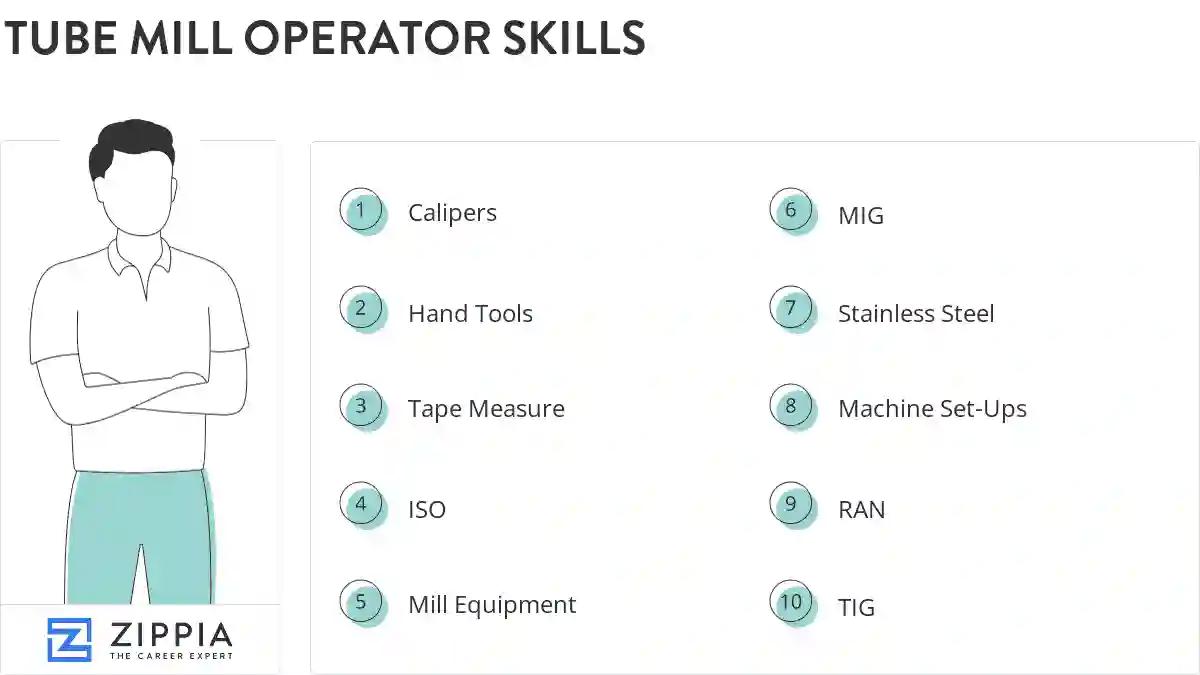
The most important skills for a tube mill operator resume and required skills for a tube mill operator to have include:
- Calipers
- Hand Tools
- Tape Measure
- ISO
- Mill Equipment
- MIG
- Stainless Steel
- Machine Set-Ups
- RAN
- TIG
- Quality Inspection
- Tig Welding
- Machine Cycles
- Quality Checks
- Mill Operations
- Quality Standards
- ASTM
- CNC
Updated January 8, 2025
