
Automatically apply for jobs with Zippia
Upload your resume to get started.
Unit operator skills for your resume and career

15 unit operator skills for your resume and career
1. Asphalt
- Assisted crew workers with laying asphalt and smoothing asphalt out.
- Asphalt prep, Rotomill operator trainee,Tank truck driver,Dump truck driver
2. Plant Equipment
The equipment that has a capital nature and can be easily moved from personal property is called plant equipment. Unlike fixed equipment, plant equipment is temporarily added to the structure of a building. These can be appliances, power tools, forklifts, vehicles, etc. Plant equipment plays a vital role in plant maintenance and ensures that the area has minimum breakdowns and the plant is fully functional at the lowest possible cost
- Ensured plant equipment was properly operating within specific temperature, pressure, level, vibration, amperage and voltage limits.
- Received instruction from the RE to properly clear and tag plant equipment as a Qualified Employee (QE).
3. Safety Procedures
Safety procedures are a set of standardized procedures, that ensures minimal to no risk to people, resources, and the work environment. A company follows the step-by-step safety procedures as it they not only keep the customers and the employees safe, but also help in avoiding legal claims.
- Implemented safety procedures, rules, and regulations.
- Go over safety procedures before entering the plant.
4. Control Room
A control room, also known as an operations center, is a room that serves as central control and monitoring station for security, building, and other types of systems of a large facility or physical area. Control rooms act as the central nervous system of a facility and require a reliable and efficient communication system to effectively handle emergencies, as well as critical incidents and decisions.
- Control and monitor all equipment associated in the fossil power process from the unit control room.
- Worked as Plant Helper, Auxiliary Operator, Boiler Control Room Operator and Turbine & Switchboard
5. Unit Operations
- Managed Crystallization Unit operation to peak efficiency and make sodium sulfate.
- Monitored process variables for safe unit operations.
6. Rig
Rigging includes designing, preparing, or setting up equipment for drilling operations. This skill is one of the main and most important activities in the oil and gas industry, whether it's for onboard operations or port operations. Rigging systems should have parts like master links, shackles, slings, and lifting bags for underwater lifting. Professionals working with rigging systems are responsible for tasks like operating platform lifts, forklifts, and overhead cranes.
- Used Hydraulic pump to MIx Drilling mud and dye then it pumped down hole on a drilling rig.
- Started as floor hand on workover rig, promoted to derricks, then operator, then reverse operator.
Choose from 10+ customizable unit operator resume templates
Build a professional unit operator resume in minutes. Our AI resume writing assistant will guide you through every step of the process, and you can choose from 10+ resume templates to create your unit operator resume.7. Environmental Compliance
Environmental compliance means to fulfill official environmental requirements. It comprises environmental rules, laws, and regulations, and permits regarding which sites to operate. Environmental concerns have raised compliances across the globe. Environmental compliance includes managing and monitoring the required permits for correct parameters, performing and processing calculations, generate daily compliance reports, and record data with compliance to any risk alert
- Adhered to all applicable regulations, policies, and procedures for health, safety, and environmental compliance.
8. DOT
- Follow DOT rules in regards to the FMCSA rule book.
- Transported perishable goods via refrigerated carriers Maintain accurate logs and paperwork, along with compliancy with DOT regulations
9. Control Valves
A control valve is a device that uses power to manipulate and regulate the flow of fluids. A control valve is the most common final control element in the industry since it is a critical part of a control loop.
- Maintained all pumps, control valves and necessary equipment while an operator.
10. Condensers
- Regulated boiler blow down, backwashed and cleaned condensers.
11. Auxiliary Equipment
Auxiliary Equipment will differ depending on the work environment, but it is often recognized as machinery that promotes efficiency within a company. Auxiliary equipment can complete work without employee input or direct communication. This equipment can range from something as simple as conveyor belts and bulk storage to more complex machines that assist with oil extraction.
- Monitor, troubleshoot, and correct any equipment malfunctions while continuously monitoring auxiliary equipment involved in the process.
- Operated and maintained plant auxiliary equipment.
12. Distillation
- Experiment with laboratory-scale: Separation, Filtration, Fermentation, Distillation, Extrusion, and Flow Reactor Units.
- Performed day to day operational oversight and maintenance over numerous distillation and utility units in a cresylic acid manufacturing facility.
13. Water Treatment
- Operated steam turbines, generators, cooling tower, pumps, compressors and water treatment plants.
- Operated the waste water treatment plant, loaded RR cars and trucks with different products.
14. Hazardous Materials
Any substance or good that is harmful to human health as well as the environment are called hazardous materials. Such materials must be handled carefully to avoid any mishaps. Harmful gases. chemicals, strong medicines or drugs, radioactive elements required for radiation purposes, a human blood sample that carries germs, all of these are considered hazardous materials.
- Trained in proper and safe ways to dispose of hazardous materials.
- Conduct daily equipment inspections and successfully maintain daily equipment reports preparation all shipping documentations for transportation of hazardous materials.
15. Process Equipment
Process equipment refers to the machinery used in processing and refining industries. This equipment is responsible for a single job in the refinement process, which can vary from maintaining the flow of a chemical, controlling chemical reactions, or even storing chemicals. Process equipment can also be broken down into two categories, which are fixed and rotating equipment, depending on the movement required from the equipment.
- Performed LOTO on various process equipment in preparation of upcoming maintenance and/or testing.
- Trained to perform minor maintenance on machinery and process equipment.
5 Unit Operator resume examples
Build a professional unit operator resume in minutes. Browse through our resume examples to identify the best way to word your resume. Then choose from 5+ resume templates to create your unit operator resume.

What skills help Unit Operators find jobs?
Tell us what job you are looking for, we’ll show you what skills employers want.
List of unit operator skills to add to your resume
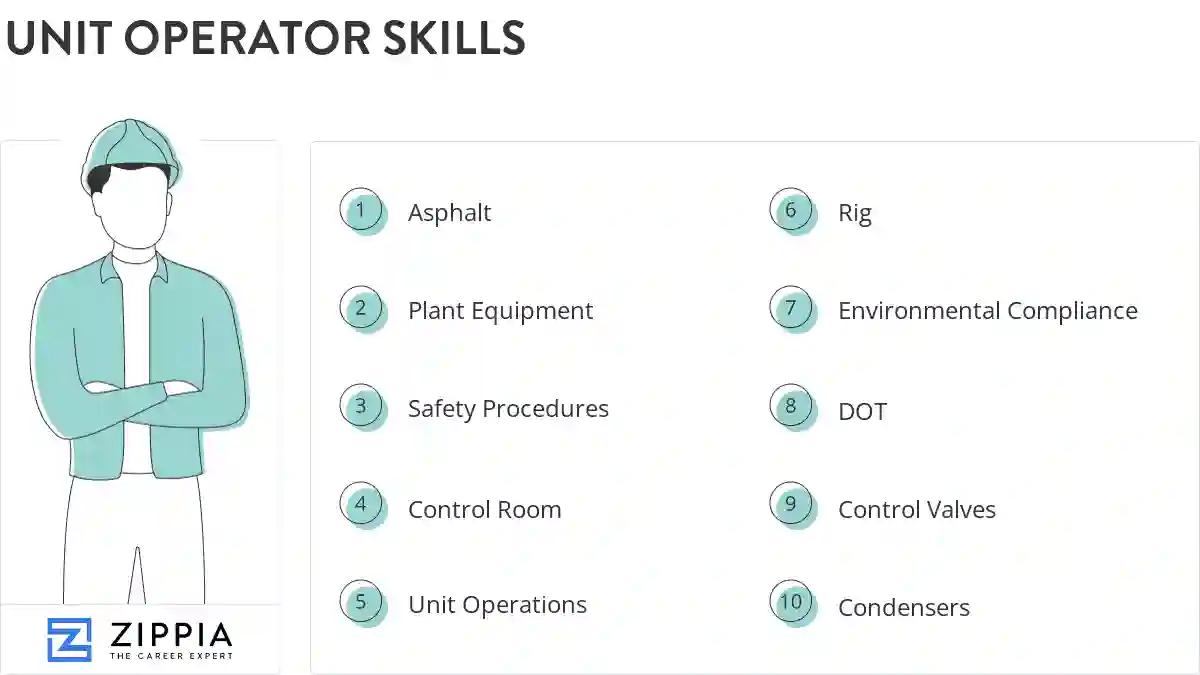
The most important skills for a unit operator resume and required skills for a unit operator to have include:
- Asphalt
- Plant Equipment
- Safety Procedures
- Control Room
- Unit Operations
- Rig
- Environmental Compliance
- DOT
- Control Valves
- Condensers
- Auxiliary Equipment
- Distillation
- Water Treatment
- Hazardous Materials
- Process Equipment
- EPA
- Firefighting
- Frac
- Routine Inspections
- Product Quality
- Clearance Procedure
- DCS
- Water Systems
- Logistics
- Safety Standards
- Safety Regulations
- Equipment Maintenance
- JSA
- MW
- Rail Cars
- Well Control
- CPR
- Demineralizers
- Communications Equipment
- Combustion Turbines
- BOP
- H2S
- Customer Specifications
- Gas Plant
- Equipment Operation
- TVA
- Benzene
- PPE
Updated January 8, 2025
