
Automatically apply for jobs with Zippia
Upload your resume to get started.
Unix systems engineer skills for your resume and career
15 unix systems engineer skills for your resume and career
1. Python
Python is a widely-known programming language. It is an object-oriented and all-purpose, coding language that can be used for software development as well as web development.
- Shell scripting languages used to support my role included KSH, Perl, Python, and PHP.
- Experienced with Bash and Python scripting languages.
2. Windows
Windows is a chain of operating systems that controls a computer and is developed by Microsoft. Every version of Windows consists of GUI (graphical user interface), with a desktop that allows the user to open their files.
- Converted SAMBA configuration to centralized servers using Windows Active Directory for authentication.
- Supported Microsoft Windows 2003/2008 server operations and maintenance.
3. Solaris
- Create specification and implementation of Sun Solaris 2.6 hosts in international locations to an international customer.
- Administered servers and workstations running multiple versions of Solaris on multiple generations of Sun computers.
4. Unix Systems
- Executed engineering projects and implemented general day-to-day UNIX administration for their 5,000+ UNIX systems users nationwide.
- Coordinated all interaction involving Unix systems between business, application and system owners and the IBM support team.
5. Application Server
- Installed Microsoft Office application servers.
- Administered Java application servers, Oracle 9i and 10g databases, and Oracle B2B software.
6. Bash
The Bourne- Again Shell, or simply BASH, is commonly known as a default command interpreter of Linux and GNU systems.
- Created BASH scripts to monitor and restart services.
- Created BASH shell scripts to automate Cron jobs and system maintenance.
Choose from 10+ customizable unix systems engineer resume templates
Build a professional unix systems engineer resume in minutes. Our AI resume writing assistant will guide you through every step of the process, and you can choose from 10+ resume templates to create your unix systems engineer resume.7. Perl
A Practical Extraction and Report Language, or simply PERL, is a programming language used for a script intended for syntax. You can see this when a particular web programmer or a junior developer creates a script for servers. It is used to manipulate text and utilize tasks such as web development, programming, and system administration.
- Developed system administration tools and applications in sh, Perl, PHP.
- Write shell and Perl scripts for administration of Unix environment.
8. System Administration
System administration entails the overall management, organization, and operation of system software and hardware. It also extends to the management of servers, workstations, and working operations concerning them all. System administration aims to ensure all functions covering the systems run smoothly and hitch-free.
- Managed system administration of HP-UX and Linux Servers including installation, configuration, and daily maintenance.
- Provide Unix and general system administration services to assist in the elimination of a backlog of technical change tickets.
9. Unix
UNIX is a computer operating system that was first created in the 1960s and has been constantly updated since then. The operating system refers to the set of programs that enable a machine to function. It is a multi-user, multi-tasking device that works on computers, laptops, and servers. UNIX systems also have a graphical user interface (GUI), similar to Microsoft Windows, that makes it simple to use.
- Planned and implemented network conversion from existing network to contracted PowerPath network involving UNIX Servers/Clients.
- Trained developers and junior system administrators in UNIX application integration and optimization.
10. Linux
Linux is a Unix-like operating system. Just like Windows, Mac OS, and IOS, Linux is an operating system used by millions across the globe. Android itself is powered by the Linux operating system. Linux manages all the hardware resources that are associated with your computer. The software is famous because of the protection it grants from viruses, malware, and crashes. The Linux operating system is entirely free and is an open-source software meaning it can be altered by those equipped with the knowledge to code.
- Provide direction and deployment of internally developed, next generation systems management software on Linux and FreeBSD systems.
- Forward-deployed Linux installations for on-site government and financial data analysis software clusters.
11. Red Hat
Red Hat is a USA software company that provides open sources software products to enterprises.
- Key contributions:* Experience with installing and configuring the Operating System upgrade on IBM AIX 6/5 and Red Hat 6/5.
- Manage and Configure DNS and SMTP Servers running on Red Hat systems.
12. Technical Support
Technical support or tech support are the services provided by any hardware or software company to users. They help in solving the technical difficulties the customers face with their products or services. Moreover, the tech support employees maintain, manage, and repair the IT faults. They are also responsible for resolving the network problems, installing and configuring hardware and software.
- Monitored network performance, contributed to and employed problem resolutions, addressed user issues and provided technical support.
- Provided technical support to Production/Development environments.
13. DNS
Domain Name Systems, or DNS for short, is the internet's system for converting readable language, i.e., google.com, to machine language, i.e, 192.168. For a simple analogy, some call it the phonebook of the internet. Any website has its own IP address, for example, 192.168.160. Understandably this is hard to remember. So what a DNS does is link the domain name, google.com, with its IP address, 192.168.160.
- Supported Web, WorldNet News, Email complex, VOIP, DNS, SAS, LDAP and other Internet related applications.
- Upgraded and migrated BIND 4.x DNS environment running on old version of a Cisco management tool to 9.x.
14. RHEL
- Provide third level support for Clustering/High Availability technologies such as RHEL clustering or VERITAS Cluster Service (VCS).
- Experience in administering, troubleshooting and deployment of Tomcat 6.x on RHEL 5, 6.
15. Production Environment
The term production environment is mainly used by software developers to describe the phase of production where the latest versions of products, updates, or software are pushed live to their intended users. In this phase, clients can see a live service of the product.
- Build LINUX/UNIX servers: ensure security requirements are met, test servers/systems/software/hardware, and integrate/install them into the production environment.
- Support multiple development and production environments by providing software installation, configuration assistance.
5 Unix Systems Engineer resume examples
Build a professional unix systems engineer resume in minutes. Browse through our resume examples to identify the best way to word your resume. Then choose from 5+ resume templates to create your unix systems engineer resume.

What skills help Unix Systems Engineers find jobs?
Tell us what job you are looking for, we’ll show you what skills employers want.
What skills stand out on unix systems engineer resumes?
David Garaventa
Director, Computer Information Systems and Cybersecurity Programs, Assistant Professor, CIS, Albertus Magnus College
What unix systems engineer skills would you recommend for someone trying to advance their career?
Mark Whalen P.E.
Department Chair, Massachusetts Maritime Academy
Many system engineers can feel challenged by their lack of depth of understanding of particular technologies compared to technical specialists.
What type of skills will young unix systems engineers need?
Marc Lessard
Professor, University of New Hampshire
What is more valuable, of course, is being able to use a broad-based background to provide new and creative solutions, or at least to suggest new ideas and engage in discussions to further develop those ideas. The cliche of "thinking outside the box" will always be important.
List of unix systems engineer skills to add to your resume
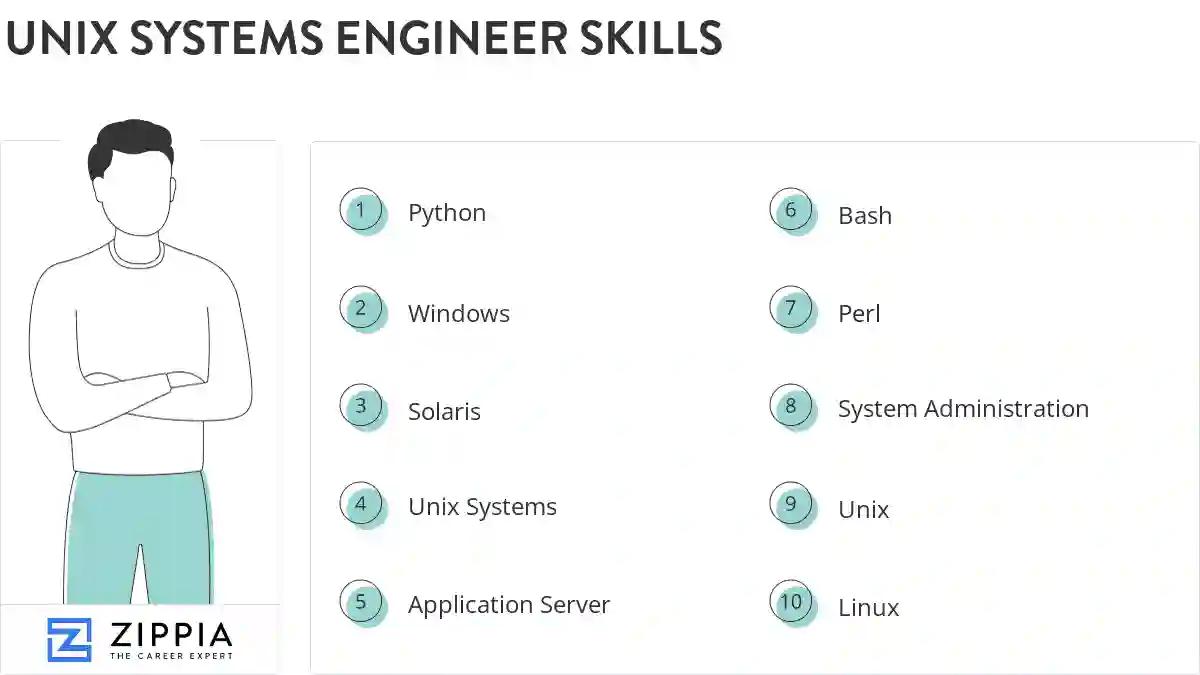
The most important skills for a unix systems engineer resume and required skills for a unix systems engineer to have include:
- Python
- Windows
- Solaris
- Unix Systems
- Application Server
- Bash
- Perl
- System Administration
- Unix
- Linux
- Red Hat
- Technical Support
- DNS
- RHEL
- Production Environment
- Ruby
- Virtualization
- Disk
- Java
- Web Servers
- Redhat Linux
- SQL
- NFS
- Provisioning
- Veritas Netbackup
- IBM AIX
- LDAP
- GIT
- Nagios
- Cisco Ucs
- PHP
- Switches
- TCP/IP
- Tcp Ip
- HP-UX
- O/S
- System Performance
- Tomcat
- EMC
- Capacity Planning
- Sun Solaris
- NAS
- LVM
- Veritas Cluster
- SSH
- VIO
- NetApp
- Vmware ESX
Updated January 8, 2025
