Explore jobs
Find specific jobs
Explore careers
Explore professions
Best companies
Explore companies
What is a user interaction designer and how to become one

User interaction designers are individuals who design digital interfaces that are user-friendly, intuitive, and engaging. They work to create seamless interactions between users and digital products, using their knowledge of human behavior, psychology, and design principles to create intuitive interfaces that meet the needs of the users. They conduct research, create prototypes, and collaborate with other members of the development team to create a final product that meets the needs of both the users and the business.
What general advice would you give to a user interaction designer?
Brian Law
Assistant Professor of Computer Science, Illinois Wesleyan University
ii) Specialize. There's no job out there with the title, "Computer Scientist." Employers are looking to hire you for a specific set of skills and knowledge. If you can identify the area of Computer Science you're interested in and the work you want to do in that area, you can again get a big leg up over your competition if you can demonstrate that you actually want to do what your future employer wants you to and that you're good at it. If you want to work with databases, then take those extra database electives and learn some other database technologies on your own time, and your resume will stand out amongst all the others for any DBA job.
iii) Don't sweat it too much. You've probably been alive for 22 years or so, so you'll probably be in the labor force for 50+ years. Your first job is not going to be your last job, and you may easily find your career path taking unexpected turns that you never even knew existed. Just like you didn't know what the areas of computer science were as a freshman, there are many many CS-related job types out there that you're not even aware of, and 50 years from now, there will probably be even more. While it may seem like your first job will set you on one path for the rest of your life, really it starts you towards 5000 possible paths out of millions in total. No, you don't get the stability of a "job for life" anymore, but that can also be freeing in a way. Don't worry about finding that "perfect" job; even if you did find it, you and the world around you will change over time anyway, so just take your first step confidently and always keep an eye out for your next one.
Avg. Salary $82,651
Avg. Salary $59,228
Growth rate 13%
Growth rate 0.3%
American Indian and Alaska Native 0.42%
Asian 15.98%
Black or African American 6.45%
Hispanic or Latino 12.02%
Unknown 6.51%
White 58.61%
Genderfemale 33.35%
male 66.65%
Age - 36American Indian and Alaska Native 3.00%
Asian 7.00%
Black or African American 14.00%
Hispanic or Latino 19.00%
White 57.00%
Genderfemale 47.00%
male 53.00%
Age - 36Stress level is manageable
7.1 - high
Complexity level is challenging
7 - challenging
Work life balance is fair
6.4 - fair
What are the pros and cons of being a user interaction designer?
Pros
You get to work on creating products that can have a significant impact on people's lives.
The work is creative and allows you to think outside the box.
You get to work with a variety of people from different backgrounds and fields.
You can work remotely or have flexible hours, depending on the company you work for.
You get to see your ideas come to life and make a tangible impact.
Cons
The job can be stressful, especially when working on tight deadlines or with demanding clients.
The work can be subjective, leading to disagreements over design decisions.
It can be challenging to balance the needs of users with the needs of the business or client.
It can be difficult to keep up with new technologies and trends in the industry, which can quickly become outdated.
It can be challenging to create designs that are accessible to everyone, regardless of their abilities or limitations.
User interaction designer career paths
Key steps to become a user interaction designer
Explore user interaction designer education requirements
Start to develop specific user interaction designer skills
Skills Percentages UI 15.76% Sketch 14.35% UX 6.03% Html Css 4.46% User Experience 4.27% Complete relevant user interaction designer training and internships
Accountants spend an average of 3-6 months on post-employment, on-the-job training. New user interaction designers learn the skills and techniques required for their job and employer during this time. The chart below shows how long it takes to gain competency as a user interaction designer based on U.S. Bureau of Labor Statistics data and data from real user interaction designer resumes.Research user interaction designer duties and responsibilities
- Manage and implement all code changes via SVN.
- Work closely with ASP.NET developer to attain refine results.
- Used CSS3 media queries to achieve the responsiveness of the user interface.
- Lead a remote team of web designers and developers to redesign brands and websites for local small businesses.
Prepare your user interaction designer resume
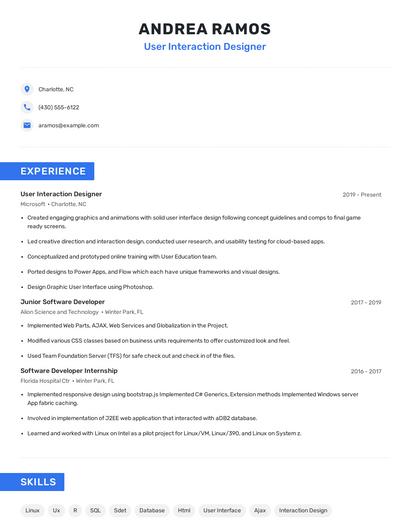
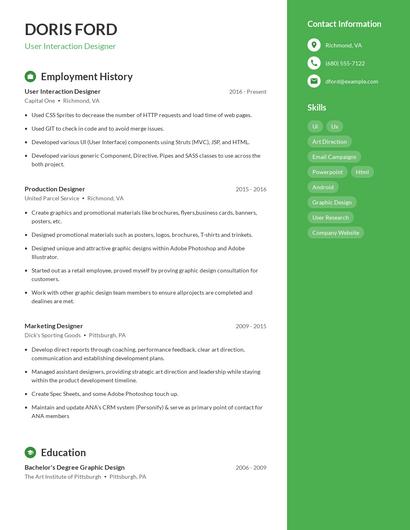
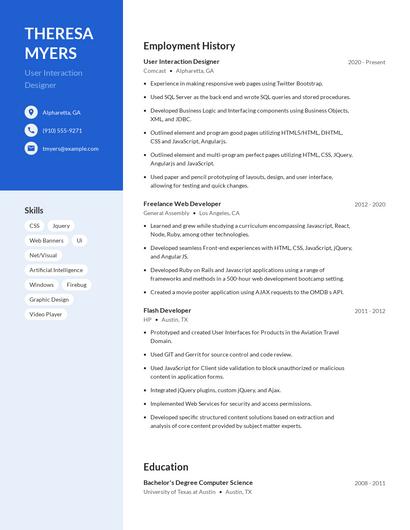
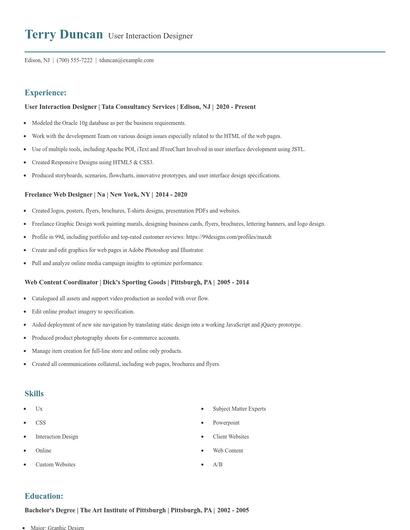
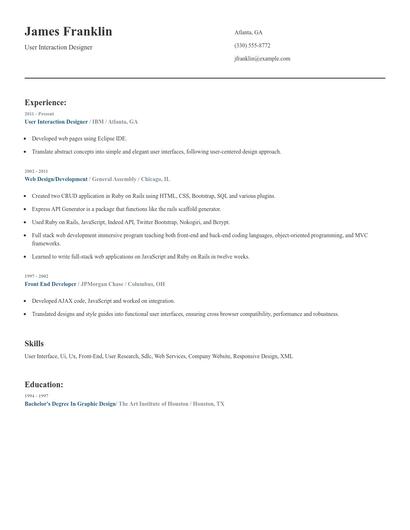
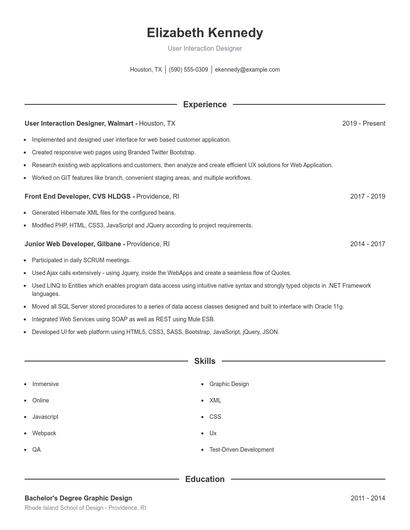
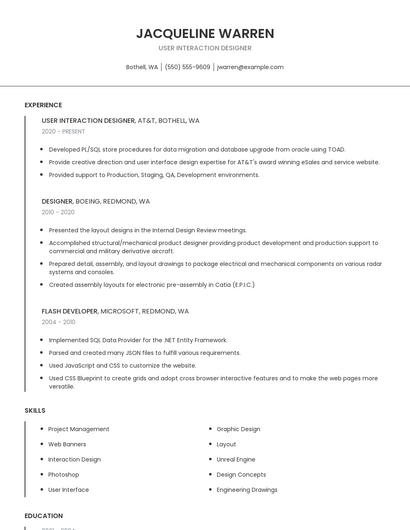
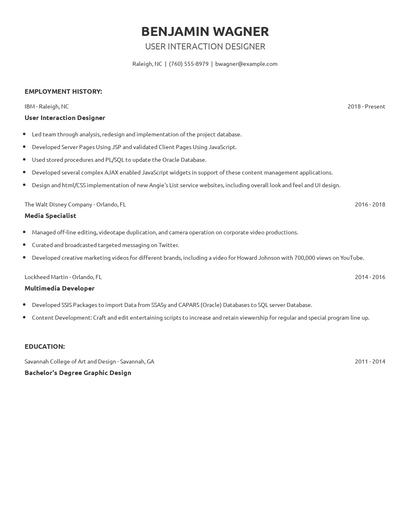
When your background is strong enough, you can start writing your user interaction designer resume.
You can use Zippia's AI resume builder to make the resume writing process easier while also making sure that you include key information that hiring managers expect to see on a user interaction designer resume. You'll find resume tips and examples of skills, responsibilities, and summaries, all provided by Zippi, your career sidekick.
Choose from 10+ customizable user interaction designer resume templates
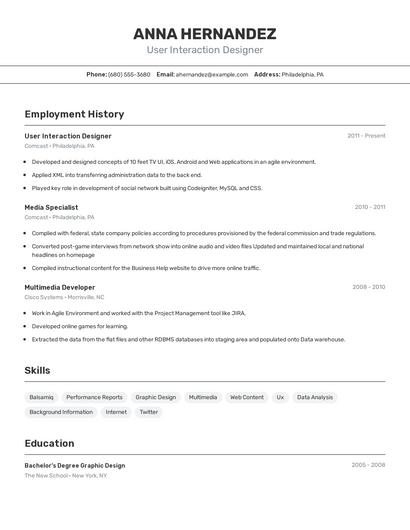
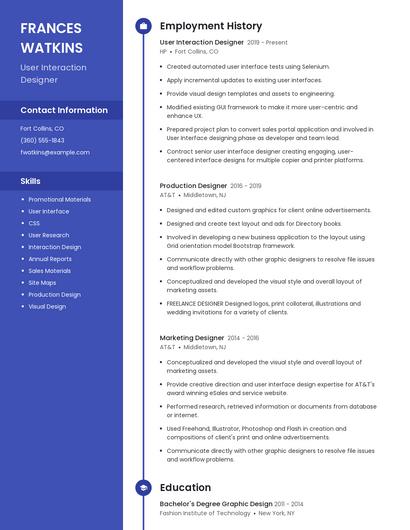
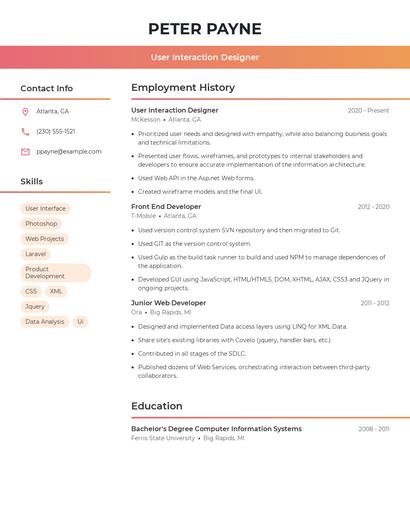
Build a professional user interaction designer resume in minutes. Browse through our resume examples to identify the best way to word your resume. Then choose from 10+ resume templates to create your user interaction designer resume.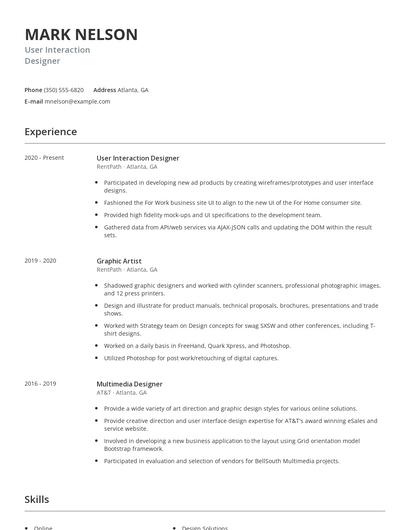
Apply for user interaction designer jobs
Now it's time to start searching for a user interaction designer job. Consider the tips below for a successful job search:
- Browse job boards for relevant postings
- Consult your professional network
- Reach out to companies you're interested in working for directly
- Watch out for job scams
How did you land your first user interaction designer job

Are you a user interaction designer?
Share your story for a free salary report.
Average user interaction designer salary
The average user interaction designer salary in the United States is $82,651 per year or $40 per hour. User interaction designer salaries range between $59,000 and $114,000 per year.
What am I worth?

How do user interaction designers rate their job?
User interaction designer reviews

Making your own website
Taking time to make it
User interaction designer FAQs
Search for user interaction designer jobs
Updated January 8, 2025
