Explore jobs
Find specific jobs
Explore careers
Explore professions
Best companies
Explore companies
Job outlook for vice presidents of software engineering in the United States
Vice president of software engineering job growth summary. After extensive research, interviews, and analysis, Zippia's data science team found that:
The projected vice president of software engineering job growth rate is 2% from 2018-2028.
About 4,400 new jobs for vice presidents of software engineering are projected over the next decade.
Vice president of software engineering salaries have increased 11% for vice presidents of software engineering in the last 5 years.
There are over 14,769 vice presidents of software engineering currently employed in the United States.
There are 107,984 active vice president of software engineering job openings in the US.
The average vice president of software engineering salary is $142,315.
Are vice president of software engineering jobs in demand?
Vice president of software engineering job and salary trends over time
Vice president of software engineering jobs over time
Vice president of software engineering job growth rate over time
| Year | # of jobs | % of population |
|---|---|---|
| 2021 | 14,769 | 0.00% |
| 2020 | 17,211 | 0.01% |
| 2019 | 16,717 | 0.01% |
| 2018 | 15,816 | 0.00% |
| 2017 | 14,984 | 0.00% |
Average vice president of software engineering salary over time
Vice president of software engineering salary by year
| Year | Avg. salary | Hourly rate | % Change |
|---|---|---|---|
| 2025 | $142,315 | $68.42 | +3.2% |
| 2024 | $137,841 | $66.27 | +2.9% |
| 2023 | $133,968 | $64.41 | +2.2% |
| 2022 | $131,074 | $63.02 | +2.2% |
| 2021 | $128,229 | $61.65 | +1.5% |
Vice president of software engineering jobs by state
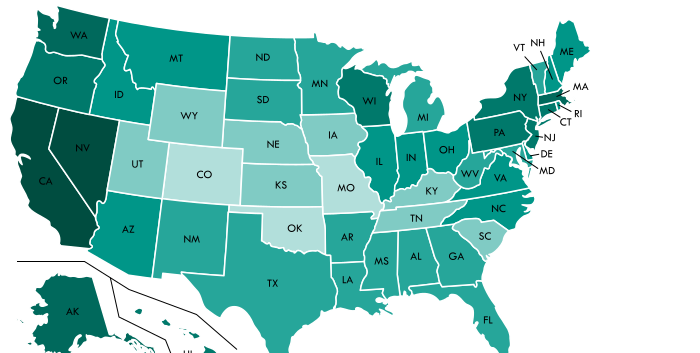
Most common states for vice presidents of software engineering
| Rank | State | Population | # of jobs | Employment/ 1000ppl |
|---|---|---|---|---|
| 1 | District of Columbia | 693,972 | 524 | 76% |
| 2 | Massachusetts | 6,859,819 | 2,469 | 36% |
| 3 | Delaware | 961,939 | 319 | 33% |
| 4 | Washington | 7,405,743 | 2,375 | 32% |
| 5 | Rhode Island | 1,059,639 | 293 | 28% |
| 6 | South Dakota | 869,666 | 237 | 27% |
| 7 | Utah | 3,101,833 | 810 | 26% |
| 8 | Virginia | 8,470,020 | 2,144 | 25% |
| 9 | Maryland | 6,052,177 | 1,489 | 25% |
| 10 | Colorado | 5,607,154 | 1,361 | 24% |
| 11 | New Hampshire | 1,342,795 | 326 | 24% |
| 12 | North Dakota | 755,393 | 182 | 24% |
| 13 | Wyoming | 579,315 | 138 | 24% |
| 14 | Missouri | 6,113,532 | 1,332 | 22% |
| 15 | Wisconsin | 5,795,483 | 1,279 | 22% |
| 16 | Minnesota | 5,576,606 | 1,208 | 22% |
| 17 | Connecticut | 3,588,184 | 776 | 22% |
| 18 | New Mexico | 2,088,070 | 464 | 22% |
| 19 | Alaska | 739,795 | 165 | 22% |
| 20 | Montana | 1,050,493 | 225 | 21% |
Most common cities for vice presidents of software engineering
| Rank | City | # of jobs | Employment/ 1000ppl | Avg. salary |
|---|---|---|---|---|
| 1 | Wilmington | 8 | 11% | $125,341 |
| 2 | Altamonte Springs | 2 | 5% | $107,167 |
| 3 | Englewood | 1 | 3% | $93,123 |
| 4 | Costa Mesa | 2 | 2% | $164,715 |
| 5 | Stamford | 2 | 2% | $137,519 |
| 6 | Alpharetta | 1 | 2% | $118,007 |
| 7 | Bentonville | 1 | 2% | $113,846 |
| 8 | Irving | 2 | 1% | $114,734 |
| 9 | Saint Paul | 2 | 1% | $115,003 |
| 10 | Fort Lauderdale | 1 | 1% | $106,348 |
| 11 | Chicago | 4 | 0% | $120,979 |
| 12 | New York | 4 | 0% | $136,287 |
| 13 | Phoenix | 3 | 0% | $119,592 |
| 14 | San Francisco | 2 | 0% | $180,959 |
| 15 | Atlanta | 1 | 0% | $117,505 |
| 16 | Detroit | 1 | 0% | $113,384 |
| 17 | Gilbert | 1 | 0% | $118,891 |
Vice President Of Software Engineering job outlook: Expert opinions
Our panel of vice president of software engineering experts
Southern Illinois University Edwardsville
Pennsylvania State University - Abington
University of Phoenix - Maryland Campus

University of Iowa

University of Maryland - College Park

University of Hawaii at Hilo
Chapman University

Kettering University

Gannon University
California State University - Sacramento
University of Pittsburgh

Allegheny College

Saint Xavier University

Taylor University
John Brown University
Rider University

Union University

Seminole State College of Florida

Harding University
What general advice would you give to a Vice President Of Software Engineering?
Dale Dzielski MBA, CMA®, PMP®, SAFe® 4 Agilist: Be prepared for a lifelong learning experience; it just begins now. Be confident in what you know but open to learn more because you will.
What general advice would you give to a Vice President Of Software Engineering?
Ahmed Imteaj PH.D.: Research Salary Trends, Acquire In-Demand Skills, Gain Relevant Experience, Customize Your Resume and Cover Letter, Prepare for Salary Negotiations, Consider Additional Benefits.
What will help Vice Presidents Of Software Engineering increase their earning potential?
Ahmed Imteaj PH.D.: Research Salary Trends: Before entering the job market, research salary trends for entry-level positions in your field and location. Websites like Glassdoor, PayScale, and LinkedIn Salary can provide valuable insights into typical salary ranges for different roles.
Acquire In-Demand Skills: Identify in-demand skills and technologies in your field and focus on acquiring them through coursework, certifications, internships, or personal projects. Skills such as machine learning, cloud computing, cybersecurity, and data science are highly valued and can command higher salaries.
Gain Relevant Experience: Prioritize gaining relevant experience through internships, co-op programs, part-time jobs, or freelance projects. Practical experience can significantly increase your market value and make you more attractive to employers.Customize Your Resume and Cover Letter: Tailor your resume and cover letter to highlight your relevant skills, experiences, and achievements that align with the job requirements. Highlighting your unique qualifications can increase your chances of landing interviews and negotiating a higher salary.
Prepare for Salary Negotiations: Before entering salary negotiations, research the typical salary range for the position and location, considering factors such as cost of living and industry standards. Practice articulating your value proposition and be prepared to negotiate confidently for a salary that reflects your skills, experience, and market value.
Consider Additional Benefits: In addition to salary, consider other benefits and perks offered by employers, such as health insurance, retirement plans, paid time off, flexible work arrangements, professional development opportunities, and bonuses. These benefits can add significant value to your overall compensation package.
What will help Vice Presidents Of Software Engineering increase their earning potential?
Yi Yang PhD: First of all, be really good at what you do. Always negotiate for a higher salary based on your qualifications and market value. Additionally, consider exploring opportunities in management and actively contribute to strategic decision-making. Taking calculated risks, such as joining a startup, can also lead to valuable experiences and skill development that can enhance your earning potential in the long run.
Anmol Dash
Adjunct Professor in Information Systems + Software Engineer (My full time job)University of Phoenix - Maryland Campus
Computer/Information Technology Administration And Management
What Vice President Of Software Engineering skills would you recommend for someone trying to advance their career?
Anmol Dash: I have seen mixed responses on this, but in general it is important at each stage of your career, some may say that it is always better to jump ship and job hop every 2-3 years but that is not always the case, sometimes staying at a company, assuming you are seeing growth and are being valued for your leadership, may also pay dividends. There is no one size fits all, but always make sure that you are being fairly valued at your current employer.
What skills stand out on Vice President Of Software Engineering resumes?
Casey DeRoo Ph.D.: Rather than a concrete skill, previous experience in managing teams to accomplish engineering-related tasks is sure to make you a standout. Showcasing familiarity with work management software (e.g., Jira) or budget/total effort tracking systems is important. Find out what software the company you're seeking employment with uses, and be sure to highlight this if you're familiar with it.
What soft skills should all Vice Presidents Of Software Engineering possess?
Casey DeRoo Ph.D.: The ability to understand the people on your team and allocate project work accordingly is important. In this role, you may find that you "step back" from the day-to-day of engineering and coordinate work on a project across multiple individuals with unique outlooks and skillsets. Recognize that "one size doesn't fit all" when it comes to management. Harnessing the make-up or the desired professional goals of your team to accomplish your assigned projects leads to better outcomes and productivity. Many skilled engineers lack leadership skills, so highlight these on your resume or during your interview if you have applicable experience.
Donald Yeung
Professor and Associate Chair for Undergraduate Education, Affiliate Professor, Computer Science DepartmentUniversity of Maryland - College Park
Department of Electrical and Computer Engineering
What hard/technical skills are most important for Vice Presidents Of Software Engineering?
Donald Yeung: In terms of hard technical skills, I believe the courses students take along with their GPA in these courses is one level of demonstration. (As I mentioned above, employers know about our program probably down to specific courses, and so if someone gets an A+ in some notoriously challenging course, that's probably known and appreciated). Some employers will give technical interviews and require students to solve problems on their feet. But I think most employers will judge this based on a student's transcript.
Travis Mandel Ph.D.
Assistant ProfessorUniversity of Hawaii at Hilo
Department of Computer Science
What soft skills should all Vice Presidents Of Software Engineering possess?
Travis Mandel Ph.D.: Although computer science seems like a highly technical field, soft skills are really what differentiates software engineers. One of the most important qualities of any software engineer is explaining their code clearly at various levels of technical depth and explaining why certain design decisions were made. You could write code that does amazing things, but if that code consists of snippets you pasted from StackOverflow without really fully understanding them, it will be a huge headache for anyone who needs to come into the codebase later and maintain or update it.
Another one is asking the right questions. Imagine you are dropped into a huge codebase and asked to add a new feature (very common!). There's no time to understand everything that is going on, but on the other hand, you need to understand enough of the code to do your task effectively, which involves asking questions. A failure to ask questions will likely result in you wasting a huge amount of time working on something that is ultimately not useful, for instance, re-implementing a complex function that already exists somewhere in the codebase.
What skills stand out on Vice President Of Software Engineering resumes?
Tom Springer Ph.D.: -Classroom or work-related experience with electrical circuit design and electrical schematic analysis
-Exposure to control system design and theory, communications systems principles
-Lab experience with power/analog electronics testing or test methodology
-Understanding of digital design using hardware verification languages: System Verilog
-Experience leading engineering projects
What soft skills should all Vice Presidents Of Software Engineering possess?
Tom Springer Ph.D.: -Good communication skills
-Ability to exercise critical thinking and innovative problem solving
-Able to work under supervision and mentoring
-Works well in a team-oriented environment
What hard/technical skills are most important for Vice Presidents Of Software Engineering?
Tom Springer Ph.D.: -Experience/exposure to Automated Test Equipment (ATE) -Setup/Programming
-Understanding of basic software architectures and general syntax of coding languages such as C/C++
-Knowledge using Linux or Unix terminal commands
-Experience using Revision Control Systems: Subversion (SVN), CVS, Git.
-Exposure to System on Chip (SoC) hardware/software
-Experience with Robot Operating System (ROS) or equivalent is a bonus
What skills will help Vice Presidents Of Software Engineering earn the most?
Tom Springer Ph.D.: Skill sets that span domain disciplines are very much in demand. Such as a computer architect or electrical engineer with a strong background in software development
How have salaries changed over time for Vice Presidents Of Software Engineering?
Patrick Atkinson: To my knowledge, salaries continue to be strong. Jobs like Biomedical Engineering tend to be more insulated from market fluctuations since people always need healthcare.
Are there any particularly good places in the United States for Vice Presidents Of Software Engineering to find work opportunities?
Dr. Stephen Frezza Ph.D.: Computing is ubiquitous, and with more industries moving to remote work, location is becoming less critical. If the internet reaches a place reliably, computing jobs can be located there.
How do you envision technology impacting Vice Presidents Of Software Engineering in the next 5 years?
Dr. Stephen Frezza Ph.D.: Breadth and depth: Computing is becoming more like engineering; where the value of the product, its lifetime risks, costs, and benefits are more critical than just it's roll-out. So the engineering competencies that have always been a part of computing will become more central. Computing is also expanding; the role of data and the shift of once-research technologies (like machine learning) into production applications will continue to require computing graduates to broaden their base and continue as learners. This will cause shifts in what is considered 'fundamental' and the need for professionals to continue to hone and redevelop their technical skill sets.
What are the biggest trends we'll see in the Vice President Of Software Engineering job market given the pandemic?
Steven Fernandez: No sure, with respect to mechanical engineering there is so many variables as to what new trends ME grads can experience. One of the greatest challenges Mechanical Engineering students face is the broadness of the field of study they have chosen. Surprisingly, many ME grads find themselves at a bit of a loss as to what carrier path to choose when they finally get their degree. As a mechanical engineer you can be designing anything from a supersonic missile, to a food processing line, in multiple functions. Mechanical engineers can be project engineers, design engineers, operation engineers, or manufacturing engineers with all options in just one industrial field. Each industrial field is affected differently by the pandemic. Take Space X, Google, Amazon, and Raytheon which are all industries ME's work in. These company seem to be doing the same if not better during the pandemic. How about the bicycle industry? With more families at home looking for activities there is a backlog of bicycles as the manufacturers cannot keep up with the orders. Try and order a NordicTrack treadmill, or a concept-2 rowing machine and you will be put on a waiting list due to the shortage of supply. Mechanical engineers work in all these industries. On the flip side look at some industries tied to travel and vacation. Yes, Boeing took a hit because of their 737 planes being grounded, but also because of the massive decrease in flight travel. So, all that said, I would say the pandemic trend for now would follow the course as such; industries which are negatively affected due to the loss of public activities will continue to struggle or have slow growth, while other industries where the mass public has been redirected will flourish and grow.
What experience really stands out on Vice President Of Software Engineering resumes?
Matthew Barry Ph.D.: What really stands out on a resume to me is anything related to hands-on experience. I honestly prefer students and potential employees that have hands-on experience and ok grade point averages (GPAs) compared to students with high GPAs and no hands-on experience. And this hands-on experience does not have to come from internships or co-ops, but could be the result of participating in clubs, or being part of a Makerspace, either as a mentor, or a user.
Oliver Bonham-Carter Ph.D.
Assistant ProfessorAllegheny College
Department of Computer Science and Affiliated Faculty in Integrative Informatics
What are the biggest trends we'll see in the Vice President Of Software Engineering job market given the pandemic?
Oliver Bonham-Carter Ph.D.: Pandemic has accelerated social connectivity trends using technology, including technology for remote work, and e-learning, and technology to make e-commerce more comfortable and faster. I foresee these accelerated technology trends to continue, even after the pandemic, and therefore job markets in these areas to continue to grow. Another big surge we have seen is in data analytics, which has been increasing over the last decade, and COVID-19 has spotlighted this field. I expect data analyst jobs to continue to be in demand and to grow. Also, the pandemic showed us the interconnectedness of technology with other areas. As the need to develop better solutions to fight various diseases heightens, for example, I expect jobs in biotech to grow.
Will there be an increase or decrease in demand for Vice Presidents Of Software Engineering in the next 5 years?
James Vanderhyde: There has been a steady increase in software and IT jobs for the last 20 years, and this is not going to slow down any time soon. In the next 5 years, demand will increase, particularly in software development and cybersecurity. The technology field changes so quickly that beyond 5 years, it is difficult to make predictions. That is why we thoroughly prepare our computer science and information systems students for technology changes and career shifts to discover the best in themselves and to be prepared to meet the demand and excel within the field.
Are there any particularly good places in the United States for Vice Presidents Of Software Engineering to find work opportunities?
James Vanderhyde: Any big city will have lots of opportunities for computing, software, and IT work. Silicon Valley and the rest of the west coast are the most famous, but innovation is happening everywhere around the country and around the world, including here in Chicago. Chicago tech companies have hired our students upon graduation, and likewise, our graduates have found success and gratification in the field.
What are the best companies to work for a Vice President Of Software Engineering?
James Vanderhyde: The best companies to work for are companies that respect you as a person and not just a cog in the machine. They are inclusive, and they recognize and appreciate diversity. They have a track record of handling sick leave and family leave as needed. They will not expect you to eat dinner in your office and then go back to work after an already long day. All software companies experience crunch times around release dates, but the best companies do not experience constant crunch. That is a sign of poor management. The best companies will give you challenging problems to work on and reward innovation.
Dr. Jonathan Geisler
Associate ProfessorTaylor University
Department of Computer Science and Engineering
What are the best companies to work for a Vice President Of Software Engineering?
Dr. Jonathan Geisler: The best companies to work for are the ones that are responsive to both their customers' and employees' needs. They are the ones that have tried to be proactive during the pandemic and not just survive until everything got "back to normal." They know that a damaged workforce leads to a damaged company, and so they provide good management, encouraging everyone to be healthy mentally and physically.
Will there be an increase or decrease in demand for Vice Presidents Of Software Engineering in the next 5 years?
Dr. Jonathan Geisler: There will be a continued increase in demand for computer engineering
graduates as computers become more heavily integrated into the fabric
of our lives. Things like self-driving cars, the Internet of Things, and
mobile computing will become more commonplace and increase the demand for engineering talent; the long-term trend of using smartphones and web-based applications will not slow, leading to an increase in the
demand for computing talent.
How do you envision technology impacting Vice Presidents Of Software Engineering in the next 5 years?
Dr. Ted Junseok Song: The question is not whether technology will advance or not. It is, rather, how it will advance. Professionals in the industry need to be equipped to see the customers' demand and where our society is headed. I would recommend college students to be interested in broad topics apart from topics in their major. Well-rounded people will have more opportunities to impact the future.
Dr. Howard Rees
Adjunct Assistant Professor of Information SystemsRider University
Information systems
What technology do you think will become more important and prevalent for Vice Presidents Of Software Engineering in the next 3-5 years?
Dr. Howard Rees: Hmm, what technology? That's a question with many different levels of context. For some undergraduates in CS and IT, I would look at systems programming in massively parallel environments, application programming with particular focus on security and privacy, and data science and analytics. For other undergraduates, they might look at artificial intelligence and machine learning, for business applications especially. AI is becoming ubiquitous throughout the business, but it's often used as a "black box."
Meaning that the applications (and those "operating" them) do not understand what's happening inside. AI systems are often "designed, trained, and tested" by the provider and certified as generating the output most desired by the customer but only in a statistical sense. There is no "proof" that the AI black box is, with certainty, doing what the business customer (or the provider for that matter) thinks it is doing - it just does a good job when tested on data. There will be a significant need for tech-savvy people to design, train, monitor, and apply them so that they do not deviate from the desired goals. Such deviations can result in socially destructive business practices. As you can't properly manage what you don't understand, there is a risk in using AI too blindly. CS and IT graduates will need to help out.
Will there be an enduring impact of the coronavirus pandemic on Vice Presidents Of Software Engineering?
Dr. Howard Rees: We're moving into a volatile time for the economy, and planning for an uncertain future is what big companies are concerned with. In many ways, the pandemic and concerns over future pandemics that we now know can be globally devastating will be a boon for CS and IT graduates. Face to face business interactions and transactions will be dramatically reduced, both in the short term and in the long run, as there will be a need to hedge against future pandemics. Everything changes from production and operations to supply chain and risk management and diversification to the nature of "office work." And all of that must be underpinned by computer technology: communications, security, data analytics. These are trends that have been developing for the past few decades but the pandemic will accelerate them, and that's all useful, if you're a CS or IT graduate with a broad base of knowledge, which provides you the freedom to adapt.
What general advice would you give to a Vice President Of Software Engineering?
Brian Glas: Build relationships: Different technologies will interest and challenge you, but throughout your career, you'll find that it's the relationships that are the most important. This is harder to grasp earlier in your career, but much easier to understand after 15-20 years.
Gain different perspectives: Spend time with people in other roles that your job interacts with, and gain a solid understanding of how they view things; this is most valuable for career progression and understanding of how your work fits into the big picture.
Craig Tidwell Ph.D.
Professor/Program ManagerSeminole State College of Florida
Center for Information Technology
Will there be an enduring impact of the coronavirus pandemic on Vice Presidents Of Software Engineering?
Craig Tidwell Ph.D.: Many I.T. employees already have the option to work remotely (telecommute), but this will become even more important with the Coronavirus challenges. Employees must be able to work remotely and be organized and self-directed. Employers are looking for teleworkers that can work on a task from anywhere.
Will there be an enduring impact of the coronavirus pandemic on Vice Presidents Of Software Engineering?
Frank McCown Ph.D.: Many companies have changed their hiring practices. It's not unusual for a new graduate to jump straight into remote work. I predict the move from in-person work to remote work is only going to accelerate as we get more comfortable with it. Once the pandemic dies down, and economic uncertainties start to go away, companies that had been on hiring freezes will likely jump back in, creating a strong market for graduates.