
Automatically apply for jobs with Zippia
Upload your resume to get started.
Virtualization engineer skills for your resume and career
15 virtualization engineer skills for your resume and career
1. Troubleshoot
Troubleshooting is the process of analyzing and fixing any kind of problem in a system or a machine. Troubleshooting is the detailed yet quick search in the system for the main source of an issue and solving it.
- Interacted with customers using email, telephone and ticketing system to troubleshoot and resolve issues.
- Helped users to troubleshoot CITRIX XenDesktop issues from Windows, Linux, and Mac OSX.
2. Virtualization
- Follow ITIL approach to drive virtualization service improvement, problem management automation through interlock with service aligned teams.
- Provided technical guidance and assistance to product support and development teams involving virtualization and cloud technologies.
3. VDI
- Participate in development and implementation of VDI related operational procedures standards for production and DR sites.
- Evaluated monitoring solutions for ADP specific to virtual desktop environment (VDI).
4. VSphere
- Implemented and maintained collection of PowerShell scripts providing daily report functionality, enabling potential vSphere issues to be handled proactively.
- Utilize cloud automation tools to provision Virtual application environments and manage vSphere resources.
5. SAN
SAN abbreviation for storage area network is a computer network that provides storage access.
- Assist with the Engineering / managing a total of 20 SAN arrays along with linked FC switches and brocades.
- Engineered, planned and implemented virtual DC migration to newly deployed SAN's with new protocols within ESX environment.
6. PowerShell
- Develop PowerShell scripts to automate server analysis.
- Implemented a PowerShell self-service portal for automation.
Choose from 10+ customizable virtualization engineer resume templates
Build a professional virtualization engineer resume in minutes. Our AI resume writing assistant will guide you through every step of the process, and you can choose from 10+ resume templates to create your virtualization engineer resume.7. Linux
Linux is a Unix-like operating system. Just like Windows, Mac OS, and IOS, Linux is an operating system used by millions across the globe. Android itself is powered by the Linux operating system. Linux manages all the hardware resources that are associated with your computer. The software is famous because of the protection it grants from viruses, malware, and crashes. The Linux operating system is entirely free and is an open-source software meaning it can be altered by those equipped with the knowledge to code.
- Provided Data Center consolidation services of physical servers including both Windows and Linux based systems.
- Administered integrated Ubuntu Linux, Red Hat (RHEL 4), and windows Server 2003 networks including High Availability clusters.
8. Cisco Ucs
- Served on the architectural review team to provide guidance for Cisco UCS, and VM-Ware platforms.
- Standardized configurations with Cisco UCS stateless computing in combination with EMC VNX storage arrays.
9. Windows Server
- Installed System Center Operation Manager (SCOM)2007; Installed and configure SCOM Management Packs for Windows Server Operating System.
- Manage Users, Groups and Permissions using Windows Server 2008 Configure privileges for user groups on Virtual Servers
10. Enterprise Applications
- Perform ESX server builds, VM host configurations for Enterprise applications and Infrastructure related servers for Virtual Hosting Service customers.
- Installed and configured Citrix XenDesktop 7.5 XenApp to stream enterprise applications to mobile users of Android and iPad tablets.
11. UC
- Implemented UCS Performance manager for monitoring and alerting.
- Upgraded existing storage and UCS environment to accommodate 5-year data warehouse vision.
12. SCCM
- Maintain, update and patch virtual lab which consist of: Virtual Desktops, Virtual Servers, SCCM 2007 server.
- Involved in SCCM Patching- Deploying Microsoft Patches to all Domain Controllers and Infrastructure servers through SCCM.
13. Virtual Infrastructure
- Evaluated and increased security of virtual infrastructure in accordance with industry standards.
- Provided Load balancing capability for the virtual infrastructure.
14. DNS
Domain Name Systems, or DNS for short, is the internet's system for converting readable language, i.e., google.com, to machine language, i.e, 192.168. For a simple analogy, some call it the phonebook of the internet. Any website has its own IP address, for example, 192.168.160. Understandably this is hard to remember. So what a DNS does is link the domain name, google.com, with its IP address, 192.168.160.
- Resolved Production Server problems related to web applications, file system, DNS and network connectivity.
- Handled DNS troubleshooting on servers, clients, dynamic updates and zones problems.
15. OS
In technical terms, OS stands for "Operating System". It is a software that is used to run programs on the computer. An operating system acts as a link between the user and the hardware components. Windows, macOS, iOS, Linux are examples of an operating system.
- Created and mirrored preconfigured Operating system like Windows/Linux and configured Oracle/SQL, Web sphere services in the OS.
- Created and managed VMs, installation of VM tools, custom virtual hardware provisioning as per guest OS.
5 Virtualization Engineer resume examples
Build a professional virtualization engineer resume in minutes. Browse through our resume examples to identify the best way to word your resume. Then choose from 5+ resume templates to create your virtualization engineer resume.

What skills help Virtualization Engineers find jobs?
Tell us what job you are looking for, we’ll show you what skills employers want.
What skills stand out on virtualization engineer resumes?
David Garaventa
Director, Computer Information Systems and Cybersecurity Programs, Assistant Professor, CIS, Albertus Magnus College
What virtualization engineer skills would you recommend for someone trying to advance their career?
Dr. Bobby Roohparvar Ph.D.
Professor of Computer Science and Computer Engineering, California State University - East Bay
*Variety: Each day presents new challenges and opportunities for problem-solving.*
*Demand: The field offers strong job growth and stability.*
*Impact: Your work ensures businesses and organizations remain connected and operational.*
*Learning: There's always something new to learn with emerging technologies.*
*Dislike:*
*Troubleshooting: Issues can be complex and take a lot of time to resolve.*
*On-call: Network problems can occur at any time, requiring on-call availability.*
*Pressure: Maintaining network uptime can be stressful, especially during critical periods.*
*Keeping Up-to-Date: Rapid technological changes necessitate continuous learning.*
List of virtualization engineer skills to add to your resume
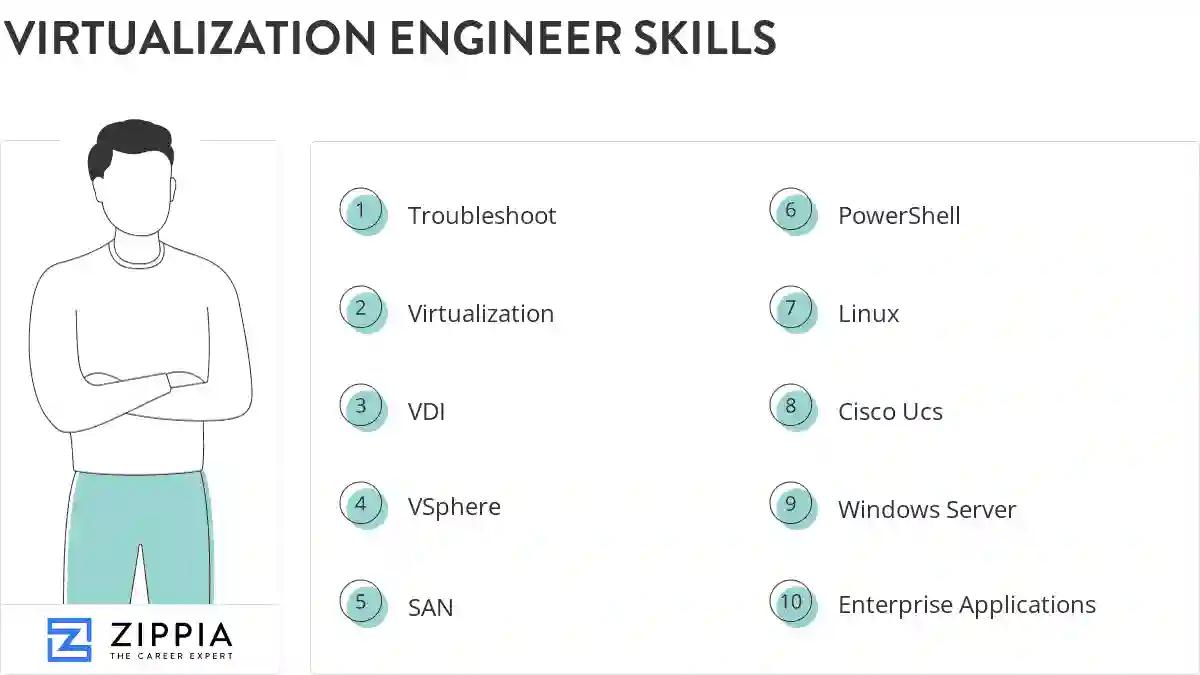
The most important skills for a virtualization engineer resume and required skills for a virtualization engineer to have include:
- Troubleshoot
- Virtualization
- VDI
- VSphere
- SAN
- PowerShell
- Linux
- Cisco Ucs
- Windows Server
- Enterprise Applications
- UC
- SCCM
- Virtual Infrastructure
- DNS
- OS
- Virtual Machines
- Provisioning
- Vmware ESX
- Switches
- ITIL
- NetApp
- PowerCLI
- Vmware Esxi
- Emerging Technologies
- Hyper-V
- DHCP
- NAS
- Remedy
- VMS
- Lifecycle Management
- Citrix Xenapp
- NFS
- SRM
- Capacity Planning
- Red Hat
- SQL Server
- DRS
- Virtual Servers
- Performance Issues
- Production Environment
- Citrix Xendesktop
- Data Centers
- R2
- Cycle Management
- ISCSI
- Enterprise Solutions
Updated January 8, 2025
