
Automatically apply for jobs with Zippia
Upload your resume to get started.
Visiting professor skills for your resume and career

15 visiting professor skills for your resume and career
1. Course Content
- Provided student feedback and assessed mastery of course content relative to actual events.
- Created curriculum and planned course content and methods for a complex subject.
2. Student Learning
- Maximize the effectiveness of educational technology and distance learning techniques to facilitate student learning.
- Plan and actively facilitate weekly online discussions to promote student learning and engagement.
3. Professional Development
Professional development means to have the essential training certification or education with the purpose of earning and having a successful career. Every job requires a different set of skills. However, new skills may be needed in the future. Professional development, in this regard, helps people to develop and polish the skills and become efficient workers.
- Organized and conducted two professional development workshops for Duval and Seminole school districts.
- Facilitate 11 interdisciplinary professional development workshops on sustainability.
4. Philosophy
Philosophy is the study of our current reality and existence and the questions and knowledge surrounding it.
- Have been involved in varying capacities as a Professor in Philosophy at Wheeling Jesuit University.
- Developed engaging presentations for college level undergraduate courses in Interpersonal Communication, Philosophy and World Religions PROFESSIONAL WORK EXPERIENCE
5. Health Assessments
- Managed and lectured clinical labs to students including Health Assessment, Fundamentals of Nursing, and senior practicums.
- Manage online classroom for a variety of courses such as Fundamentals of Nursing and Health Assessment.
6. Economics
- Developed and taught business and economics-financial economics, price theory, microeconomics and macroeconomics.
- Consulted with the Mongolian Stock Exchange and the Institute of Finance & Economics.
Choose from 10+ customizable visiting professor resume templates
Build a professional visiting professor resume in minutes. Our AI resume writing assistant will guide you through every step of the process, and you can choose from 10+ resume templates to create your visiting professor resume.7. Literature
- Race and American Literature: Crossing the Color Line, one semester.
- Instructed Literature courses and gave seminars on formatting of MLA style documentation.
8. Course Objectives
A course objective allows students to know all that a course is about, why it is taught, where it is going, and what is required of them to be successful in the course. It forms the basis of the class and establishes a behavior, skill, or action that a student can demonstrate if they have achieved mastery of the objective. The objectives must be observable, measurable, valid, and also aligned with the expectations of the course.
- Evaluated and provided documented feedback to nursing students on their level of performance based on course objective.
- Develop course curriculum to meet terminal course objectives directed by the University.
9. Curriculum Development
- Assisted with curriculum development for MGMT404 Microsoft Project Labs.
- Lead planning in curriculum development & assessment.
10. Political Science
- Instructed students in introductory political science classes.
- Introduced cadets to Political Science and the theories of war.
11. Undergraduate Courses
Undergraduate courses usually refer to the first studies undertaken at university.
- Teach undergraduate course work - Introduction to Business and Management; and Marketing Management in the master's program.
- Subject Matter expert for development of undergraduate courses in the engineering and computer science program.
12. Capstone
- Created a new, experiential-based undergraduate business capstone course applicable to all business majors that was used at multiple locations.
- Teach the following courses: o Transitions o Capstone Course in Nursing o Informatics and Technology
13. BSN
An academic degree in the principles and science of nursing is called Bachelor of Science in Nursing. The degree prepares nurses for a variety of professional roles. Students are taught courses in research, nursing science, and leadership. General education is imparted in humanities, math, and social sciences. There are endless career options for a BSN graduate in public and private hospitals and it is a common prerequisite for administrative, teaching, consulting, and research roles.
- Facilitate didactic for the Transitions in Professional Nursing course in the RN to BSN online program.
- Facilitate RN to BSN Health Assessment course, through Socratic and collaborative methods.
14. Anatomy
Anatomy is the comprehensive study of the internal structure and functions of a thing (living or nonliving). In the body, it's referred to as human anatomy which is the study of the body's internal structure and how they function with one another. There's also plant anatomy and animal anatomy for studying the structures of both.
- Provided instruction for Anatomy & Physiology II, General Ecology and Principles of Biology I&II labs.
- Instructed Anatomy and Physiology I and II, Veterinary medical terminology, Introduction to Veterinary Technology, and Small animal Husbandry.
15. Physiology
Physiology is a branch of biology focused on studying living things, other parts, and the functions of these parts. It studies the functions of living things, especially the human body, and the effects of different processes and actions on the well-being of the body.
- General Biology lecture and laboratory to enhance understanding of animal and plant cells with focus on cellular physiology.
- Research, schedule and develop course Physiology, biology and medical terminology professor All proper duty and responsibilities for a professor position
5 Visiting Professor resume examples
Build a professional visiting professor resume in minutes. Browse through our resume examples to identify the best way to word your resume. Then choose from 5+ resume templates to create your visiting professor resume.

What skills help Visiting Professors find jobs?
Tell us what job you are looking for, we’ll show you what skills employers want.
What skills stand out on visiting professor resumes?
Alejandra Rodriguez-Villar Ph.D.
Assistant Professor of Spanish, Hanover College
What hard/technical skills are most important for visiting professors?
Lee Braver
Professor, University of South Florida
What soft skills should all visiting professors possess?
Lee Braver
Professor, University of South Florida
I believe that tenacity, organizational skills and time management, and the ability to work long hours are crucial to getting tenure and succeeding in academia more broadly, in some ways more important than raw intelligence (if such a notion is coherent). Failure and rejection are endemic to the job; anyone who gets discouraged easily will do so. One must persevere in the face of sometimes harsh criticism and hostile conditions (especially now that much of the country has turned against higher education and the humanities in particular), and one must be able to juggle multiple responsibilities that make considerable time demands. In this, the tenure track resembles other early-career positions, such as medical residency or working towards partnership in a law firm. The untenured often must do the scut work that no one else wants to do, made more difficult by the fact that they are frantically trying to learn on the job with little to no guidance. It is not at all unusual for early-career professors to teach 4 classes per semester, at least some of which are new and/or large, do all the grading for them, serve on multiple committees, and write for elusive publications, all at once.
What visiting professor skills would you recommend for someone trying to advance their career?
Dr. Margaretha Rudstrom
Lecturer, University of Minnesota Crookston
If a student isn't able to land a position within their field of study, I would suggest they work on their people skills and stay up to date with what is happening in the markets, ag policy, and agriculture. Staying up to date means following the popular press in the areas you have a career interest in. That could mean following the news from places like Drovers, local and national producer associations, or congressional or senate ag committees. This will help keep you up to date on what's happening in the areas you have an interest in or are looking for a career.
I seem to be harping on the people skills piece. Get experience in working with customers, customer service, customer complaints. These experiences will help you develop critical thinking skills, problem-solving skills, and communication skills sought after by employers.
What type of skills will young visiting professors need?
Dr. Radhika Grover
Adjunct Lecturer, Santa Clara University
List of visiting professor skills to add to your resume
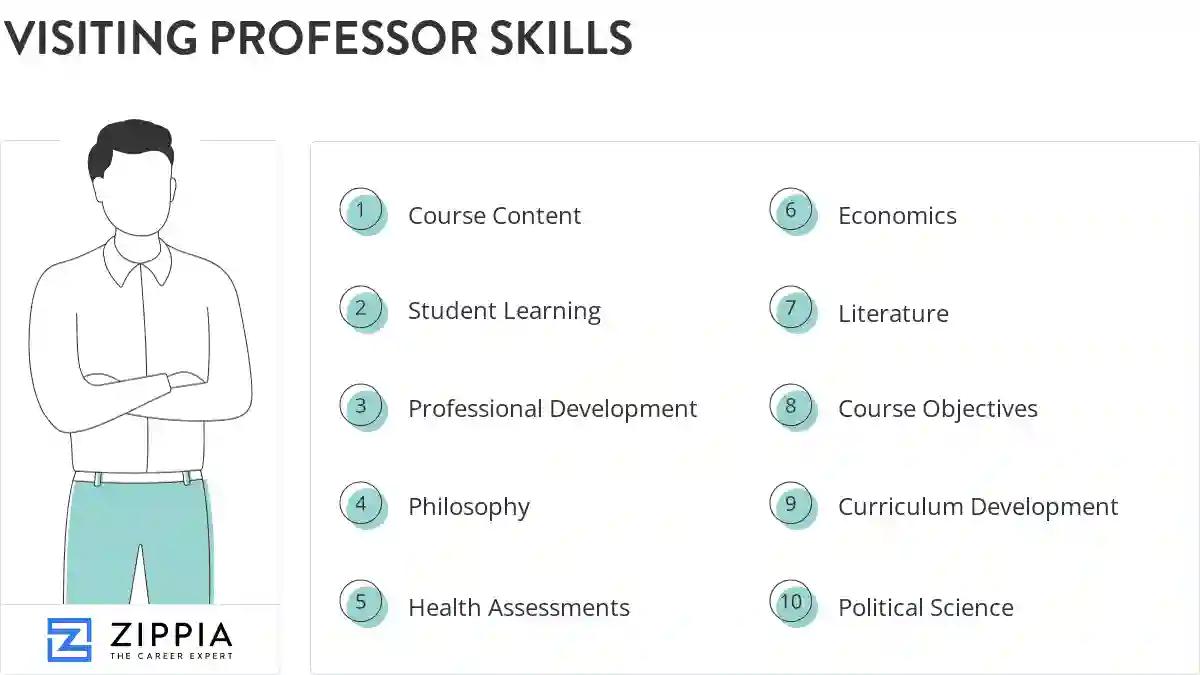
The most important skills for a visiting professor resume and required skills for a visiting professor to have include:
- Course Content
- Student Learning
- Professional Development
- Philosophy
- Health Assessments
- Economics
- Literature
- Course Objectives
- Curriculum Development
- Political Science
- Undergraduate Courses
- Capstone
- BSN
- Anatomy
- Physiology
- Organic Chemistry
- Cell Biology
- Seminar
- Sociology
- Architecture
- Syllabus
- Business Administration
- Graduate Courses
- Mathematics
- Ethics
- Genetics
- International Business
- Course Materials
- Data Analysis
- Organizational Behavior
- Business Management
- C++
- Mentoring Students
- Courses Taught
- Entrepreneurship
- Public Speaking
- Econometrics
- Fiction
- Social Justice
- Blended Learning
- Student Performance
- Anthropology
- Devry
- III
Updated January 8, 2025
