
Automatically apply for jobs with Zippia
Upload your resume to get started.
Vocal music instructor skills for your resume and career
13 vocal music instructor skills for your resume and career
1. Musical Theater
- Produced and directed drama and musical theater performances.
- Specialized knowledge in musical genres such as: jazz, rag-time, classical, musical theater, pop and rock.
2. Music Education
- Coordinate with administrators, counselors, parents, teachers and community officials to deliver optimal services in music education.
- Administered an original, theme-based curriculum in music education for Kindergarten through Second Grade students at East Elementary School.
3. Classroom Management
- Created innovative curriculum, mastered classroom management at all education levels.
- Presented lectures on effective classroom management techniques for teachers.
4. Music Curriculum
- Develop specialized music curriculum to music students ages 4-25 on a weekly basis.
- Cooperated with administration and peers to design a music curriculum that integrated all state and federal requirements.
5. Stage Presence
- Teach the art of performance, stage presence, and exercises for better vocal health.
- Teach students of all ages' voice, stage presence and vocal maintenance.
6. K-12
K12 is a term that incldues all 12 years of education in the US education system. It includes the education offered at the primary stage, middle stage, and secondary stage. It includes children of ages as young as 5 to 18 years. The grades included in K12 are Kindergarten, the initial 5 stages, grades 6 to 8, and 9 to 12. This system is followed specifically followed in the US and may vary in other countries.
- Introduced K-12 students to basics of creating original musical and theatrical works in accordance with their age and development.
- Prepared three Christmas concerts for grades K-12.
Choose from 10+ customizable vocal music instructor resume templates
Build a professional vocal music instructor resume in minutes. Our AI resume writing assistant will guide you through every step of the process, and you can choose from 10+ resume templates to create your vocal music instructor resume.7. EAR Training
Ear training is formal musical training that helps musicians to connect notes and learn to identify rhythms, pitches, melodies, intervals, chords, and other various basic elements of music solely by hearing them.
- Incorporated elements of general musicianship, including ear training and theory, as well as instrumental technique and interpretation.
- Instructed classes in Theory and Harmony and Aural Perception (ear training).
8. Music Theory
- Guide vocal development while incorporating movement and integral understanding of music theory.
- Created units for students in grades 7-12 based on Music Theory, History, Aural Skills and active listening.
9. Group Lessons
- Provided individual and group lessons to band students during the summer school program.
- Design and market music services, including private and group lessons, workshops, and online consultation.
10. Chorus
- Designed and launched the first International Youth Barbershop Chorus Festival, an event that just completed its eighth year.
- Conducted and managed all-inclusive fourth and fifth grade choirs and all-inclusive first through third grade chorus.
11. Songwriting
- Facilitated creative exploration via songwriting, vocal improvisation and beat-boxing, and musician history.
- Developed a songwriting project with the 5/6 grade class, utilized GarageBand software to create accompaniment with their original lyrics.
12. Drama
- Served as choral director and drama instructor.
- Offered After School Workshops in Drama, Voice, Keyboard, and Recorder.
13. General Music Classes
- Developed curriculum-based units and lesson plans for five general music classes daily.
- Observed and co taught elementary general music classes

What skills help Vocal Music Instructors find jobs?
Tell us what job you are looking for, we’ll show you what skills employers want.
What skills stand out on vocal music instructor resumes?
Dr. Michael Mapp
Director of Bands, Professor of Conducting, New Mexico State University
As the pandemic has highlighted, a need to understand technology and apply it within one's individual area will be valuable no matter the job. For musicians, the lack of performance opportunities will also no doubt, create even more competition in the future thus requiring high technical ability.
Additionally, it is also a plus to see applicants that have creative areas of interest outside their field of expertise that only strengthen their critical thinking skills, diverse world views, and work ethic.
What soft skills should all vocal music instructors possess?
J. Anthony Allen
Assistant Professor - Music, Media and Management, Augsburg University
What hard/technical skills are most important for vocal music instructors?
J. Anthony Allen
Assistant Professor - Music, Media and Management, Augsburg University
What vocal music instructor skills would you recommend for someone trying to advance their career?
Helen Callus
Professor of Viola, Northwestern University
What type of skills will young vocal music instructors need?
Dr. Lori Gray
Associate Professor: Director of Music Education, Boise State University
I would add that graduates need a strong work ethic, an understanding of professionalism and respect in the workplace, and self-awareness and an understanding of personal needs and limitations both at work and in their personal lives. In these current living conditions during a global pandemic (COVID-19), graduates also need resilience, perseverance, adaptability, and flexibility. These are all skills I would want for our Music Education majors to cultivate, as the climate in K-12 Education is ever-changing. However, I believe these are all skills that would be useful in any new career path.
What technical skills for a vocal music instructor stand out to employers?
Fred David Romines Ph.D.
Associate Professor, Marywood University
List of vocal music instructor skills to add to your resume
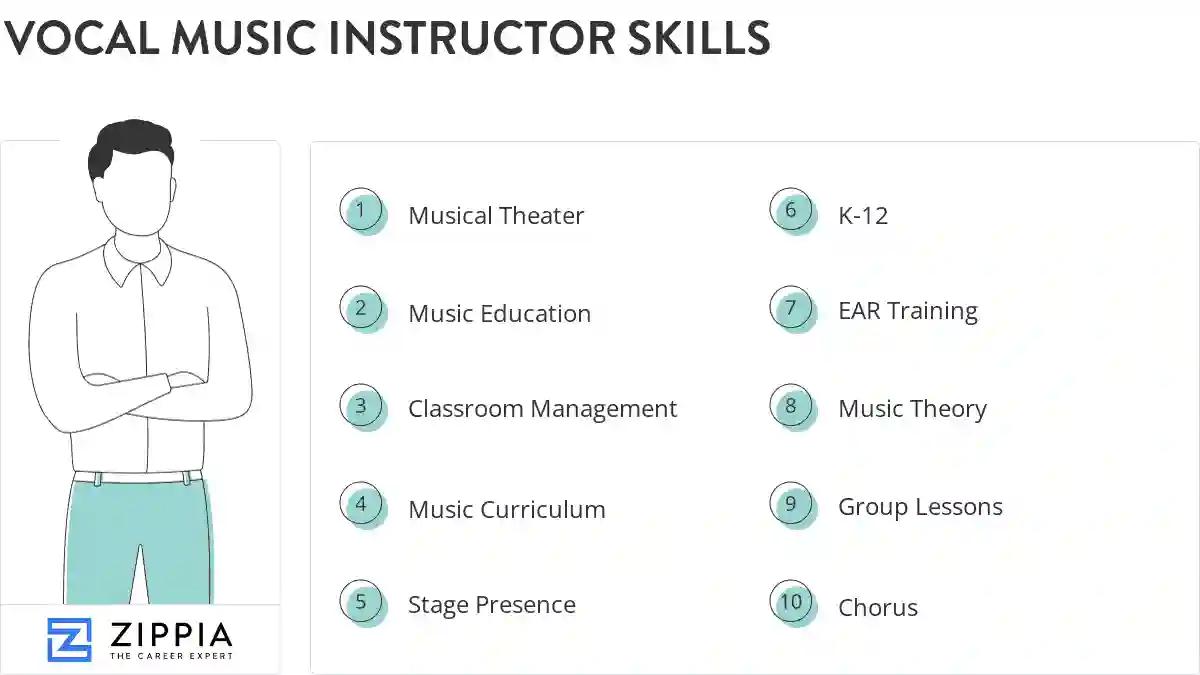
The most important skills for a vocal music instructor resume and required skills for a vocal music instructor to have include:
- Musical Theater
- Music Education
- Classroom Management
- Music Curriculum
- Stage Presence
- K-12
- EAR Training
- Music Theory
- Group Lessons
- Chorus
- Songwriting
- Drama
- General Music Classes
Updated January 8, 2025
